A "solar generator" is a portable power station: a battery with a built-in inverter and charger. It makes no power by itself. Panels, a wall outlet or your vehicle refill it, and it runs your gear until the watt-hours run out.
Solar Generators for RVs: What Portable Power Station Specs Mean
Some links on this site are affiliate links: if you buy through them we earn a commission, at no extra cost to you. As an Amazon Associate we earn from qualifying purchases.
At a glance
- What it is: a battery plus an inverter and a charger, with the solar panels usually sold separately.
- The two numbers: watt-hours set how long it runs, inverter watts set what it can run at once.
- Running the trailer from one: only the larger units have the big three-prong RV socket your shore cord plugs into, and no maker publishes a rating showing its station will start a roof air conditioner.
On this page (7)
A battery with an inverter, not a generator
Nothing inside the box makes energy. The battery stores it, the inverter turns the stored DC into 120 V AC for the outlets, and the charger refills the battery from a wall outlet, a 12 V car socket or a solar panel.
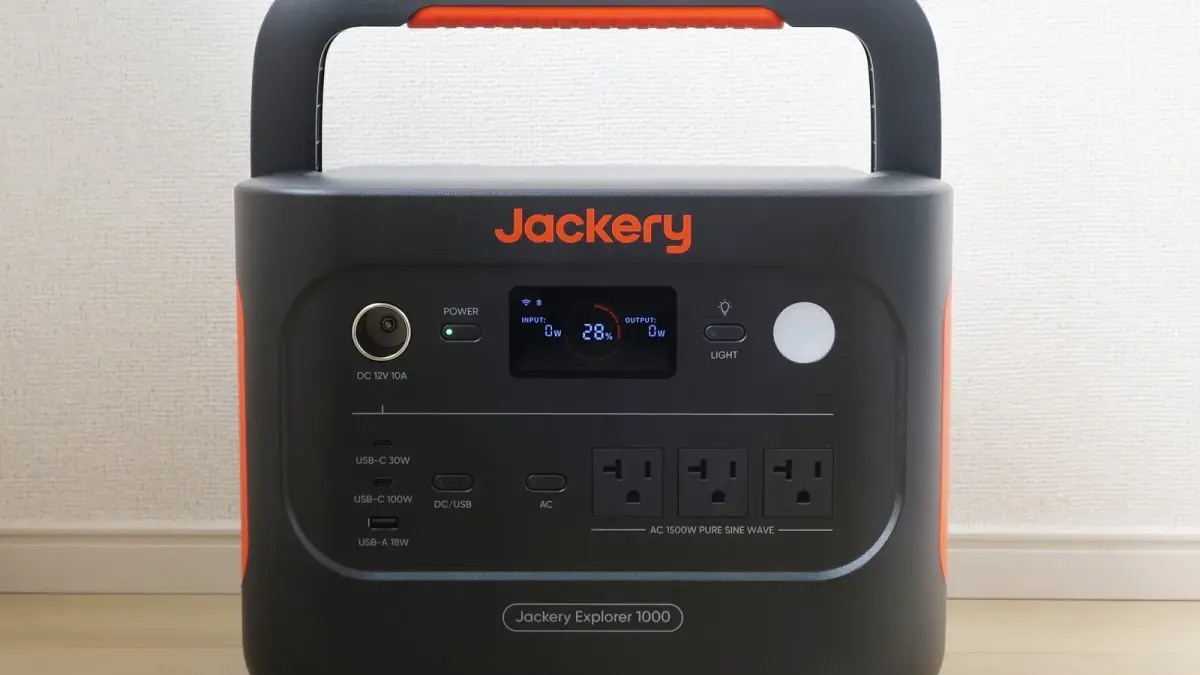
Budget for the panel separately. EcoFlow sells the DELTA 3 on its own or in kits with a solar panel, and Jackery sells the Explorer 1000 v2 on its own or bundled with a SolarSaga 200 panel. The size of the panel sets how fast the station recharges.
What the numbers on the box mean
Four figures decide how a station behaves in a camper.
- Watt-hours (Wh): the size of the tank. On Goal Zero's Yeti 3000X page, a 500 Wh battery should run a 100 W light for 5 hours.
- Continuous inverter watts: what it can run at once.
- Surge or peak watts: a brief allowance above the continuous rating, for motors starting.
- Inputs: AC watts, solar watts with a voltage window, and a car socket figure. These set refill speed, not run time.
Most current units use LFP (LiFePO4) cells, rated from 3,000 up to 6,000 or more cycles; the older Yeti 3000X used Li-ion NMC and was rated 500. Cycle counts do not compare well across makers, because each tests to its own end point.
Tip: Surge watts, not watt-hours, decide whether an air conditioner or a compressor fridge can start. A 4,000 Wh station with a modest surge rating can stall on a motor that a smaller unit with a high surge figure will spin up.
Current models, smallest tank to largest
Choose the size by watt-hours, then check the last column if you want to plug the trailer in. This is a sort by size, not a ranking.
| Model | Watt-hours | Continuous / surge watts | RV (TT-30) outlet, as printed |
|---|---|---|---|
| EcoFlow DELTA 3 | 1,024 Wh | 1,800 W / 3,600 W surge | No |
| Anker SOLIX C1000 Gen 2 | 1,024 Wh | 2,000 W / 3,000 W peak | No |
| Jackery Explorer 1000 v2 | 1,070 Wh | 1,500 W / 3,000 W surge | No |
| Bluetti AC180 | 1,152 Wh (AC180P: 1,440 Wh) | 1,800 W / 2,700 W surge | No |
| Jackery Explorer 2000 Plus | 2,042.8 Wh | 3,000 W / 6,000 W surge | Not stated (a 25 A outlet, not named TT-30) |
| Anker SOLIX F2000 | 2,048 Wh | 2,400 W (manual prints no surge) | Yes, 1 x TT-30R |
| Bluetti Elite 300 | 3,014.4 Wh | 2,400 W / 4,800 W lifting (resistive loads only) | Yes, 1 x TT-30 port |
| Goal Zero Yeti PRO 4000 | 3,993.6 Wh | 3,600 W / 7,200 W surge | Yes, TT-30R, 3,600 W, 30 A |
| EcoFlow DELTA Pro 3 | 4,096 Wh | 4,000 W / 8,000 W surge | Yes, 1 x NEMA TT-30R, 30 A |
Sources: Jackery Explorer 1000 v2 tech specs, EcoFlow DELTA 3, EcoFlow DELTA Pro 3 specs, Bluetti Elite 300 page and user manual, Anker SOLIX F2000 user manual and the Goal Zero Yeti PRO 4000 specifications.
Tip: A TT-30 socket does not always mean 30 amps. Anker lists the TT-30R outlet on the SOLIX C2000 Gen 2 as 120 V, 20 A max, 2,400 W max. Read the outlet's own rating, not its shape.
What each size actually runs
Watt-hours divided by an appliance's labeled watts gives an upper bound, because the inverter loses some energy. Bluetti's run-time formula multiplies capacity by depth of discharge and inverter efficiency, then divides by the device's watts plus the unit's own idle draw, about 15 W on the Elite 300. The Elite 300 manual warns that devices with motors or compressors may use 2 to 4 times their rated power during startup, which could overload the unit.
- About 1,000 Wh: an absorption fridge's 120 V heater, rated 300 W on the Norcold Polar series, runs roughly 3.5 hours on a full Explorer 1000 v2 (1,070 Wh ÷ 300 W, calculated, upper bound).
- About 3,000 Wh: Bluetti's formula gives a 1,000 W microwave about 2.5 hours on the 3,014.4 Wh Elite 300 (3,014.4 x 0.95 x 0.9 ÷ 1,015 W, calculated, using the 95% depth of discharge, 90% inverter efficiency and 15 W idle draw in Bluetti's own example).
- 12 V compressor fridges: the manuals give only a maximum draw, such as 11 A at start-up for some of Furrion's Arctic models, not an average, so there is no run time to calculate.
A roof air conditioner is the hard case: running it fits, starting it does not. Furrion's Chill at 13,500 BTU draws 1,340 W in cooling, within an 1,800 W or 2,400 W inverter. But Dometic's installation manual lists the 13,500 BTU Brisk II compressor at 68.0 A locked rotor, about 8,160 W at 120 V (calculated), at or above the highest surge figure in the table. None of the station makers in the table publishes a rating showing its station will start a 13,500 BTU roof air conditioner, and Bluetti limits the Elite 300's 4,800 W lifting mode to pure resistive loads. So size a gas generator if cooling is why you are shopping.
Plugging the trailer into one
To plug the shore cord straight in, you need one of the larger units with a TT-30 outlet. Bluetti's Elite 300 page tells RV owners to plug in through its TT-30 outlet, and Anker's F2000 manual tells owners to run an RV through its TT-30R port, within the outlet's 2,400 W ceiling. That outlet is not extra capacity: it shares the unit's total inverter rating.
Your 30 amp shore cord plugs straight into a TT-30 outlet. A dogbone adapter into a household outlet changes the plug, not the power; Camco rates its 15 A adapters at 1,875 W. A 30 amp RV can draw about 3,600 W (calculated from Jayco's description of the one-leg system), more than most stations supply, so the station, not the RV's breakers, becomes your limit.
One catch: Jayco's owner's manual notes that the converter turns 120 V power into 12 V power whenever the RV is connected to an external power source, and the station counts as one, so the converter's battery charging draws on the station too.
Tip: EcoFlow warns that the RV's built-in charger wastes a portable station's power by trying to charge the house batteries, and says some owners switch off the converter breaker while running on portable power.
How fast it refills, and where it can sit
Wall charging is quick and predictable; solar depends on your panels and the station's input limits. Third-party panels must fit both the watt limit and the voltage window. Bluetti rates the Elite 300 at 1,200 W max, 12 to 60 V open circuit and 22 A max.
Solar ceilings range from 3,000 W on the Goal Zero Yeti PRO 4000's high-voltage input to 400 W on Jackery's Explorer 1000 v2. That Jackery refills in 1.58 hours on its AC adapter.
Temperature limits are narrower than most owners expect. Jackery specifies charging from 32°F to 113°F (0°C to 45°C). Bluetti's AC180 charges only to 104°F and limits output to 1,500 W above 86°F.
Indoors there is no fuel and no exhaust, but there are conditions. EcoFlow calls the DELTA Pro 3 suitable for well-ventilated indoor or sheltered outdoor use, away from rain and dust. Anker says to charge in a well-ventilated area and keep the station out of direct sun, such as in a car or cargo bed. If you want to top up all day without hauling folding panels, compare the cost against panels mounted on the roof.
Common questions
Can you run an RV off a solar generator?
Yes, from a station with a TT-30 outlet, but only part of the rig at a time. Those units are rated 2,400 W to 4,000 W continuous, against the 3,600 W a 30 amp hookup allows, and none of their makers publishes a rating showing the unit will start a roof air conditioner.
How long will a 2,000 watt-hour power station run an RV fridge?
No fridge maker publishes an average draw, so measure it. Run the fridge from the station through a full compressor cycle, on and off, read the average output on the display, and divide the station's watt-hours by it. Expect the answer to change with outside temperature and how often the door is opened.
How big a solar generator do I need for a camper?
Add up the labeled watts of everything you will have on at once and keep the total below the station's rated output, as Bluetti advises. Then pick the watt-hours for how long you want that to last. Short bursts from a microwave or coffee maker point to the 2,000 Wh class; lights, fans and devices are comfortable on 1,000 Wh.
Is it safe to use a solar generator inside the RV?
Nothing burns, so unlike a gas generator there is no carbon monoxide risk. Check your own station's manual for ventilation and temperature limits before you put it in a cabinet, a closet or under a bunk.