A 30 amp RV runs on one 120 volt leg, so it can draw 30 amps in total, about 3,600 watts. A 50 amp RV runs on two 120 volt legs at 50 amps each, about 12,000 watts. An adapter changes the plug, not the power.
30 Amp vs 50 Amp RV Shore Power: What Each Runs and the Adapters
Some links on this site are affiliate links: if you buy through them we earn a commission, at no extra cost to you. As an Amazon Associate we earn from qualifying purchases.
At a glance
- 30 amp service: one 120 volt leg, 30 amps total for the whole RV, about 3,600 W (calculated).
- 50 amp service: two 120 volt legs, 50 amps per leg, about 12,000 W (calculated), which is why a second roof air conditioner needs it.
- Adapters: available power drops to the rating of the adapter, so a 50 amp RV on a 30 amp pedestal still gets 30 amps.
On this page (7)
What is the difference between 30 amp and 50 amp?
A 50 amp RV has two separate supplies, not one bigger wire. A 30 amp RV has a single 120 volt leg, and everything shares those 30 amps, as Jayco's 2027 towable owner's manual states. A 50 amp RV has two 120 volt legs at 50 amps each, 100 amps in total, and Keystone's 2027 owner's manual describes it the same way.
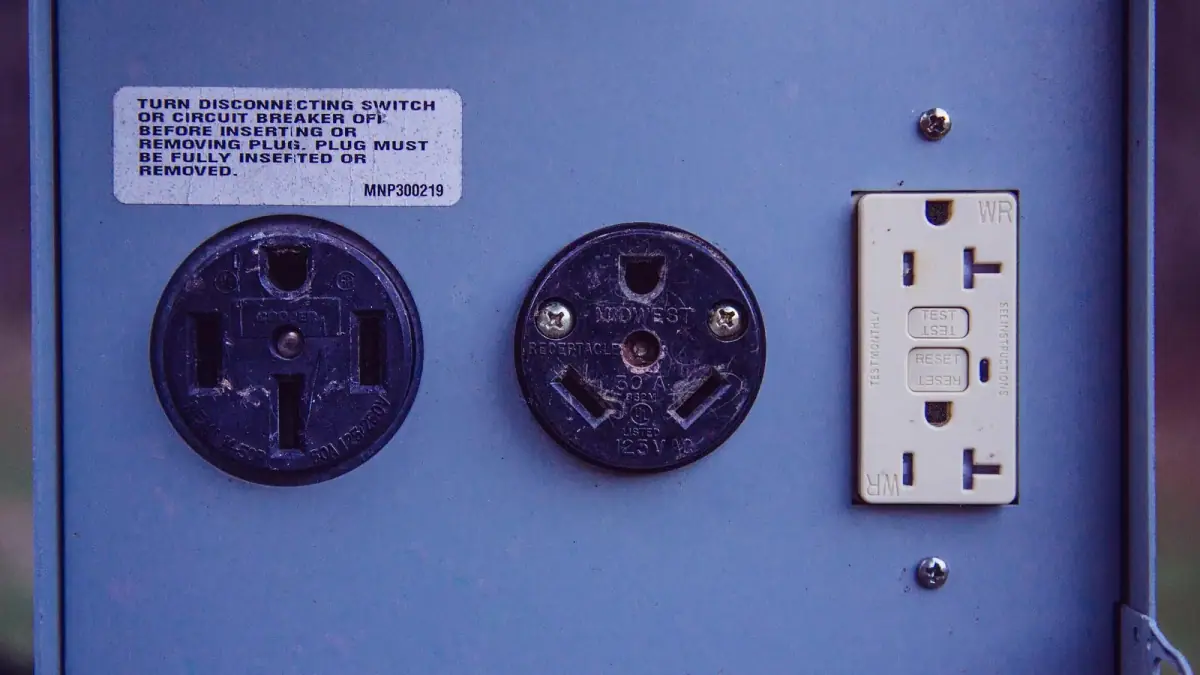
The 30 amp cord has three prongs; the 50 amp cord has four: two 120 volt lines, a neutral and a ground.
| Service | Plug | Volts and legs | Most it can supply |
|---|---|---|---|
| 30 amp RV | NEMA TT-30 | One 120 volt leg, 30 A | About 3,600 W (calculated, 30 A x 120 V) |
| 50 amp RV | NEMA 14-50 | Two 120 volt legs, 50 A each | About 12,000 W (calculated, 2 x 50 A x 120 V) |
| Household outlet | NEMA 5-15 | One 120 volt leg, 15 A | 1,875 W as Camco rates its 15 amp cords |
Plug names from Jayco and the Camco RV accessories catalog. Camco rates its 30 amp cords at 125 V and 3,750 W. Its 50 amp cords are rated 125 to 250 V and 12,500 W.
Is RV shore power 110 or 220?
Everything inside your RV runs on 120 volts. The 50 amp pedestal is a 120/240 volt (or 208Y/120 volt) supply, as Winnebago's 2026 towables manual labels it, but the RV uses it as two separate 120 volt legs. The 240 volts exists only across the two legs, never at an outlet.
Keystone says to plug each cord only into a receptacle wired for it. Wrong wiring sends the wrong power into 120 volt components, and that damage is not covered by the warranty.
Tip: Unplug a 50 amp cord by pulling straight out on the plug head so all four prongs release together. Keystone warns that pulling up on the cord can cause a loss of neutral, which puts 240 volts into the 120 volt system.
What can I run on 30 amps?
On 30 amps, run one big appliance at a time. Keystone's example: an air conditioner draws up to 15 amps and a microwave about 10 amps, so both is 25. The converter adds another 5 to 13 amps, and that combination may trip a breaker.
Jayco's approximate load table runs higher than the appliance makers' own figures:
- Roof air conditioner: 18 A in Jayco's table. Furrion rates its Chill 15,000 BTU at 14.6 A cooling, and Coleman-Mach its Mach 15 at 13.9 A.
- Microwave: 15 A in Jayco's table. Furrion's built-in microwave is rated 1,500 W input.
- Electric water heater: 12 A in Jayco's table. Suburban's 1,440 W element comes to the same 12 A at 120 V (calculated).
- Smaller loads, Jayco's figures: hair dryer 10 to 14 A, refrigerator 6 A, converter 8 A.
Two roof air conditioners usually need 50 amps, as Keystone and Winnebago both say. The exception is Jayco's 30 amp energy management system on some Class C models, which lets two run on 30 amps when other appliances are not in use.
Before starting the microwave or a hair dryer, switch off the electric water heater, the electric fireplace (15 A in Jayco's table) and the washer/dryer (12 A). Keystone recommends running the water heater on gas while other big loads are on. If you are sizing a generator instead of a pedestal, the same appliance amps decide it.
Can I plug a 50 amp RV into 30 amps, or the other way?
Yes, with a dogbone adapter, but you only get the lower of the two ratings. Keystone says that with an adapter, power for the entire RV drops to the adapter's rating, so a 50 amp RV on a 30 amp pedestal has 30 amps.
Camco rates both its 50-to-30 and its 30-to-50 dogbones at 30 amps, which shows an adapter adds no power. Its catalog says to use its offset adapters with breakers rated for the lower amperage.
Builders disagree on adapters, so check your own manual:
- Jayco: do not use adapters, remove grounding pins or connect to ungrounded outlets, and never use extension cords.
- Keystone: if you must use an adapter, keep the ground through it, and never combine an adapter with an extension cord.
- Winnebago: keep the ground if an adapter is used; never plug into an ungrounded receptacle.
- Forest River: never use a two wire extension cord, a "cheater" adapter with the ground pin removed, or a lower amperage plug fitted in place of the molded plug, as its travel trailer and fifth wheel manual states.
A household outlet is the smallest step down. Camco's two-plug adapter lets a 30 amp RV plug into a 5-15R household outlet, and it is still rated 1,875 W because it is one 15 amp circuit. Keystone notes that 15 amp service is not enough to run an air conditioner properly.
Does plugging in charge my battery?
Yes: while you are plugged in, the converter turns 120 volt AC into 12 volt DC and charges the house battery, as Jayco, Keystone, Winnebago and Forest River all describe.
Charging speed depends on the unit, not the pedestal. Winnebago's towables use a 6 amp battery charger, while a Progressive Dynamics PD9245C is a 45 amp converter/charger. A WFCO WF-8955 power center draws up to 11 amps AC, and that comes out of your 30 amps. The converter page covers charge stages and lithium settings.
Checking the pedestal before you plug in
Test the pedestal first, because a badly wired one can damage the RV. Jayco and Keystone give the same order:
- Turn off the RV's main 120 volt breaker and the breaker at the pedestal.
- Test the receptacle with a digital multimeter or a plug-in circuit analyzer. If it shows reverse polarity or an open ground, do not connect.
- Connect the cord to the RV and lock it, then extend the whole cord so it is not left coiled.
- Plug fully into the correct 30 amp or 50 amp receptacle, prongs aligned.
- Turn the pedestal breaker on, then the RV main breaker. Reverse the order to leave, and never plug or unplug under load.
Jayco cautions that breakers and fuses may not fully protect against power surges or voltage spikes, so owners add a protector ahead of the cord. Camco's voltage protectors cut power at dangerous voltage and reconnect once it is back between 102 and 132 VAC. See surge and voltage protection for what the different units monitor.
Two jobs are not yours. A pedestal with bad wiring or a missing ground is the receptacle owner's responsibility, as Jayco states: report it and move sites rather than opening it. Work inside the RV's load center is for a licensed electrician; Jayco says only qualified electrical technicians should service or modify the electrical system. If a breaker keeps tripping after you cut the load, have it diagnosed; a replacement breaker must be the same voltage, amperage and type.
Common questions
Is RV shore power 110 or 220?
Inside the RV it is 120 volt. The risk is a 240 volt outlet: Jayco's 2025 Class C manual says to connect a 30 amp cord only to a properly wired NEMA TT-30 RV receptacle, never to 240 volt AC.
Can I plug a 50 amp RV into a 30 amp outlet?
Yes, with a 50-to-30 dogbone, and you then have 30 amps to work with. If the cord will not reach, Keystone says a 30 amp extension cord should be 10 gauge and no longer than 50 feet.
Does plugging my RV into shore power charge the battery?
Yes, through the converter. Unplugged, it runs the other way: Winnebago says a towable's battery fully discharges within 72 hours if the power center is not connected to a 110 volt source, because the 12 volt loads keep drawing.
What can I run on 30 amp shore power?
Watch the individual circuits as well as the 30 amp total. Keystone notes the RV's 120 volt circuits are protected by 15 to 30 amp breakers, so a space heater plus a toaster on one 15 amp circuit is at least 17 amps and trips it while the main breaker holds.