A basic RV surge protector absorbs voltage spikes and shows pedestal wiring faults with lights, but it keeps passing power to the RV. A full protection unit also cuts the power when voltage goes too low or too high and when the pedestal is wired wrong. Progressive calls this kind an EMS, short for Electrical Management System.
RV Surge Protectors and EMS Units: What They Catch, 30 vs 50 Amp
Some links on this site are affiliate links: if you buy through them we earn a commission, at no extra cost to you. As an Amazon Associate we earn from qualifying purchases.
At a glance
- Basic units let bad voltage through: Progressive's Smart Surge Protector keeps passing power during reverse polarity, open neutral or open ground, and only shows it with a warning light on the unit.
- Full protection cuts power: makers set the shut-off at 102 V or 104 V low and 132 V high, then restart after a delay that protects the air conditioner compressor.
- Match the amps to your RV: Hughes says to match the protection to the coach, and a 50 amp unit on a 30 amp pedestal still gives you only 30 amps.
On this page (7)
Our picks
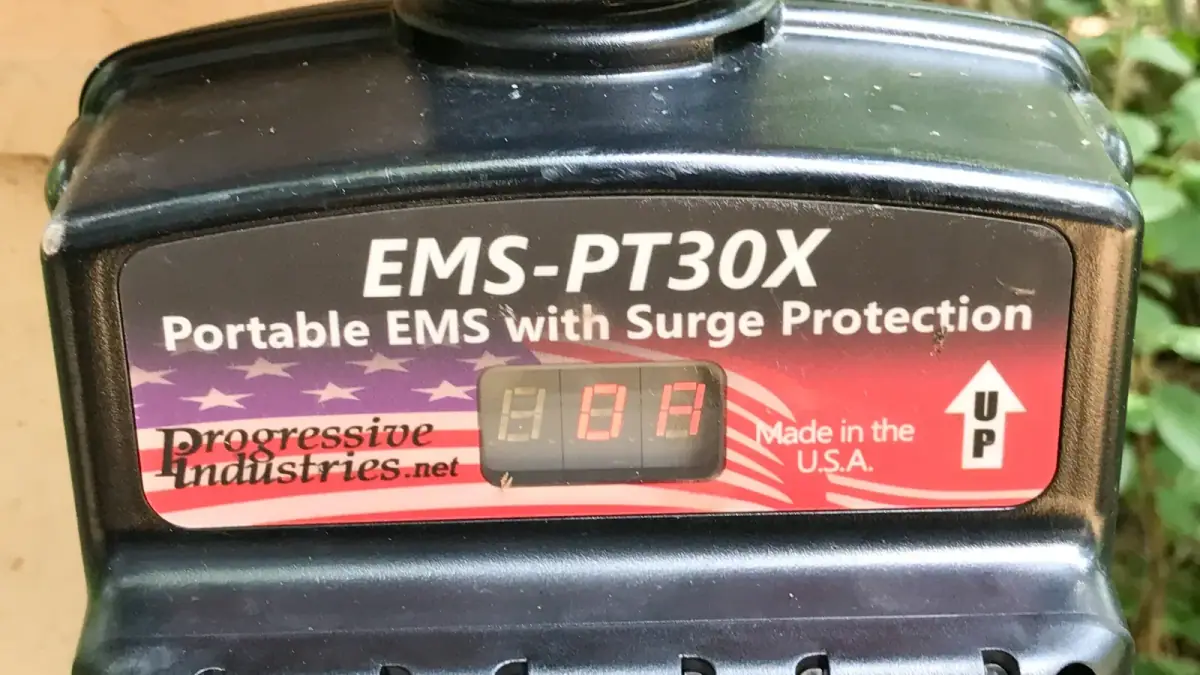
- Progressive Industries EMS-PT30X portable EMS, 30 amp: cuts power on low or high voltage and on a miswired pedestal; 1,790 J
- Progressive Industries EMS-PT50X portable EMS, 50 amp: the 50 amp version, 3,580 J; still protects on a 30 amp pedestal through an adapter
- Hughes Power Watchdog PWD30-EPO, 30 amp: cuts power below 104 V and above 132 V; replaceable surge module
- Hughes Power Watchdog PWD50-EPO, 50 amp: 50 amp EPO unit, 6,100 J, with a 90 second restart delay
- Southwire Surge Guard 34930 full protection portable, 30 amp: Southwire full protection model with an LCD display; 2,450 J
Do you need one at all?
Nothing built into the RV guards against pedestal problems. Jayco's 2027 towable manual states that circuit breakers and fuses may not provide full protection against power surges or voltage spikes, and Southwire makes the same point from the other side: the breaker panel only interrupts power when the amperage load exceeds the circuit rating, which is no protection against voltage changes or input wiring faults. Southwire also calls low voltage one of the most common pedestal problems RVers experience.
What a basic surge protector catches, and what it lets through
A basic unit does two things: it absorbs a spike up to its energy rating, and it tells you how the pedestal is wired. It does not disconnect the RV.
Progressive's SSP-30X and SSP-50X manual says it directly: the unit will continue to work during any of the wiring conditions, and anything other than correct wiring should be corrected by campground maintenance before use. Southwire's entry-level portables test and indicate open ground, open neutral and polarity but, in Southwire's words, provide surge protection only, with no low or high voltage or miswiring protection. Camco's Power Grip circuit analyzers work the same way: diagnostic lights plus 1,050 to 4,200 Joules of surge protection depending on the model.
So a low voltage condition reaches the air conditioner, the microwave and the converter that charges the house batteries, whether or not you notice the lights. Progressive's troubleshooting adds that a short dip may simply be a large load such as a water heater or air conditioner starting.
Tip: Progressive has you plug the protector into the pedestal first, with the RV cord still unplugged, read the result, and only then connect the coach. If an error shows, disconnect and report it to the park manager or a qualified technician rather than plugging in anyway.
What full protection adds, and what the makers call it
The power-cutting tier has four names. Progressive sells an EMS, Southwire calls these its full protection models, Hughes adds EPO (Emergency Power Off) to the model name, and Camco calls its version a Voltage Protector. The capability is the same idea: test the pedestal, refuse or cut power when it is unsafe, restore it when it is safe again.
| Fault | Basic surge protector | Full protection (EMS) |
|---|---|---|
| Voltage spike | Absorbed to the joule rating | Absorbed to the joule rating |
| Low voltage | No protection, power keeps flowing | Cuts power, restores it when voltage returns |
| High voltage | No protection | Cuts power |
| Reverse polarity | Light only, on models that test for it | No power (Progressive code E 1) |
| Open neutral | Light only, and some models do not test for it | No power (Progressive unit stays dark) |
| Open ground | Light only | No power (Progressive code E 2) |
| 240 volts by mistake | No protection | Refuses power, or shuts down instantly if live |
| Frequency out of range | No protection | Cuts power below 51 Hz or above 69 Hz (Progressive) |
Rows from the Progressive EMS-PT30X and EMS-PT50X manual, the Southwire Surge Guard training manual and the Hughes Power Watchdog EPO instruction sheet.
The cut-off voltages differ by maker: Progressive and Hughes shut down below 104 V and above 132 V, Southwire and Camco use 102 V and 132 V. So do the restart delays, which exist to keep the air conditioner compressor from being cycled rapidly: 136 seconds on the portable Progressive EMS, 128 seconds on the 2023 Southwire portables, 90 seconds on the Hughes Watchdog, and a reconnect delay Camco does not put a number on.
Joule ratings, and when the protection is used up
Joules are the energy the unit can absorb. Southwire explains that the MOVs inside clamp a surge and dissipate the excess as heat and through the ground, and that the joule rating is only a loose guide to effectiveness. Its warranty adds the limit: no surge protector will protect against a direct lightning strike.
Figures as the makers print them, by model:
- Progressive SSP-30X 825 J and SSP-50X 1,650 J; EMS-PT30X and EMS-HW30C 1,790 J, EMS-PT50X and EMS-HW50C 3,580 J.
- Southwire Surge Guard 44750 510 J, 30 amp portables 2,100 J, 50 amp portables 4,200 J, full protection 34930 2,450 J and 34950 4,200 J, hardwire 35530 2,450 J and 35550 3,850 J.
- Hughes Power Watchdog Gen I PWD30-EPO 3,000 J and PWD50-EPO 6,100 J; Gen II hardwired PWD30EPOHW 2,300 J and PWD50EPOHW 4,600 J.
Southwire's basic 50 amp portables carry the same 4,200 J as its full protection 50 amp portable: a bigger joule number does not buy voltage or wiring protection.
When the protection is spent, what you replace depends on the brand. Southwire says its protectors are designed to sacrifice themselves, the lifetime warranty is void once that happens, and you buy a new unit. Hughes uses a replaceable surge module and sends a free one within the first two years of ownership. Progressive services its hardwired EMS with plug-and-play parts, while the portable manual recommends replacing the protector, and Camco's hardwired Voltage Protector has a replaceable circuit board.
Tip: On a Progressive EMS a spent surge module shows as code E 10, and Progressive says that error does not shut off incoming power. Hughes says the same of its E 9, the only code that does not cut power. The RV keeps running normally with no surge protection left, so read the display rather than trusting the silence.
30 amp or 50 amp version?
Buy the rating your RV is wired for: Hughes states plainly that it is extremely important to match power protection products to the RV. Hughes' FAQ also describes 30 amp RV service as wired like a house wall outlet, one hot, one common and a ground, while Southwire describes a 50 amp coach as two 120 V circuits fed from a 120/240 V pedestal.
Using a bigger unit on a smaller source is allowed. Southwire's FAQ says its 50 amp models can in most cases run from a 30, 20 or 15 amp source with a purchased adapter cord set, and Progressive says its EMS may be used with 15, 20, 30 or 50 amp service with the proper adapter and still gives full protection, with power limited to the lower rating of the source and the RV. Hughes is blunt about the limit: the Watchdog is not going to convert 30 amps into 50, and on a 30 amp site you need to watch the draw so the pedestal breaker does not trip.
The reverse is worse. Southwire says a 30 amp unit can be run from a 50 amp pedestal through an adapter but does not recommend it, because the higher input can throw breakers. If you are still working out which service your rig has, start with 30 amp and 50 amp shore power.
Portable or hardwired?
A portable unit hangs at the pedestal, which makes it easy to move between rigs and easy to steal. Makers answer that with locks: Progressive builds in a locking bracket for a bicycle cable lock, Hughes puts a padlock ring on the clamshell door plus a lock ring on the cable, and Southwire offers a lock hasp and ships an anti-theft lock ring on its 2023 full protection portables.
Weather is the other portable constraint. Progressive's and Southwire's weather-resistant units must never be submerged, and Progressive says the unit must be used upright and not placed on the ground. Hughes notes the vertical rule keeps the IP65 rating on portables, while hardwired units mounted inside the coach can sit in any orientation.
Hardwired units are permanently installed and out of the weather. Hughes requires its hardwired Watchdog to go in front of the transfer switch, as the first device the power runs through from the shore cord. Progressive allows either position and notes that installing after the transfer box protects the RV from generator power as well. Bypass switches differ: Southwire removed bypass from all current products for safety reasons, while Progressive's hardwired EMS and Camco's hardwired Voltage Protector keep one for emergency use.
Hardwiring means working in the RV's 120 volt wiring. Progressive recommends a certified electrician, Southwire a qualified licensed electrician, and Jayco says the electrical system should be serviced only by qualified electrical technicians. Have it installed by a licensed electrician. Hughes also warns that modifying a portable Watchdog into a hardwired one voids the warranty; it sells a hardwire kit instead.
Tip: A melted cord end is not evidence of a surge. Hughes says melted plugs come from corrosion, loose connections and overloading, and the fix is inspecting and cleaning the connections and keeping a tight fit.
Common questions
Do you really need a surge protector on an RV?
Southwire's dealer training manual makes the case by frequency: while surges do occur, an RV is likely to meet voltage and wiring problems more often than a surge, which is why Southwire tells dealers to sell full protection rather than surge protection alone. The worst of those faults is an open neutral on a 50 amp system, where Southwire says the shared neutral turns the split 120 V supply into a 240 V loop, one leg swinging very high and the other very low, damaging 120 V equipment quickly.
What is the difference between an EMS and a surge protector?
Watch the naming first: on an RV spec sheet, "Energy Management System" usually means something else entirely. Jayco's 2025 Class C manual describes its 30 amp Energy Management System as a load manager that monitors incoming power and turns off a few select loads to avoid tripping the shore breaker, with no voltage or wiring function at all. A Progressive EMS, a Southwire full protection model, a Hughes EPO unit or a Camco Voltage Protector is the protective device: it tests the pedestal and cuts power, where a plain surge protector only absorbs the spike.
Can I use a 50 amp surge protector on a 30 amp RV?
Yes, with conditions. Southwire's FAQ says its 50 amp models can in most cases run from a smaller source, but the adapter must be configured to supply both input lines of the 120/240 V, 50 amp unit, and the source must be protected by a properly rated circuit breaker so the adapter cord is not overloaded.
How long does an RV surge protector last?
No maker publishes a lifespan in years. Southwire's FAQ says the surge protection should last indefinitely unless there is a direct lightning strike, which uses it up. Progressive and Hughes both show a code when their surge module is depleted, and that code does not stop power reaching the RV.