The house battery charges whenever the RV has 120 V power, from a campground post or a generator, through the converter in the power center. It also charges from solar through a charge controller, and from the tow vehicle or motorhome engine while you drive. In storage, a plug-in maintainer does the job.
How an RV Battery Charges: Shore Power, Generator, Solar and the Truck
Some links on this site are affiliate links: if you buy through them we earn a commission, at no extra cost to you. As an Amazon Associate we earn from qualifying purchases.
At a glance
- What charges it: the converter on 120 V power, a solar controller, and the engine through the 7-way plug or a motorhome isolator.
- When it is full: a rested flooded battery reads 12.73 V at 100% in Trojan's table, while lithium voltage barely moves, so a battery monitor is the gauge.
- Parked RV: small always-on loads can flatten the battery within 72 hours with no charging, according to Winnebago.
On this page (8)
What charges your RV battery
On 120 V power the converter in the power center does the charging; how it steps through its voltages is on the page about the RV converter.
| Source | What does the charging | What limits it |
|---|---|---|
| Shore power | The converter/charger in the power center | Converter output and voltage setting |
| Generator | The same converter, through the RV's power cord | Generator has to be running; its own 12 V outlet is a different route |
| Solar | The solar charge controller | Sun, panel output, controller size |
| Tow vehicle, 7-way plug | Alternator, through the 12 volt charge line | Only while the engine runs; no rate is published |
| Motorhome engine | Alternator, through the isolator solenoid or Battery Isolation Manager | Only while the engine runs |
| Plug-in charger or maintainer | The charger itself | Must suit the battery chemistry |
Sources: the Keystone 2027 manual, the Jayco and Forest River owner's manuals, and Progressive Dynamics.
Shore power charging is slower than many owners expect, and the converter's voltage matters most. In a Progressive Dynamics test, a 55-amp converter fully charged a run-down 125 Ah battery in about 11 hours at 14.4 volts, but needed 78 hours at 13.6 volts.
Tip: If the battery goes flat while the RV is plugged in, check the in-line fuses before blaming the converter. WFCO says the most common are auto-reset thermal fuses within 18 inches of the battery on the positive side.
Charging from a generator
A generator charges the battery the same way shore power does, through the RV's power cord and the converter.
The 12 V outlet on a portable generator is a second, limited route. Honda says the EU2200i's DC outlet is for 12-volt automotive batteries only and is not regulated, so check the battery voltage often to avoid overcharging. Champion's 200988 has a regulated 8 A outlet, but says to charge only vented wet lead acid batteries with it, as other types may burst.
Charging from solar
Solar charges the battery through a charge controller, which regulates the voltage between the panels and the battery. Sizing is covered under RV solar sizing. For storage, Keystone's solar package has a separate PV disconnect switch near the controller to shut off panel voltage.
Does the battery charge while you drive?
Yes, a little, so treat it as a top-up rather than a recharge. The 7-way plug carries a 12-volt charge line from the tow vehicle alternator, but no builder publishes a charging rate. The pin layout and fusing are under 7-pin trailer wiring.
The connection works both ways. With the plug in, Grand Design says both batteries power the RV, so disconnect the plug or fit a battery isolator to keep the truck battery from running down. In a motorhome, an isolator solenoid lets the alternator charge the house batteries while the engine runs.
How to tell when it is full
On lead-acid or AGM, a resting voltage reading tells you; on lithium, you need a battery monitor. Let the battery sit with no charging and no load first: Trojan asks for at least 6 hours and prefers 24, Lifeline asks for 4. Makers differ by a tenth of a volt or so, so use the row for your battery.
| Battery maker | 100% at rest | 50% at rest |
|---|---|---|
| Trojan, flooded | 12.73 V | 12.10 V |
| Lifeline, AGM | Above 12.78 V | 12.18 V |
| Keystone builder chart, lead acid | 12.6 V | 12.2 V |
From Trojan's battery maintenance page, the Lifeline AGM technical manual and the Keystone 2027 manual.
Lithium voltage is almost flat: on Renogy's Pro Series it runs from 13.2 V at 90% down to 12.8 V at 20%. A shunt-based monitor such as Victron's SmartShunt tracks charge by measuring current in and out of the battery instead; change its settings from the lead-acid defaults for lithium.
Tip: On lithium, the charger tells you when it is full. Renogy calls its Pro Series full when the charge current falls below 5 A, and Victron says its 12.8 V lithium battery is full once the charger drops to the 13.5 V float stage.
Can a flat battery come back?
Sometimes; it depends on the battery type and how long it sat flat. Lifeline says a 12 V battery below 11.6 V is deeply discharged and can sometimes be recovered, but only by a trained technician in a well ventilated area. Trojan says one reading below its table values should go to a specialist or be retired, and does not recommend desulfators.
Flooded batteries give off hydrogen while charging, which can ignite at as little as 4% in air, so charge in a ventilated space and keep sparks and flames away.
A run-down lithium battery switches itself off instead: it blocks discharge but still accepts charge, though some chargers cannot sense it. Dragonfly's text in the Keystone manual says to jump it from another 12 V source within 5 days; Battle Born's manual gives 24 hours. Renogy says to use a charger with lithium activation or force charging, and to find the fault before using it again. Follow your battery's own manual.
Keeping it topped up in storage
A parked RV keeps drawing power, so a battery left connected goes flat. Keystone calls 300 mA to 700 mA of always-on draw from detectors, radio memory and control boards normal. Winnebago says a trailer battery will fully discharge within 72 hours if it is not recharged. The RV battery disconnect switch cuts most of that draw.
Tip: Disconnecting is not the same as maintaining. Forest River says a battery loses charge after 30 to 45 days even with the disconnect switch off, and must be recharged at 80% or less, because a discharged battery will freeze and crack its case.
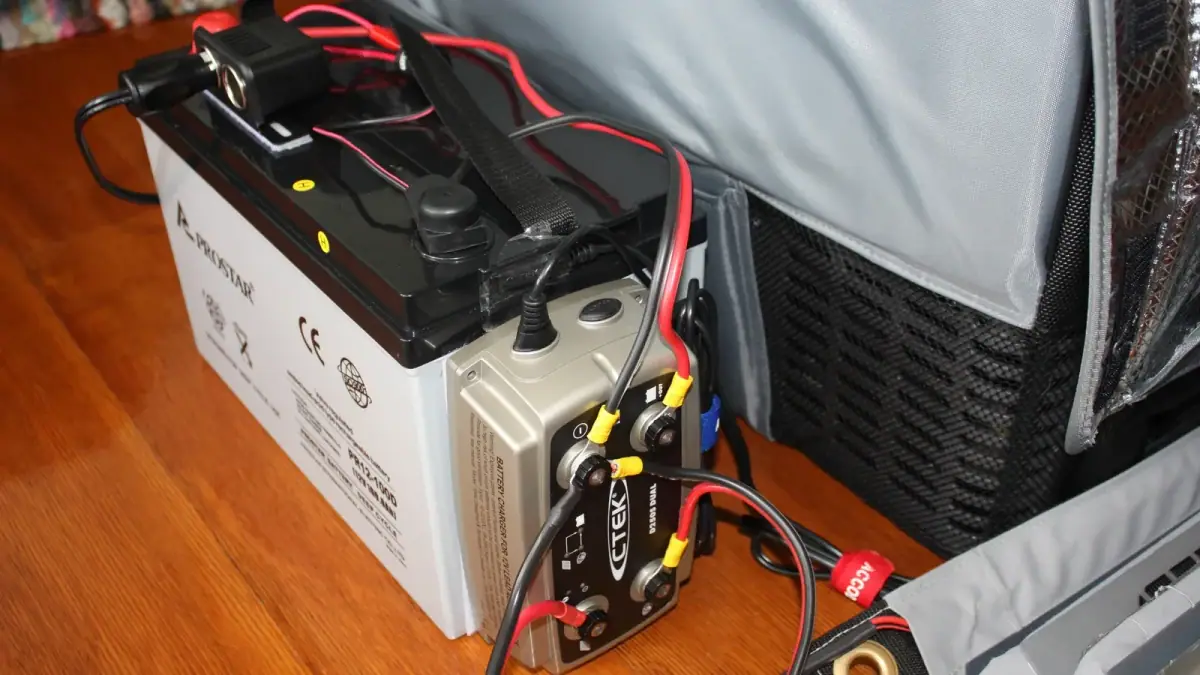
For lead-acid, Trojan says to store fully charged, check voltage every 4 to 6 weeks and give a boost charge at or below 70%. A float charger can do this for you: NOCO says the GENIUS5 can be left connected indefinitely, and its lithium mode is for batteries with a BMS only.
Lithium makers disagree on storage charge. Battle Born says store at 100% with the negative cable off, counting 4% to 5% loss a month. Renogy says 30% to 50% for its Pro Series, charged at least once every 3 to 6 months. Interstate says 60% to 80%.
Common questions
What is the simplest way to charge an RV battery at home?
Plug the RV into household 120 V power so the converter charges it, or connect a plug-in charger or maintainer to the battery terminals. NOCO's GENIUS5 is rated for batteries up to 120 Ah and for maintaining all sizes. NOCO warns that its Force Mode, for batteries below 1 V, disables safety features and leaves live power at the connectors.
How long does it take to charge an RV battery?
It depends on charger output and how far down the battery is. Lifeline puts a 100 Ah AGM battery at 40% depth of discharge at about 4.6 hours with a 25 A charger. Renogy quotes about 2.5 hours for its 100 Ah lithium battery at 50 A, more than most RV converters supply.