Turn the RV's 12 V system, shore power and converter off before you touch a terminal. Connect the positive cable first and the negative last, and remove them in the opposite order. Two 12 V batteries wire in parallel; two 6 V batteries wire in series.
How to Connect RV Batteries: One Battery, 12 V in Parallel, 6 V in Series
At a glance
- Cable order: positive on first and the grounded negative last; negative off first when you remove a battery.
- Which wire is positive: go by the + and - marks on the battery and cable ends, because no builder prints a color rule for house 12 V wiring.
- Two batteries: two 12 V in parallel stays 12 V and the amp-hours add; two 6 V in series makes 12 V at one battery's amp-hours.
On this page (8)
Which cable goes on first?
The grounded negative goes on last and comes off first. On a towable the negative terminal is the grounded one, and Forest River's travel trailer and fifth wheel manual gives this order. Keystone's 2027 manual agrees for removal: negative cable first, then the positive. Grand Design asks you to turn the power converter off before disconnecting the battery at all.
Tip: If the two cables go on the wrong posts, the converter pays for it. Forest River, Jayco and Grand Design all warn that reversed polarity blows the fuses that protect the converter, so check the stamped + and - before you tighten anything.
Fitting one battery, step by step
- Shut the system down. Jayco's 2027 towable manual gives the order: inverter/charger off, shore cord unplugged, generator off with auto-start disabled, the battery disconnect switch off, and the 120 V main breaker off.
- Put on goggles and gloves and use insulated tools.
- Set the battery in its box with the cable ends clear of the posts, then fit the hold-down bracket.
- Connect the positive cable, then the negative. A washer goes on top of the cable lug, never between the lug and the terminal, where it can melt the terminal.
- Tighten to the figure for your battery, not finger tight. Lifeline calls for 35 in-lb on an M6 terminal; Battle Born asks for 9 to 11 ft-lb. Figures vary by terminal type, so use your battery's own documentation.
- Keep the terminals clean and dry. Trojan recommends a terminal protector spray once the connections are made.
Which wire is positive on a camper?
Follow the + and - marks, not the color. No major builder gives a color rule for the house 12 V wiring, and household habits do not carry over: Grand Design notes that the auxiliary +12 V wire in the 7-way connector is typically black. Battle Born marks its own terminals red for positive and black for negative.
Wiring two batteries together
How the cables join decides whether you get more capacity or a different voltage.
| Setup | How the cables join | Voltage and capacity |
|---|---|---|
| Two 12 V in parallel | Positive to positive, negative to negative | 12 V, amp-hours add: two 100 Ah batteries make a 12 V 200 Ah bank |
| Two 6 V in series | Positive of one to negative of the other; the system cables go on the two free posts | 12 V, capacity stays that of one battery |
Figures from Battle Born and Lifeline. Which capacity and chemistry suits your rig is on the RV battery types page.
Tip: On a parallel bank, take the RV's positive from one battery and the negative from the other. Victron explains that running both cables off one end works the nearest battery harder, and it fails early.
Tip: Before joining batteries, charge each one fully and measure them. Renogy wants the difference under 0.1 V; Lifeline wants every battery at 100 percent. Keep the interconnect cables the same length.
Cables and a fuse
There is no single wire size for every RV: the cable has to carry the full current the batteries can deliver. Renogy's Pro Series manual rates 4 AWG copper at 140 A and 2/0 AWG at 300 A for runs up to 13 feet, and longer runs may need thicker cable.
Put a fuse close to the battery on the positive side. Battle Born fits an ANL fuse between the bank and the inverter or load. Rewiring the bank for a large inverter, or changing the charging system, is a job for a qualified RV technician, as Jayco and Grand Design both say.
What not to mix in one bank
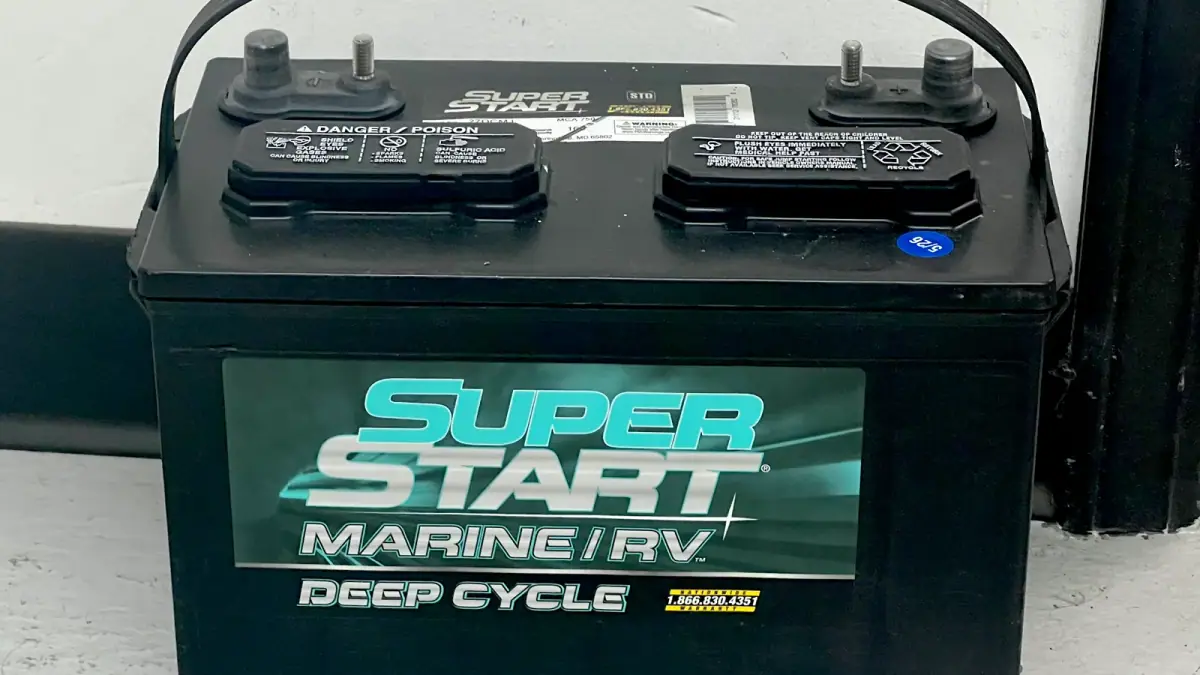
Use deep cycle batteries only, never car batteries, and keep them the same brand and type, as Jayco asks. Group size comes from your RV's manual: Jayco's 2027 towable manual specifies Group 27 or 31, Grand Design's Reflection Group 24 or 27.
Battery makers set their own limits, and they disagree:
- Lifeline: a series string must be the same model and size; a new parallel string beside an old one is fine if every battery is fully charged.
- Trojan: does not recommend replacing only some batteries in a flooded bank.
- Renogy: never mix chemistries, capacities, voltages, brands or models; the Pro Series is parallel only, up to 8 batteries.
- Battle Born: never in series or parallel with another type of battery; series up to 48 V.
- Victron: up to four 12.8 V batteries in series and 20 in parallel.
- Interstate: no more than four of its lithium batteries in parallel, all the same type and capacity.
Because chemistries cannot share a bank, moving to lithium means replacing the whole bank and checking the charger, not adding one battery to the lead-acid pair you have.
Safety in one place
Flooded batteries give off hydrogen, and Forest River calls hydrogen and air a very explosive mixture. Work in a well-ventilated area, keep flames and sparks away, and do not lean over a battery, as Interstate warns. Keystone adds that batteries should not sit near anything that can spark, even a 12 V switch.
A tool laid across both terminals shorts the battery, and that spark can ignite the gas. Lifeline says a short can deliver enough current for severe burns and a fire. Insulated tools and eye protection handle both risks.
Common questions
What is the correct order for connecting RV battery cables?
With the converter, shore power and disconnect switch off, the positive goes on first and the grounded negative last. To remove a battery, reverse it: negative off first.
Is the white or the black wire positive on a camper?
Neither color is a reliable guide, and on the 7-way connector the +12 V wire is often black. Identify each cable by the + and - marks on the battery post and the cable end.
Can I add a second battery to my RV?
Yes. Two 12 V batteries go in parallel, and the cables, fuse and disconnect in the path have to carry the higher current the pair can deliver.
Can I wire a new battery with an old one?
It depends on the maker. Lifeline allows a new parallel string beside an old one if every battery is fully charged, while Renogy says to avoid batteries bought more than half a year apart. Follow the document for the batteries you own.