A lithium battery usually fits the same box, but the chargers around it have to suit it. The converter needs a lithium setting or a lithium model, the solar controller needs a lithium profile, and most lithium batteries refuse a charge below freezing.
Switching Your RV to Lithium: The Converter, Charging and Cold Rules
Some links on this site are affiliate links: if you buy through them we earn a commission, at no extra cost to you. As an Amazon Associate we earn from qualifying purchases.
At a glance
- The converter: it needs a lithium mode or auto-detect, or a lithium replacement of the same amp rating; Keystone says a converter without lithium support takes the battery to only about 80 percent.
- Charging from the truck: Jayco, Battle Born and Victron all point to a DC-to-DC charger rather than a direct alternator connection.
- Cold: Battle Born's manual says its management system blocks charging below 32°F, and Victron sets its own limit at 41°F.
On this page (7)
Can you just drop one in?
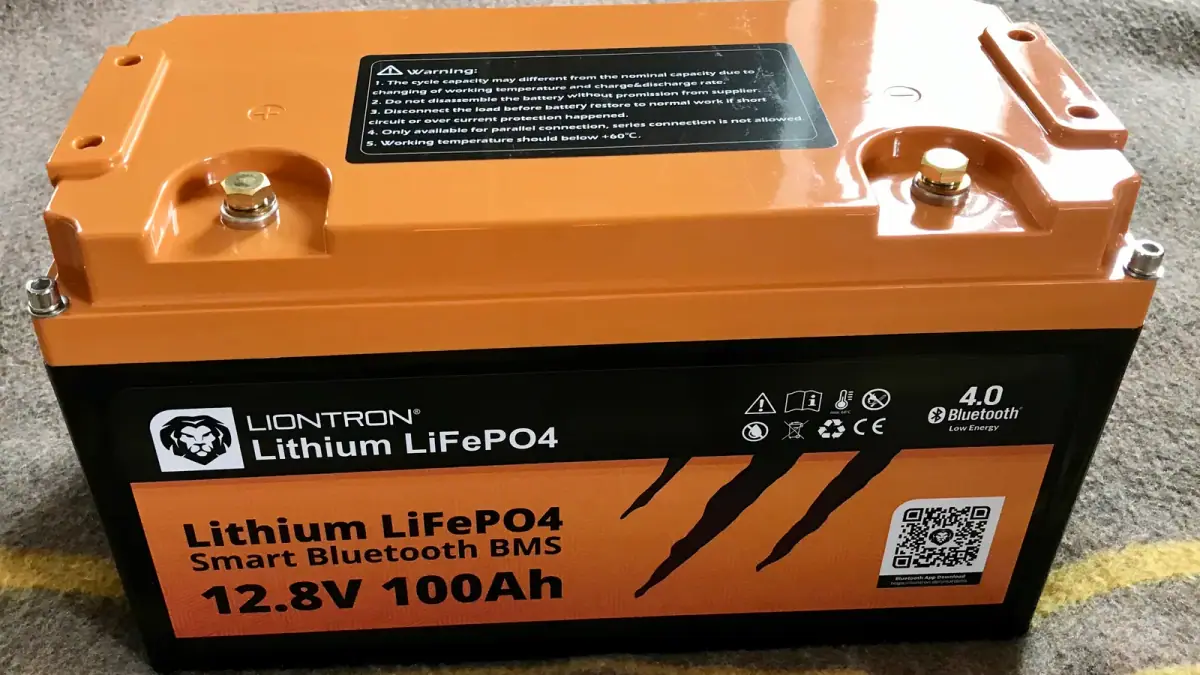
Mechanically, often yes, but everything that charges it has to be set for lithium. RV lithium batteries are lithium iron phosphate (LiFePO4), which Victron calls the most used lithium-ion chemistry.
Each has a built-in management system that cuts the battery off when a cell runs too low or conditions get extreme. It then stays off until you deal with the cause.
Never run lithium in series or parallel with any other type of battery. Replace the whole bank, not one battery beside the old pair. How lithium compares with flooded, AGM and gel is on the page covering RV battery types.
Check case size, terminal type and terminal position against the maker's data sheet before you buy. If your RV came with a factory lithium pack, Keystone says the compartment is for non-vented batteries only, and Jayco says replacement lithium parts must be identical to the factory items.
Does the converter have to change?
Only if yours cannot charge lithium. Keystone says a power center without lithium support brings a lithium battery to roughly 80 percent of capacity, so check your converter's manual. If yours has an LI/LA switch, Jayco says to ask the dealer before changing it.
Newer converters handle lithium in one of three ways. WFCO's WF-8900-AD detects the battery and switches to a lithium profile, shown by a blue LED. The Progressive Dynamics PD9300 has a selectable lithium setting. The PD9100L is lithium only and must never charge lead-acid. What the charge stages do is covered on the page about the RV converter.
Tip: WFCO's auto-detect picks the profile during a charge cycle, so a lithium battery that is always full may never trigger lithium mode. Run it down enough for the converter to start charging.
If you replace the converter, Progressive Dynamics says to fit a lithium model with the same DC amp rating as the present unit, never a higher one, because the RV wiring may not carry the extra current safely. A converter swap, a DC-to-DC charger or an inverter charger is a job for a licensed RV technician or electrician.
| Maker and document | Lithium charge voltage | What else it states |
|---|---|---|
| Battle Born battery manual | 14.2 V to 14.6 V bulk and absorption | Equalization and temperature compensation disabled |
| Renogy Pro Series battery | 14.4 V (±0.2 V) | Charger must be rated for lithium iron phosphate |
| WFCO WF-8900-AD converter | 14.6 V in lithium mode | Two charging stages, blue LED |
| Progressive Dynamics PD9100L | 14.6 V nominal | Lithium only, never lead-acid |
| Victron SmartSolar MPPT | 14.2 V absorption, 2 hours | Equalization off; adjust if the battery maker says otherwise |
From each maker's own manual. Where a charger allows a range, follow the battery maker's numbers.
What about solar?
Your panels stay; the charge controller needs its lithium setting. On a Renogy Rover Li, set the battery type to Li and enter the battery's nominal voltage by hand; the warranty does not cover damage from the wrong type.
Do not equalize a lithium battery. Panel and controller sizing is covered under how much solar an RV needs.
Charging from the truck or the engine
Your truck charges the RV battery through the 12 volt charge line in the seven-way plug, and for lithium the makers want a DC-to-DC charger in between. The pins and fuses are on the page for 7-pin trailer wiring.
Jayco says to fit one between the tow vehicle charge line and the trailer lithium batteries to prevent damage. Battle Born says a lithium bank should not connect directly to a factory alternator in most applications, and that factory wiring to the trailer plug is rarely large enough for serious lithium charging.
Tip: the reason is the alternator, not the battery. Victron says a lithium battery's low impedance can overload an alternator, and Battle Born's rule of thumb is that an alternator handles about half its rated amps continuously.
Why the battery lights read wrong
The battery lights on an RV panel read voltage, and a lithium battery's voltage barely moves until it is nearly empty. On Renogy's 100 Ah Pro Series, 90 percent down to 20 percent spans only 13.2 V to 12.8 V.
For a true reading, fit a shunt-based monitor such as the Victron SmartShunt, which measures current in and out of the battery. Set it up for LiFePO4 rather than leaving the lead-acid defaults. More on how an RV battery charges is on its own page.
Tip: the monitor itself is a small load. Victron says to cut its supply if the RV sits long enough to flatten the battery; even 1 mA can damage a 100 Ah battery left discharged more than 40 days.
Can you use it in the cold?
You can run it cold, but the management system blocks charging below a set temperature, and each maker draws the line in a different place.
| Battery | Charging allowed from | Note |
|---|---|---|
| Battle Born BB10012 | 32°F (0°C), per the manual | Data sheet prints 25°F; discharge continues to -4°F |
| Renogy Pro Series 100 Ah | 32°F, resumes at 37°F | Standard charge range 32°F to 131°F |
| Victron Smart LiFePO4 | 41°F (5°C) | Victron says setting it lower voids the warranty |
From the Battle Born BB10012 manual, the Renogy Pro Series manual and the Victron Lithium Smart Battery manual. Your own battery's limits are on its data sheet and in its app.
Heated models can charge below that, but the heater needs power. Renogy's Pro Series needs a steady charge current above 4 A before it heats itself below 41°F. Battle Born's heater draws about 1.8 A from the battery itself, roughly 48 hours with no charging, and after a long freeze it takes 2 to 4 hours before the battery accepts a charge.
For storage the makers disagree. Battle Born says charge to 100 percent, remove the negative cable and expect 4 to 5 percent loss a month. Renogy's Pro Series manual says store at 30 to 50 percent, disconnected, and recharge every three to six months. Both say to switch the heater off.
Common questions
Do I need a new converter for a lithium RV battery?
Not if yours has a lithium profile. Look on the unit for a model number, an LI/LA switch, a dip switch or a colored LED, then check that model's manual. Progressive Dynamics publishes a cross-reference from common lead-acid converters to its lithium replacements.
Can I charge a lithium RV battery from my truck?
Yes, through a DC-to-DC charger rather than straight off the charge line. Renogy suggests an alternator rated at least 1.5 times the charger's output, and lets you turn the charging current down if the alternator is working hard. Redarc states its BCDC1225D suits lithium and smart alternators alike.
What is the main downside of a lithium battery in an RV?
Cost beyond the battery: a lithium converter or profile, a solar setting and a DC-to-DC charger. The other is cold: below the maker's cutoff it will not take a charge until the cells warm up.
Can I mix a lithium battery with my old lead-acid batteries?
No, replace the whole bank. Renogy also forbids mixing capacities, voltages, brands or models, and advises against pairing batteries bought more than six months apart.