Solar sizing starts with your own use, not with a panel count. Add up the amp-hours you draw in a day, the amp-hour being the fuel gauge of a 12 V battery, divide that by the sun hours where you camp in the month you camp there, and round up to the next whole panel.
RV Solar Sizing: How Many Watts, What Battery, Which Charge Controller
Some links on this site are affiliate links: if you buy through them we earn a commission, at no extra cost to you. As an Amazon Associate we earn from qualifying purchases.
At a glance
- The worked example below: 103 amp-hours a day comes out at about 400 W of panels for Arizona in December.
- What 400 W will not run: a roof air conditioner. Furrion's 13,500 BTU Chill draws 1,340 W while cooling.
- Controller to match: 400 W charging a 12 V battery works out at about 28 A, so a 30 A charge controller.
On this page (8)
How many solar watts do you need?
Go Power.'s RV solar sizing method starts where yours should: list the DC and AC appliances, note the hours each runs per day, add up the daily draw, then multiply by the days per week you camp. A watt is a rate, how fast something draws power; a panel's watt rating is what it makes at its data sheet test conditions, 1,000 W/m² of light on a 25 °C cell. Anything running on 120 V goes through an inverter sized to the load, which adds its own losses on top.
The awkward part is that appliance makers mostly print a maximum or a wiring requirement, not an average. Working from those maximums gives a high answer, which is the safe direction for sizing.
| Item | Amps the maker prints | What the figure is | Daily amp-hours (calculated) |
|---|---|---|---|
| Furnace, Atwood AFMD25 | 7.5 A at 12 V | Rated current with the blower running | 2 h = 15 Ah |
| 12 V fridge, Furrion Arctic 10 cu. ft. | 11 A | Start-up and maximum cooling setting, not an average draw | 6 h = 66 Ah |
| 12 V fridge, Dometic DMC4101 | 15 A or more | Supply requirement for the wiring, not a draw | Not used here |
| Roof vent fan, MaxxAir MaxxFan Deluxe | 5 A | Minimum circuit the fan needs, not its running draw | 4 h = 20 Ah |
| Water pump, Shurflo Revolution 4008 | 7.5 A | Maximum; the pump runs only while water flows | 15 min = 2 Ah |
Amps as the makers print them: the Atwood AFMD furnace manual, the Furrion Arctic refrigerator manual, the MaxxFan Deluxe installation guide, Dometic's DMC 4101 and 4081 manual and Shurflo's RV product catalog. The hours and the last column are this page's example, not maker figures. No lights row: no maker figure was in reach.
Add the last column and the example day is 103 Ah. At 12 V that is 1,236 Wh (103 x 12, calculated). Divide by the sun hours for the place and month: at Quartzsite's December figure of 3.2, 1,236 ÷ 3.2 = 386 W, so four 100 W panels. Margin comes from the choices already made: maximum amps, the worst month rather than the annual average, and rounding up. That lands the example on 400 W.
Tip: The hours decide your system more than the amps do, and no fridge maker in these documents prints a daily figure. The only firm way to get your own number is a shunt-type battery monitor, read after a full day of normal camping.
How much sun does your spot get?
Renogy defines a peak sun hour as the equivalent of 1,000 W/m² of sunlight for an hour, so four peak sun hours means the day's total sunlight equals four hours at that intensity. That lets the federal solar resource figures, published by NREL and now by NLR, be read straight off as sun hours. Panels lying flat on an RV roof see the horizontal figures below.
| Place | Annual, flat | December, flat |
|---|---|---|
| Quartzsite, Arizona | 5.8 | 3.2 |
| Orlando, Florida | 4.88 | 3.1 |
| Seattle, Washington | 3.46 | 0.84 |
Figures in kWh/m²/day from NLR's solar resource data (Perez-SUNY/NREL, 2012) for the cells containing each city. For your own spot and month, run the PVWatts calculator.
The same 103 Ah day needs 1,236 ÷ 0.84 = 1,471 W of flat panels in Seattle in December (calculated), which no RV roof holds. Sizing on an annual average hides that. Panels also fall short of their rating in heat: Victron's technical paper on charge controllers puts the drop at about 4.5% per 10 °C of cell temperature above 25 °C, and its example 100 W panel makes 77.5 W at a 75 °C cell. NREL's PVWatts manual warns that monthly estimates can be off by 30%, and that a given month can run 40% from the long-term average.
Tip: A panel aimed at the sun collects far more in winter than one lying flat. At Quartzsite, NLR's December figure is 3.2 flat but 5.63 for a plate tilted at the latitude, which is the case for a tilting mount or a portable panel propped toward the sun.
What battery goes with it
Panels only fill the battery; the battery runs your night. How much rated capacity you need for the example's 103 Ah depends on the chemistry. Trojan recommends discharging flooded lead-acid to 50% or less, with 80% as the maximum safe discharge, so that day needs roughly 206 Ah of rated flooded capacity (103 ÷ 0.5, calculated). Battle Born's BB10012 data sheet lists 100% usable depth of discharge, so about 100 Ah of lithium covers the same day. The differences between the battery types decide the bank size before the panels do.
Tip: Battle Born's manual states that its battery management system will not allow charging current below 32°F (0°C), though it keeps discharging down to -4°F. In a cold-weather camp the panels can be producing while a plain lithium battery refuses the charge, which is why self-heated models exist.
PWM or MPPT, and what size controller
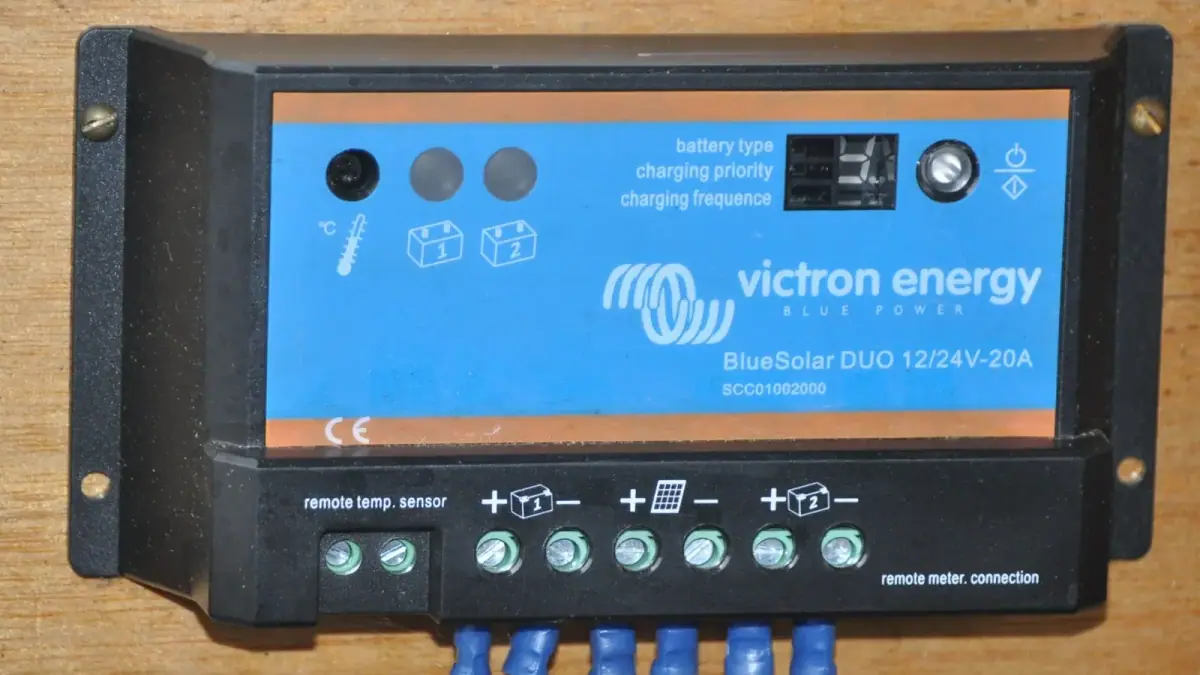
Victron describes a PWM controller as in essence a switch connecting the array to the battery, which pulls array voltage down to near battery voltage. Morningstar notes that 12 V nominal modules commonly have a Vmp of about 17 V while a 12 V battery sits between 10 and 15 V, which is where the loss lives. An MPPT controller adjusts its input voltage to harvest maximum power and converts it to what the battery needs.
How much that gains depends on who you ask. Victron's SmartSolar data sheet claims up to 30% over PWM under a clouded sky with continuously changing light; its own technical paper puts the gap at 19% at a 25 °C cell and within 10% between 45 and 75 °C, and calls PWM a good low-cost solution for small systems only. Morningstar says 10 to 15%. Victron recommends MPPT once a 12 V array exceeds a few hundred watts; Renogy says there is no universal winner, and that PWM suits a small system with closely matched panel and battery voltages and a short cable run.
For size, Renogy divides array watts by the battery charging voltage: 400 W ÷ 14.4 V is about 27.8 A, so a 30 A MPPT controller, provided its PV input power and voltage limits cover the array. Makers use different divisors, Renogy 14.4 V, Morningstar 13.3 V and Victron's example 12 V, so the answer moves by a couple of amps. Check the array against the controller's own limits: Renogy's Rover Li 30A is rated for 400 W of solar on 12 V, and Victron's SmartSolar 100/30 lists 440 W nominal PV power on 12 V with a 100 V maximum PV open-circuit voltage.
Wire, fuses and where to stop
Use the controller maker's own numbers. Renogy's Rover Li manual calls for 10 AWG up to 10 ft and 8 AWG at 21 to 30 ft on both the solar and battery runs of the 30 A model, a 30 A to 40 A battery fuse on that model, fuses at both the input and output ends, and a panel fuse of the array's total amps multiplied by 1.56; its cable table targets under 3% voltage drop. Victron's 100/30 manual specifies a 35 A to 40 A battery fuse and calls more than 2.5% drop unacceptable.
If your trailer came solar-prepped, the factory port sets a ceiling. Jayco's 2027 towable manual wires the side port for a suitcase panel through a 20 A 12 V circuit breaker and the roof port through a 30 A 12 V breaker. Jayco also states that service and modification of the electrical system, the 12 V side included, should be carried out exclusively by qualified electrical technicians, and Victron warns that the PV, battery and control circuits are hazardous and should not be user accessible. Cutting into the roof and tying an array into the RV's distribution is that job.
Can solar run your air conditioner?
No, not from the panels. Furrion's Chill FACR13HESA2 (13,500 BTU) is rated at 1,340 W while cooling and the 15,000 BTU version at 1,620 W, so six hours of the smaller unit is 8,040 Wh (calculated). The 400 W array in the example, at Quartzsite's 3.2 December sun hours and full rated output, gathers about 1,280 Wh in a day (calculated), roughly a sixth of that one afternoon. Off hookups, air conditioning is still a generator's job.
Some builders do fit a 12 V roof air conditioner, run from a large lithium bank rather than from the panels. Jayco's largest 2027 towable solar package lists six 200 W panels, six 100 Ah self-heated lithium batteries, a 100 A MPPT controller, a 3000 W split-phase inverter/charger and a 12 V 13,500 BTU bedroom unit that, in the manual's words, operates exclusively on 12 V battery power. The battery carries it; the manual does not claim the panels keep up.
Roof space and portable panels
Four 100 W panels need real roof. Renogy's RSP100D-BK is 43.3 x 20 in and 14.5 lb each, and the roof already carries vents, a fan and usually the air conditioner. A portable kit is the alternative when the roof is full or the site is shaded: Go Power.'s GP-PSK-200 folding kit is rated at 200 W, measures 39 x 52.8 in open, weighs 51 lb and ships with a 30 A PWM controller. Go Power. says the kit is not waterproof and must never be left unattended, plugged in overnight or out in bad weather.
Common questions
How many solar panels do I need to run an RV?
There is no panel count that fits every rig, because the answer comes from your own daily amp-hours and the sun hours of your worst camping month. The example on this page, 103 Ah a day at Quartzsite's 3.2 December sun hours, works out at four 100 W panels. The same day in Seattle in December would need close to four times that, which is why the month and the place belong in the sum.
How long will a 400 watt solar panel take to charge a 12 V battery?
At Renogy's 14.4 V charging voltage, 400 W is about 27.8 A at full rated output, so a flat 100 Ah lithium battery would take under four hours of perfect sun (calculated). Real days are shorter than that: 400 W across Quartzsite's 3.2 December sun hours is 1,280 Wh, or about 107 Ah at 12 V (calculated), so roughly a full winter day in Arizona and considerably longer anywhere cloudier.
Can I run my RV off solar panels?
You can run the 12 V side, lights, fans, the water pump, the furnace blower, and modest 120 V loads through an inverter, provided the array and battery were sized from your own daily use. What solar will not carry is the roof air conditioner, rated at 1,340 W or more while cooling by Furrion. Electric heaters and residential-style appliances fall in the same category.
Are solar panels on an RV worth it?
It depends on how often you camp without hookups, which is exactly why Go Power.'s method multiplies the daily amp-hour total by the days per week you camp. For a weekend or two a month at powered sites, a battery and the converter already handle it. For repeated stretches off hookups, the array is what stops the battery from running down.