Size a generator for the biggest starting load in the RV, which is almost always the roof air conditioner, plus whatever runs with it. For one 13,500 or 15,000 BTU rooftop unit, Dometic's installation manual gives a minimum generator size of 3.5 kW, and 5.0 kW for two units.
What Size Generator Does an RV Need? Watts for the AC, 30 vs 50 Amp
Some links on this site are affiliate links: if you buy through them we earn a commission, at no extra cost to you. As an Amazon Associate we earn from qualifying purchases.
At a glance
- One roof air conditioner: Dometic calls for 3.5 kW as a minimum, 5.0 kW for two units, and says those are general guidelines rather than ratings.
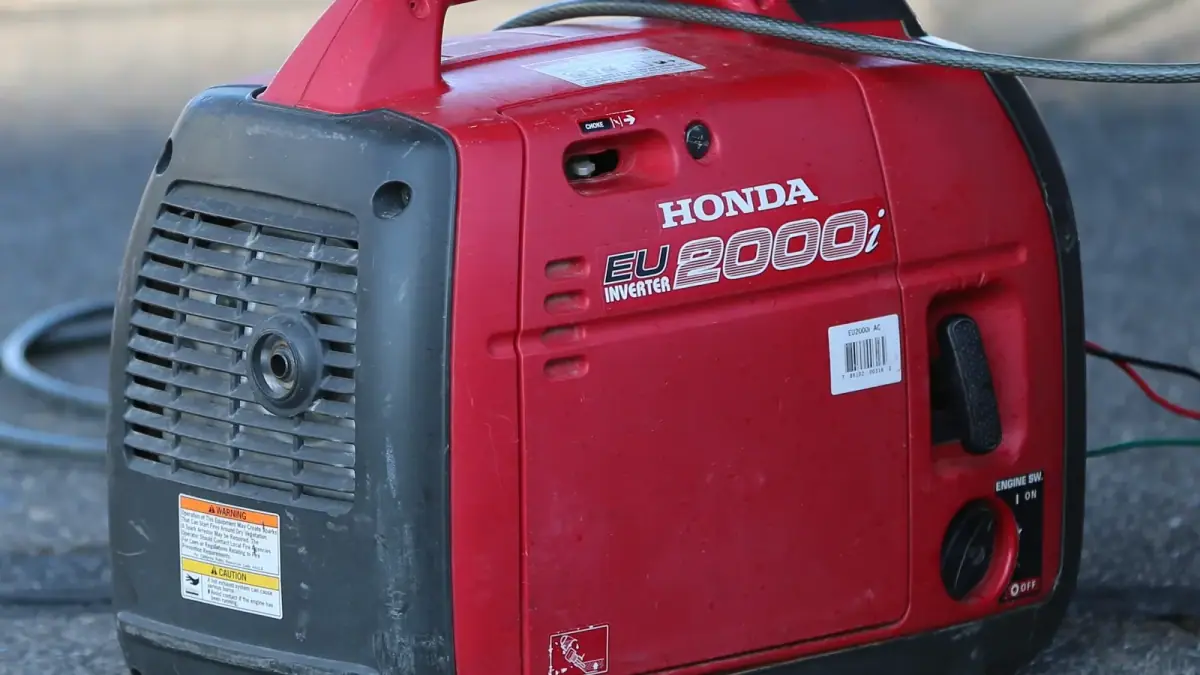
- 2,000 watts: Honda does not list an RV air conditioner among the EU2200i's applications, but does list one up to 13,500 BTU for the 3,200 W EU3200i.
- 30 amp RV: the cord carries about 3,600 W at most (calculated, 120 V times 30 A), so a larger generator buys start headroom, not more continuous power.
On this page (8)
Our picks
- Honda EU3200i inverter generator: Honda lists it for 13,500 BTU RV air conditioners; its 30 A outlet is a twist lock, so a TT-30 plug needs an adapter
- Honda EU2200i inverter generator: not listed by Honda for an RV air conditioner on its own; two in parallel give up to 4,400 W
- Champion 4500 watt dual fuel inverter generator (200988): 3,500 running watts on gasoline, 3,150 on propane; parallel ready
- Champion 50 amp parallel kit (100319): links two Champion inverters; read the kit manual on 240 V before you count on it
What size generator runs an RV air conditioner?
Champion's method in its own manual is three steps: list what runs at the same time, total their running watts, then add the single highest starting wattage among them. Champion's operator's manual also tells you to start loads one at a time, largest first, so only one thing is starting at any moment.
Two generator makers put numbers on the air conditioner question. Cummins Onan specifies the built-in QG 4000 on gasoline to start one 13,500 BTU air conditioner with a 2,000 W base load at 500 ft and 100°F (38°C), and the QG 5500 to start two 15,000 BTU units with a 1,000 W base load at the same conditions. Honda says the 3,200 W EU3200i can power 13,500 BTU RV AC units, while noting that not all of its listed applications run at once.
Dometic's footnote is worth reading before you trust any of this: its generator figures come from what owners have experienced in real installations, the whole RV's power use has to be added in, and generators lose output at altitude and from poor maintenance.
What your RV actually draws
| What you run | What the maker prints | Watts |
|---|---|---|
| Dometic Brisk II 13,500 BTU, running | 12.4 A compressor, 2.5 A fan at 115 V | about 1,700 W (calculated) |
| Dometic Brisk II 13,500 BTU, start | 68.0 A locked rotor | about 7,800 W (calculated, momentary) |
| Dometic Penguin II 13,500 BTU, start | 52.0 A locked rotor | about 6,000 W (calculated, momentary) |
| Coleman-Mach 3 Plus 13,500 BTU, cooling | 12.8 A | about 1,540 W (calculated); start not printed |
| Coleman-Mach 15 15,000 BTU, cooling | 13.9 A | about 1,670 W (calculated); start not printed |
| Furrion Chill 13,500 BTU, cooling | 1,340 W | 1,340 W; start not printed |
| Furrion FMAM11AA microwave | 1,500 W maximum rated input | 1,500 W |
| Norcold Polar fridge on 120 V | 300 W AC heater | 300 W |
| Progressive Dynamics PD9245C converter | 725 W input at full output | 725 W |
Amps from Dometic's 2021 rooftop manual and Coleman-Mach's Mach 3 Plus and Mach 15 product pages; watts from Furrion's Chill and microwave manuals, Norcold's Polar service manual and Progressive Dynamics' PD9245C page. Figures marked calculated are amps times volts, our arithmetic. Dometic's locked rotor amps are the compressor's stalled current at the instant of start, not a published "starting watts" rating.
Tip: Across the 13,500 and 15,000 BTU rows of that one Dometic table, compressor locked rotor current runs from 52.0 A to 73.0 A, so there is no single typical surge. Your own unit's rated and locked rotor amps are in its installation manual and on the model label under the shroud.
What a 30 amp or 50 amp RV can draw
Jayco's towable owner's manual describes a 30 amp RV as running on one leg of 120 volt power with a maximum current flow of 30 amps, which works out to about 3,600 W (calculated, 120 V times 30 A). A 50 amp RV runs on two legs of 120 volt power at up to 50 amps per leg, so about 12,000 W in total (calculated). Jayco names 120/240 volt generator power for the 50 amp system.
Outlets are where buyers get caught. Champion fits an RV outlet it calls a NEMA TT-30R, but on model 201531 that outlet is rated 27.1 A, not 30 A. Honda's EU3200i has a 30 A twist lock instead, which an RV's TT-30 plug does not fit without an adapter. For 50 amp service, Champion's parallel kit 100319 carries a 14-50R, and the maker's own documents disagree about it: the kit manual says 240 V AC is not available, while the inverter product page describes a 120/240 V 50 A outlet. Read the kit's manual before you count on 240 V.
Tip: Jayco warns that a 30 amp RV must be plugged only into a properly wired 30 amp TT-30 receptacle and never into 240 volt AC. The same caution applies to adapters at a generator: the cord and the RV's panel still cap you at 30 amps.
Soft starts and the compressor's surge
A soft start limits the current the compressor pulls at the moment it kicks in. Dometic's SmartStart manual says it reduces the starting current associated with the initial compressor startup, which reduces or eliminates flickering lights, brownouts and nuisance breaker trips, and rates the unit for a maximum of 15 starts per hour. Micro-Air says its EasyStart Breeze can cut start current by up to 75%.
Coleman-Mach claims up to a 75% cut in inrush amps and goes further than the others, saying a soft start also lowers power consumption while the air conditioner runs. That running claim is Coleman-Mach's alone among the sources here. No maker promises that a named generator will start a named air conditioner, and a soft start does nothing for a unit that cools poorly for other reasons, which is a separate problem.
Fitting a soft start means working inside the air conditioner's 120 volt electrical box. Dometic highly recommends a certified electrician for the job, and that is the right bar.
Inverter generator or open frame?
Inverter models are quieter and their makers publish a power quality figure. Champion's 201531 inverter is listed at 64 dBA from 23 feet with clean power under 3% THD; its 201279 open frame model is 68 dBA from the same distance, lists "Inverter: No" and publishes no THD figure. Honda puts the EU2200i at 48 to 57 dBA and says its inverter technology gives stable, clean power for computers and other sensitive equipment. Champion recommends UL1449 listed plug-in surge suppressors for sensitive electronics on any generator.
Two small inverters can be paralleled for more power: Honda lists up to 4,400 watts from two EU2200i units, using only a Honda approved parallel cable kit and only with the models it names. Champion's 200988 needs a kit too, model 100319. Overnight, many owners leave the generator off and run lights, a fan and a CPAP from the battery through an inverter sized for those loads.
Tip: Published noise figures are not comparable. Champion measures at 23 feet, Onan at 10 feet, and Honda's product page gives no distance at all. The number that governs in a national park is 60 dB(A) at 50 feet under 36 CFR 2.12, which Onan says its QG 4000 and QG 5500 meet.
Propane and altitude
| Model | Gasoline running watts | Propane running watts |
|---|---|---|
| Champion 200988 inverter | 3,500 W | 3,150 W |
| Champion 201531 inverter | 3,250 W | 2,925 W |
| Champion 201279 open frame | 4,250 W | 3,825 W |
| Onan QG 4000 | 4,000 W | 3,600 W (separate LP model) |
| Onan QG 5500 | 5,500 W | 5,500 W |
Figures from Champion's manuals and product pages and Cummins Onan's QG 4000 and QG 5500 spec sheets. The loss depends on the model, so there is no single propane percentage: Champion keeps starting watts at 4,500 on both fuels for those two inverters but drops them from 5,300 to 4,780 on the open frame, and Onan rates the QG 5500 the same either way. Honda's EU2200i and EU3200i are gasoline only.
Altitude costs output on every one of them. Champion prints a drop of about 3.5% for each 1,000 ft of elevation and says adjusting the engine cannot change it. Onan prints the same 3.5% per 1,000 ft, measured from a 500 ft baseline, plus 1% for every 10°F rise in temperature. Honda states about 3.5% per 1,000 ft as a horsepower loss and wants a dealer carburetor modification above 5,000 feet.
Running a generator safely
Honda states it plainly: generator exhaust contains carbon monoxide, breathing it can kill you in minutes, and the machine runs outside only, far from windows, doors and vents, at least 3 feet from buildings. Champion adds that a portable must never run inside any enclosure, including the generator compartment of a recreational vehicle, nor in the back of a camper, trailer or truck bed, and keeps 5 feet clear of objects for fire. CPSC's 20 foot figure is written for a house, not an RV; treating it as a campsite minimum is our advice, not a published rule.
CO shutoff features help but do not replace an alarm. Honda's CO-MINDER shuts the engine down before CO near the generator gets dangerously high, and Champion says its CO Shield is not a substitute for an indoor carbon monoxide alarm. Cummins Onan's RV manual says never sleep in the vehicle with the set running unless the vehicle has a working carbon monoxide detector.
The start and stop sequence the makers give:
- Check that the RV's carbon monoxide detector works (Jayco).
- Turn the air conditioners and other appliances off before starting (Jayco).
- Start the generator with no load and let it run a few minutes to stabilize (Champion).
- Switch on the largest load first, then the rest one at a time (Champion).
- Turn the air conditioners and large loads off before shutting it down (Jayco).
Where a park limits generator hours, as Joshua Tree does with three two hour windows a day, a battery bank topped up by solar panels covers the quiet gaps. Hours are set park by park, so check the campground you are booking.
One stop line, and it is ours rather than any maker's: wiring a generator into the RV's panel or fitting a transfer switch is a job for a licensed electrician or RV technician. Honda and Champion both say connections to a building's electrical system belong to a qualified electrician, and the isolation problem in an RV is the same.
Common questions
What size generator do I need to run my RV?
Total the running watts of everything you will run together, then add the largest single starting load, which is Champion's own method. For one 13,500 or 15,000 BTU rooftop air conditioner, Dometic's manual gives 3.5 kW as a minimum generator size and 5.0 kW for two units, described as a general guideline rather than a rating.
Will a 2,000 watt generator run my RV air conditioner?
Honda does not list an RV air conditioner among the applications for its 2,200 W EU2200i, while it does list one up to 13,500 BTU for the 3,200 W EU3200i. Soft start makers claim up to a 70 to 75% cut in starting current, and SoftStartRV names a Honda 2200 as an example, but no maker guarantees a given generator will start a given air conditioner.
Will a 5,000 watt generator run a 30 amp RV?
Yes, with headroom for the compressor's start, but the 30 amp RV itself is the limit on continuous power. Jayco describes the 30 amp system as one leg of 120 volts at a maximum of 30 amps, which is about 3,600 W (calculated). Note too that a generator's TT-30R outlet can be rated below 30 A, 27.1 A on Champion's 201531.
What size generator do I need for a 50 amp RV?
Jayco describes 50 amp service as two legs of 120 volts at up to 50 amps each, about 12,000 W in total (calculated), which no portable in these sources supplies. For two air conditioners, Onan specifies its built-in QG 5500 to start two 15,000 BTU units with a 1,000 W base load at 500 ft and 100°F (38°C), and Champion says its 100319 parallel kit with two of its inverters gives enough power to start and run two 15,000 BTU RV air conditioners.