Flooded lead-acid, sealed AGM lead-acid (absorbent glass mat, no water to add) and lithium iron phosphate are the three deep cycle types sold for RV house banks. What decides between them is how much of the rated capacity the maker lets you use, what the battery weighs, and how many cycles it is rated for.
RV Battery Types: Flooded, AGM and Lithium Compared
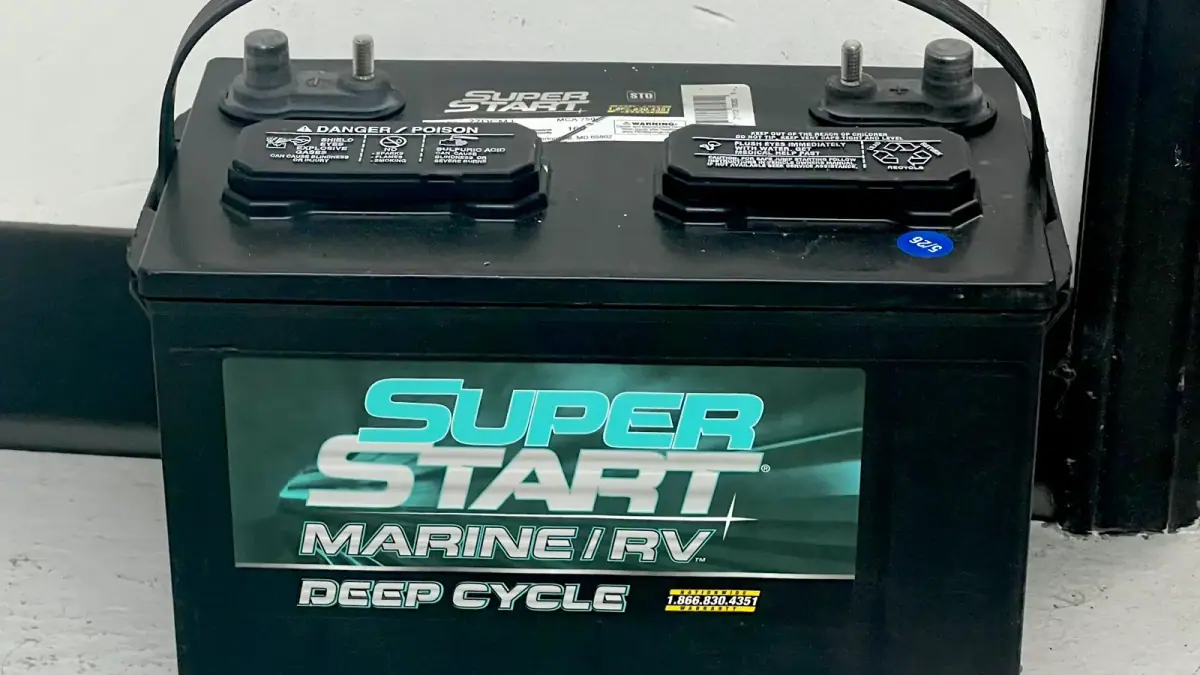
At a glance
- Usable capacity: lead-acid makers (flooded and sealed) advise an average discharge no deeper than half the rating, while Battle Born rates its 100 Ah lithium at 100% usable.
- Weight: Trojan's 105 Ah flooded group 27 weighs 55 lb; Battle Born's 100 Ah lithium weighs 31 lb.
- Swapping to lithium: the charging side has to match the chemistry, so a lead-acid converter may need reprogramming or replacing.
On this page (8)
Which battery type should you get?
Match the type to how you camp, not to the amp-hour number on the label. All three are deep cycle batteries, built for steady draw over hours rather than a short cranking burst.
- Flooded lead-acid: needs water topped up and a vented compartment, and you use about half the rating. Fine if you mostly plug in.
- AGM: sealed, no watering, can be mounted on its side. Trojan says to check that your charger has a VRLA (sealed battery) setting.
- Lithium iron phosphate: lightest, most of the rating is usable, longest cycle rating, and the only one that will not charge below freezing without a heater.
To run a microwave or residential fridge off the bank, the battery type decides how long it lasts, and the converter and inverter have to suit it.
Flooded, AGM and lithium side by side
These are the makers' own figures for one 12 V model of each type, all close to 100 Ah so the weights compare directly. A cycle figure means little without the depth of discharge it was measured at.
| Type | Usable capacity, as the maker states it | Named model and weight | Cycle life and the condition it was measured at |
|---|---|---|---|
| Flooded lead-acid | Trojan recommends 50% or less, with 80% the maximum safe discharge | Trojan 27TMX, 105 Ah at the 20-hour rate, 55 lb | No cycle figure published for the 27TMX; Lifeline's lithium sheet puts regular lead-acid at 300 to 400 cycles at 100% depth of discharge and 1,000 at 50%, a general comparison, not a rating of this model |
| AGM | Lifeline recommends an average no greater than 50% of the 20-hour rating; tolerates up to 80% repeatedly | Lifeline GPL-31T, 105 Ah at the 20-hour rate, 64 lb | Trojan validates its 31-AES at 1,200 cycles at 100% depth of discharge, and puts standard AGM at 400 at the same depth |
| Lithium (LiFePO4) | Battle Born lists usable depth of discharge of 100% | Battle Born BB10012, 100 Ah, 31 lb | Battle Born: 3,000 to 5,000 cycles, no test condition given; Renogy Pro Series: 5,000 cycles at 80% depth of discharge, 80% end of life |
Figures from the makers' product pages and data sheets, including Lifeline's lithium spec sheet.
A battery's life ends, in Lifeline's definition, when it holds only 80% of its rated capacity, the same end point Renogy uses. Heat shortens it: Trojan says life halves for every 18°F (10°C) above 77°F (25°C).
How much can you actually use?
Lead-acid gives back about half its label, because draining it deeply shortens its life. Trojan recommends using 20 to 50% of rated capacity for best life, and calls 80% the maximum safe discharge.
Lithium makers allow more. Battle Born rates its battery at 100% usable, with a low voltage disconnect at 10.5 V. Renogy allows 100% but quotes its cycle rating at 80%, so plan on 80% routinely.
Makers disagree on how big lithium's edge is. Lifeline says lithium of the same rating "effectively doubles" usable energy, because it holds 12 volts across the full rating. Progressive Dynamics, which builds converters, puts it at 2 to 3 times.
Can you just swap in lithium?
Physically, often yes; electrically, check the charger first. Lifeline calls its LL-12V100-24 lithium a drop-in fit for most lead-acid sizes, but the two chemistries charge at different voltages, and a lead-acid profile such as Trojan's, with an equalize step, is wrong for lithium.
- Battle Born's manual asks for 14.2 V to 14.6 V bulk, with equalization and temperature compensation turned off.
- Renogy specifies 14.4 V and charging equipment made for lithium iron phosphate only.
- WFCO's WF-8900-AD power centers detect the battery type and switch to a 14.6 V lithium profile themselves.
- Progressive Dynamics says its PD9200 is not directly compatible with lithium, and its PD9100L lithium converters must not be used on lead-acid batteries at all.
- Renogy says not to mix chemistries, capacities or brands in one bank, so a lithium upgrade means replacing the whole bank, not one battery of two.
Progressive Dynamics warns that a lithium converter with a higher DC amp rating than the old unit may overload the RV wiring, and says to disconnect all 120 VAC power before removing one. Stop there: replacing or rewiring the converter is a job for a licensed electrician or RV technician.
Cold weather
Lithium discharges in the cold but will not take a charge below freezing. Battle Born's current manual blocks charging under 32°F (0°C), while discharge continues down to -4°F (-20°C). Renogy's Pro Series manual also stops charging at 32°F and resumes at 37°F (3°C) or above.
Heated models move that limit. Renogy's Pro Series heater starts below 41°F (5°C) and needs a charge current above 4A per battery. Lifeline's lithium charges down to -4°F with its internal heating, and Battle Born's heated BB10012H switches on near 35°F.
Tip: Renogy's heaters run only while a charger feeds them, so on a cold morning a bank on solar panels alone may not charge until you run shore power or the generator.
Lead-acid is the reverse case: it charges in the cold, but a discharged flooded battery can freeze. Trojan puts the freezing point at about 16°F (-9°C) at 40% state of charge. Below 32°F, keep the charge above 60%, and never charge a frozen battery. AGM loses around 40% of its capacity at 0°F (-18°C), Lifeline says.
Upkeep
Only flooded batteries need regular attention. Trojan's instructions:
- Check water levels once a month until you learn how often your batteries need it.
- Add distilled water, never acid, and do not overwater.
- If the battery is discharged and the plates are exposed, add just enough water to cover them, then charge.
- Once fully charged, fill to 1/8 inch below the bottom of the vent well.
- Tighten the vent caps before every charge.
Charge them only in a well-ventilated area, away from sparks and flames, never in a sealed compartment. In storage they lose 5% to 15% a month, so Trojan advises a full charge every 3 to 6 months.
AGM needs no watering, but Lifeline still says not to install it in a sealed enclosure, because it can release hydrogen. For lithium storage, Battle Born recommends charging to 100% and disconnecting the battery completely.
Sizes: will it fit the box?
Measure the battery box before you order, because lithium does not always come in the lead-acid case. Lead-acid house batteries come in group 24, 27 and 31. The other common layout is a pair of 6 V golf-cart batteries such as Trojan's T-105 wired in series, and as Lifeline's technical manual puts it, series connection adds voltage while capacity stays the same.
Lifeline's LL-12V100-24 lithium is a group 24, but Renogy's Pro Series 100 Ah is a group 36R and its Core Mini a group 22NF.
Weight matters if you are near your payload limit. Four Trojan 27TMX at 55 lb each come to 220 lb; two Battle Born BB10012 at 31 lb come to 62 lb (calculated).
Common questions
Is a deep cycle battery good for an RV?
Yes, it is what the house bank needs. Lifeline rates its deep cycle AGM for up to 80% depth of discharge repeatedly, against under 25% for a typical starting battery, and Trojan lists RV service as a deep cycle use.
How long should an RV deep cycle battery last?
Makers rate life in cycles, not years, because it depends on how you use the battery: Trojan names depth of discharge, loads, maintenance, temperature and charging. Compare cycle figures only at the same depth of discharge.
Can I just replace my RV battery with a lithium battery?
Yes, if the box fits and your charger has a lithium profile. Replace every battery in the bank at once rather than adding one lithium.
What size deep cycle battery do I need for my RV?
Size it from usable capacity. Lifeline's rule for lead-acid: if your loads need 100 Ah, fit at least a 200 Ah battery. Lithium needs less spare rating, since Battle Born rates its battery at 100% usable.