Check each wheel by pulling and pushing the tire for play, spinning it for noise, and feeling the hub for heat after a drive. Then inspect and repack at your axle maker's interval, and replace a bearing, its race and the seal when they show wear.
Trailer Wheel Bearings: Checking, Repacking and When to Replace
Some links on this site are affiliate links: if you buy through them we earn a commission, at no extra cost to you. As an Amazon Associate we earn from qualifying purchases.
At a glance
- Bad bearing signs: too much play when you push and pull the tire, noise or bumpy turning, and pitting or flaking (spalling) on the rollers once the hub is off.
- How often: Dexter says every 12 months or 12,000 miles; Lippert says every 12 months or 36,000 miles, whichever comes first.
- Replace as a set: a worn bearing (the cone) and the ring it runs in (the cup) go together, and a seal that has been removed gets replaced.
On this page (7)
How do I know if my bearings are bad?
Most of the checks take a minute per wheel with the tire off the ground.
- Play. Pull the tire toward you and push it away. Dexter's service manual accepts slight end play; excessive end play calls for service.
- Noise or rough rotation. The wheel should turn freely and smoothly. Restriction, noise or bumpy rotation means a new bearing.
- Grease on the wheel. A slight weep from the seal area is normal to Dexter. Lippert says a hub that keeps weeping is not: grease on the magnets and braking surfaces cuts braking, so have the brakes checked.
- Pitting, spalling or corrosion. Visible once the bearing is out and washed. The cone and its cup are then replaced together.
- Cupping across the tread. Keystone's tire wear chart links cupping to loose bearings or wheel balance, so check the bearing adjustment and the wheel and tire balance.
A hot hub is a reason to stop, but it does not name the fault. TireMinder, a tire pressure monitor maker, says a high temperature alert above 167°F (75°C) is in most cases a sticking brake or an overheated bearing: get off the road carefully and find out which.
How often should they be repacked?
For most owners it is once a year; the mileage limits differ by maker.
| Maker | Interval | What it covers |
|---|---|---|
| Dexter (600 to 8,000 lb axles) | 12 months or 12,000 miles | Clean and repack bearings and cups |
| Lippert (2K to 7K axles) | 12 months or 36,000 miles | Bearing grease, bearing inspection, brake cleaning |
| Forest River (trailers, fifth wheels) | Yearly | Repack, and again after long storage |
| Grand Design (Influence fifth wheel) | Every 12 months | Lube bearings, brakes and hubs inspected by a technician |
From the Dexter and Lippert axle manuals and the Forest River and Grand Design owner's manuals. The breakaway switch and its cable need a check before every trip, not just at the yearly repack.
How do I repack them?
Do one wheel at a time and keep each hub's parts together. These are Dexter's steps, with Lippert's differences noted.
- Park on level ground and chock the tires. Lift by the frame at the trailer maker's jack points, never on the axle or suspension, and support the trailer on jack stands rated for the load. Never go under a trailer held up by a jack alone.
- Remove the wheel. Pry the grease cap off a little at a time around its flange, or unscrew it counterclockwise on an oil lube hub.
- Pull the cotter pin from the spindle nut (on E-Z Lube axles built after February 2002, gently pry off the retainer instead). Unscrew the nut and take off the washer.
- Pull the hub off without letting the outer bearing cone drop. The inner cone stays behind, held by the seal.
- Wash each cone in solvent, dry it with a lint-free cloth and inspect every roller. Pitting, spalling or corrosion means a new cone and cup.
- Remove all the old grease from the hub, the bearings and the spindle.
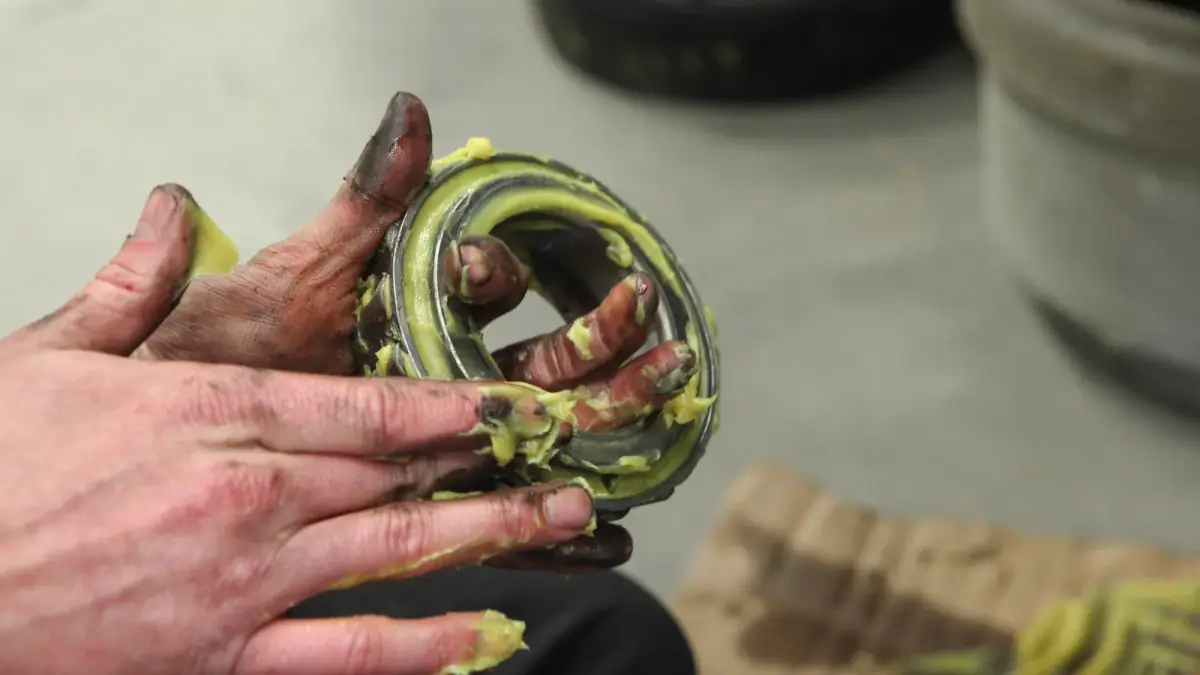
- Press the widest end of the bearing into a pile of grease in your palm, working roller to roller until it is full, then lightly grease the cup.
- Fit a new seal; a removed seal is always replaced. On E-Z Lube axles, fit it before pumping in any grease, or grease is far more likely to reach the linings.
- Refit the hub, washer and nut. Tighten to about 50 ft-lb while slowly turning the hub, loosen without turning the hub, finger tighten until just snug, then back off to the first castellation that lines up with the pin hole. Fit and bend a new cotter pin so only the pin holds the nut. On a Lippert axle, the loosening step after the 50 ft-lb is usually a quarter turn. Never tighten past finger tight.
- Refit the grease cap and plug, then the wheel.
Use a lithium complex NLGI No. 2 grease (Dexter's spec, dropping point at least 419°F (215°C)), and never mix grease types: if you change type, all the old grease comes out.
Tip: Never spin a bearing with compressed air to dry it. It damages the bearing, and bearing maker Timken adds that the rollers can be forcefully expelled.
Check the brakes while the hub is off
With the hub off, look at the brakes too, as Winnebago's towable manual advises at every repack. Dexter's manual lists what to check: the drum where the shoes contact it and, on electric brakes, the armature surface; the magnets for wear and current draw; the linings for wear or contamination. A current draw reading that is off points at the magnet or the brake controller feeding it.
E-Z Lube fittings and sealed hubs
E-Z Lube lets you grease the bearings without pulling the hubs, but Dexter says it does not replace the periodic hub-off inspection. Remove the rubber plug from the grease cap, seat a manual grease gun fully on the fitting in the spindle end, and pump slowly while turning the hub until clean grease comes out around the nozzle.
E-Z Lube axles are designed for immersion; on other axles, repack after each immersion. Sealed Nev-R-Lube hubs never need grease but are not made for immersion, and still get an inspection every year or 12,000 miles.
Which bearings do I need?
The part numbers are marked on the rings of the cone and cup you take out, so start there. If they are unreadable, Dexter's chart narrows it down from the brake size, hub size, bolt count and axle capacity.
| Axle capacity | Inner cup/cone | Outer cup/cone |
|---|---|---|
| 2K | L44610/L44649 | L44610/L44649 |
| 2.8K, 3K | LM67010/LM67048 | L44610/L44649 |
| 3.5K, 4K | L68111/L68149 | L44610/L44649 |
| 4.4K | L68111/L68149 | LM67010/LM67048 |
| 5.2K | 25520/25580 | LM67010/LM67048 |
| 6K (6 bolt), 7K (5 bolt) | 25520/25580 | 15245/15123 |
| 6K, 7K (8 bolt) | 25520/25580 | 14276/14125A |
| 7.2K | 25520/25580 | 02420/02475 |
| 8K | 25520/25580 | 02420/02475 |
Industry cup and cone numbers from Dexter's bearing replacement chart, which is also keyed by brake and hub size, so confirm against your own parts. Replace only with bearings from that chart, always as a cone and cup set. On a Lippert axle the numbers are in its manual, and the bearings are sold at auto parts stores.
Tip: Replacing a cup is a different job from replacing a cone. The cup must seat fully against the retaining shoulder or the hub can be damaged, so Lippert asks owners to consult the company and have a certified service center do it.
Common questions
How do I know what wheel bearings my trailer needs?
The part numbers on the old cone and cup, or your axle's line in Dexter's chart or the Lippert manual. Buy them as a matched set.
How do I know if my trailer wheel bearings are bad?
Lift the wheel and check for play, rough turning and noise; excessive play or any noise means a new bearing. Cupped tread wear and grease on the wheel face are secondary clues.
How often should trailer wheel bearings be replaced?
Neither Dexter nor Lippert gives a replacement mileage. Bearings are replaced on condition, when the inspection finds pitting, spalling, corrosion, flat spots or discoloration; it is the grease that runs on a fixed interval.
Are trailer bearings easy to replace?
Cleaning, packing and resealing is owner-level work with jack stands, a torque wrench and new cotter pins. Take care: Dexter warns that bearing damage can let the wheel end come off the axle.