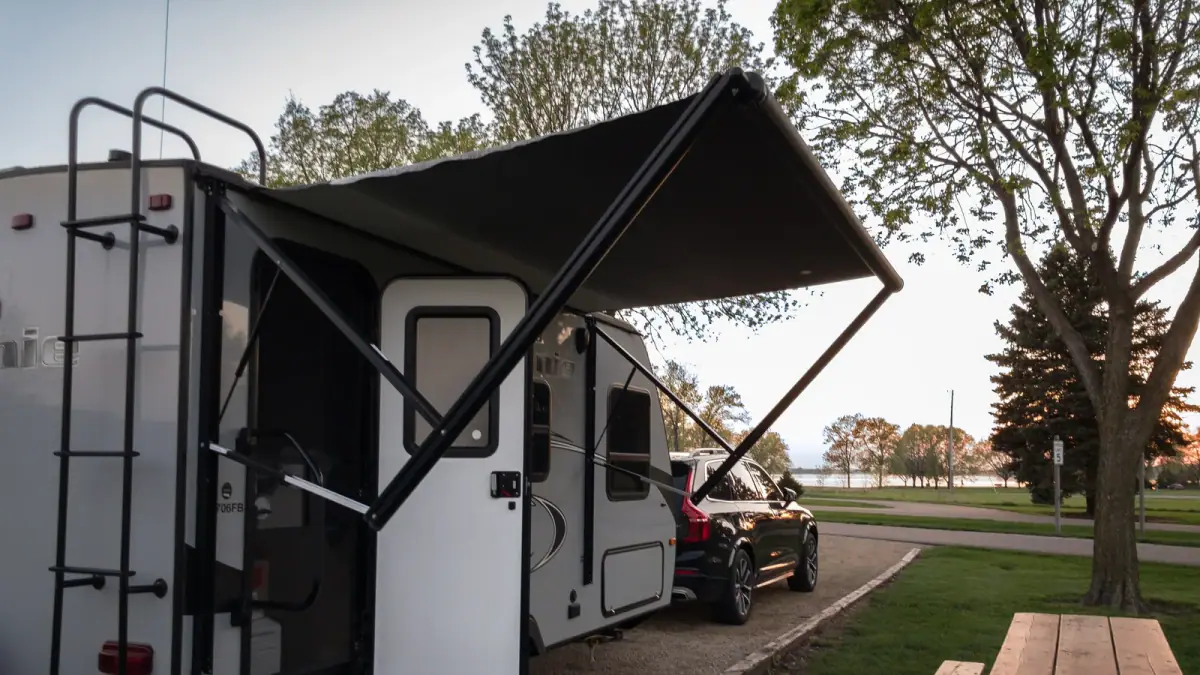
An RV patio awning is a sheet of fabric on a roller tube, held out over the campsite by two arms. A manual awning opens with a crank or a pull rod; most power awnings run on a 12 V motor and a switch. Every maker tells you to roll it up in wind and heavy rain.
RV Awnings Explained: Manual vs Power, Fabric, Wind Limits and Size
At a glance
- Manual or power: manual awnings use a crank or a pull rod, power awnings usually a 12 V motor, and most power models stop wherever you release the switch.
- Wind and rain: no maker gives a wind speed the awning can take, and all of them say to retract it before wind or heavy rain and never leave it out unattended.
- Size: awning size is measured from the center of one arm to the center of the other, and the fabric itself comes about 10 inches shorter than that number.
On this page (6)
Manual or power: what is the difference?
Both types use the same fabric and roller tube; what differs is how you turn the tube and whether you need travel locks on the road.
Manual awnings come in three common arrangements:
- Geared crank. On the Dometic Sunchaser 8500 and 9000, you turn the crank clockwise to extend. A cordless drill works, but no faster than 2 revolutions per second (120 RPM), and never an impact driver.
- Pull rod with a cam lock. On the Lippert Solera Classic you flip the cam lock to the roll-out position and pull the awning out with the rod, against a spring-loaded roller tube.
- Crank with no spring. Carefree's Pioneer has no springs, and the crank itself holds the awning against billowing during travel.
Most power awnings run from the RV's 12 V system, so check that the battery is charged and connected before extending, as Lippert's Solera Power Awning manual says. Carefree's Mirage is the exception: a 110 V motorized model.
The switch is usually hold-to-run, and the awning stops wherever you let go. Carefree's Altitude uses a worm-gear drive, so it needs no travel locks. Jayco notes that most power awnings have a manual override for an awning that will not retract.
Vinyl or acrylic fabric?
Vinyl keeps water out completely; acrylic breathes and is lighter, but it is only water repellent.
Carefree describes its vinyl canopies as 4-ply with a vinyl Weatherguard, so water will not soak through.
Acrylic is a woven cloth that lets air pass through it. Do not touch the underside while it is wet: that breaks the surface tension and water seeps through.
Cleaning rules differ by maker, so follow the one who built your awning:
- Dometic, vinyl: 1/4 cup dish soap and 1/4 cup bleach in 5 gallons of fresh water, soak five minutes, then rinse completely, because bleach left on the fabric degrades it.
- Dometic Sunchaser 8500 / 9000, woven acrylic: no detergent. The residue attracts dirt and lets the fabric absorb water.
- Carefree: a natural soap, never detergent, water no hotter than 100°F (38°C), air dry only, and no oil based, caustic or abrasive cleaners.
- Lippert: 1/4 cup of dish soap in five gallons of warm water, for vinyl or woven acrylic.
Dometic says never to store the awning wet; if you had to, roll it out to dry as soon as you can. Carefree allows rolling acrylic up wet but does not encourage it. Mildew grows on the dirt on the fabric, Lippert notes, so keep it clean.
How much wind and rain can it take?
No awning has a published wind rating, so retract it before weather arrives and never leave it out unattended.
| Awning | Manual or power | What the maker says about wind |
|---|---|---|
| Dometic Sunchaser 8500 / 9000 | Manual crank | Never leave an open awning unattended; keep it stowed when snow, heavy rain, wind or severe weather is expected |
| Dometic 9100 | Power | Stow it whenever heavy rain or snow is expected; do not let water pool, snow build up or heavy debris sit on the fabric |
| Carefree Pioneer | Manual crank | Roll up and secure the awning if wind or extended rain is expected |
| Carefree Altitude | Power, 12 V | The effects of wind and rain are unpredictable and can cause severe damage; roll it up for wind or extended rain, and retract it when leaving the RV |
| Lippert Solera 3000 Series | Power, 12 V | The awning must be retracted completely during high wind, heavy rain or any extended time away from the unit |
Sources: the Dometic 9100 operation manual, the Carefree owner's manuals and the Lippert Solera 3000 Series owner's manual.
For light rain, tilt the awning so water runs off. Dometic says to lower the arm farthest from the entry door until the awning slopes roughly 10 degrees, or at least 9 inches below the other arm. Heavy rain or snow means stow it.
Tip: If water has already collected on top, Carefree's Altitude manual says to retract in 8 to 12 inch steps to dump it, which keeps the fabric from stretching. Lippert warns that a self-purging awning can dump a lot of water without notice, so push the water off with a broom first.
Auto-retract sensors, such as Carefree's BT motion sensor and Lippert's Smart Arm, react to the awning moving, and Carefree says none is a guarantee against severe weather.
Tip: On a Carefree Altitude with the BT12 control, auto-retract works only while the power switch is ON. Switch it off with the awning out and it is not protected. With low sensor batteries, the awning beeps every 30 seconds and partially retracts until they are replaced.
What size awning do you have?
Your awning size is the distance between the arms, not the width of the cloth.
Lippert's QR-113 reference gives the method: with the awning closed, mark the center of both support arms and measure between the marks. Ten feet between arms is a 10 ft awning.
Sizes run in one-foot steps, 10 ft to 21 ft for Lippert Solera replacement fabric and 8 ft to 21 ft for a Carefree Pioneer Lite. The model number is on the awning's data tag, Dometic says. Ordering is covered under replacing the fabric.
Tip: An 18 ft awning does not carry 18 ft of fabric. Carefree and Lippert both make the canopy 10 inches shorter than the awning size, so a 10 ft order measures 9 ft 2 in. Order by arm spacing, never by the cloth you measure.
Slide toppers and window awnings
Slide toppers and window awnings are separate products with their own hardware.
A slide topper covers a slide-out room. Some drips under it are normal, Dometic says, so it works alongside the slide-out seals rather than instead of them. Carefree's Marquee window awnings have a sealed 12 V motor and 36 inches of extension. Arm and roller tube hardware is work for a qualified service technician.
Common questions
How do I know what size awning my camper needs?
The arm spacing on your RV already sets it, so you measure rather than choose. Lippert says the arm centers must match the size ordered exactly, and Carefree awning orders are custom and non-returnable.
Is a power awning worth it over a manual one?
It saves cranking, and on worm-gear models like the Altitude it saves fitting travel locks. The trade is dependence on the battery, so check that yours has a manual override for the day the motor does not run.
How much wind can an RV awning handle?
No maker gives a mph figure for the awning itself. The only numbers are sensor settings, such as the Carefree Eclipse sensitivities of approximately 6, 9 and 12 mph on a 2009 model, and those are trigger points, not a rating.
Can I leave my RV awning out in the rain?
Girard says its awnings may be used in light wind and rain, and Dometic allows light rain with one arm lowered. Keystone recommends retracting in any rain, and Winnebago says weather damage is not covered under warranty by Winnebago or the awning maker.