Travel trailers and fifth wheels run ST (special trailer) tires; larger motorhomes run commercial truck radials. The size, load range and cold inflation pressure your RV needs are printed on its tire placard, and RV tires are replaced by age as well as by tread wear.
RV and Trailer Tires: ST vs LT, Load Range, Pressure and Age
At a glance
- What to buy: ST tires for a towable, commercial-size radials for a larger motorhome, in the size on the RV's own placard.
- Pressure: set cold, from the placard or the tire maker's load and inflation table, not from a hot tire.
- Age: no legal limit exists; Michelin says replace at 10 years from the date code, Keystone says 6 to 10.
On this page (6)
Are trailer tires different from truck tires?
Yes, and the letters in front of the size tell you which kind you have. ST means Special Trailer, LT means Light Truck, P means passenger. Carlstar, which builds Carlisle trailer tires, says passenger and light truck tires are not designed for trailer use: their more flexible sidewalls can lead to sway, while the stiffer ST sidewall is built to control it.
Larger motorhomes are a different family again, running 19.5 inch and 22.5 inch commercial radials.
| Tire type | What makers fit it to | What the maker says |
|---|---|---|
| ST (special trailer) | Travel trailers, fifth wheels, toy haulers, boat and utility trailers | 65 mph unless the sidewall carries a higher speed symbol; 62 mph if there is no symbol at all |
| LT (light truck) | Pickups and tow vehicles; makers disagree about trailers | Carlstar says not designed for trailer use; Dexter accepts LT on a trailer at the capacity molded into the tire |
| Motorhome radial | Class A and larger motorhomes, 19.5 and 22.5 inch wheels | Michelin XRV 235/80R22.5 load range G: 75 mph, 4,675 lb single at 110 psi |
Sources: Carlstar and the 2027 Jayco towable manual (speeds), Dexter's axle service manual (LT), Michelin's RV tire guide (motorhome).
The sidewall of your own tire settles the speed question. In Winnebago's 2026 towable manual example, an ST225/75R15 load range E with speed symbol N is rated for 87 mph and 2,830 lb at 80 psi. Read the symbol on the tire you actually have.
Tip: Federal rule FMVSS 110 says the maximum load ratings of the tires on an axle must add up to at least that axle's GAWR. Passenger car tires on a trailer count at their rating divided by 1.10; Dexter counts LT and ST tires at their molded rating.
What load range and pressure do you need?
Buy the size and load range on the RV's Tire and Loading Information placard, and set the pressure it gives with the tires cold. On a trailer the placard sits next to the certification label, usually on the left front exterior. The cargo weight figures on that label are a separate question, covered on the payload capacity page.
Load range describes how much weight a tire carries and how much air it holds, not a count of plies. Each letter has a pressure that goes with its maximum load.
| Load range | Ply rating | Pressure at max load |
|---|---|---|
| C | 6 | 50 psi |
| D | 8 | 65 psi |
| E | 10 | 80 psi |
| F | 12 | 95 to 100 psi |
| G | 14 | 110 psi |
| H | 16 | 120 to 125 psi |
Table from the 2027 Keystone owner's manual.
Cold means the RV has sat three hours or more, or been driven less than a mile. A hot tire can read 6 psi higher on Jayco's figures, and 10 to 15 psi higher on Goodyear's. Check at least monthly, including in storage, and before and after trips.
Set every tire on an axle to the pressure the most heavily loaded one needs; Goodyear says each 1 psi of underinflation costs roughly 20 to 30 lb of load capacity per tire. On a motorhome, Michelin recommends weighing each wheel position and setting each axle from its heavier end. Goodyear counts a tire that has lost more than 20 percent of its recommended pressure as flat; it comes off for inspection.
Tip: Most makers point you to the placard or the load and inflation table for your actual weight, not to the sidewall maximum. Carlstar is the exception and tells owners to run the maximum psi molded on the sidewall, so if your tires are Carlisle, follow Carlstar.
How old is too old?
Age, not tread, usually retires an RV tire, so start with the date code. The last four digits of the DOT Tire Identification Number give the week and year of manufacture: 0308 means the third week of 2008. NHTSA notes the number may be on only one sidewall, so check both sides.
The makers differ, and no law sets a limit:
- Michelin: replace any tire 10 years or more from its date code, spares included, and have tires in service 5 years or more inspected yearly by a tire specialist.
- Keystone, and the makers NHTSA cites: replacement between 6 and 10 years, regardless of tread depth. NHTSA names RV owners and low-mileage drivers as the most exposed to aging.
- USTMA, the tire makers' trade group, knows of no technical data setting a maximum service life.
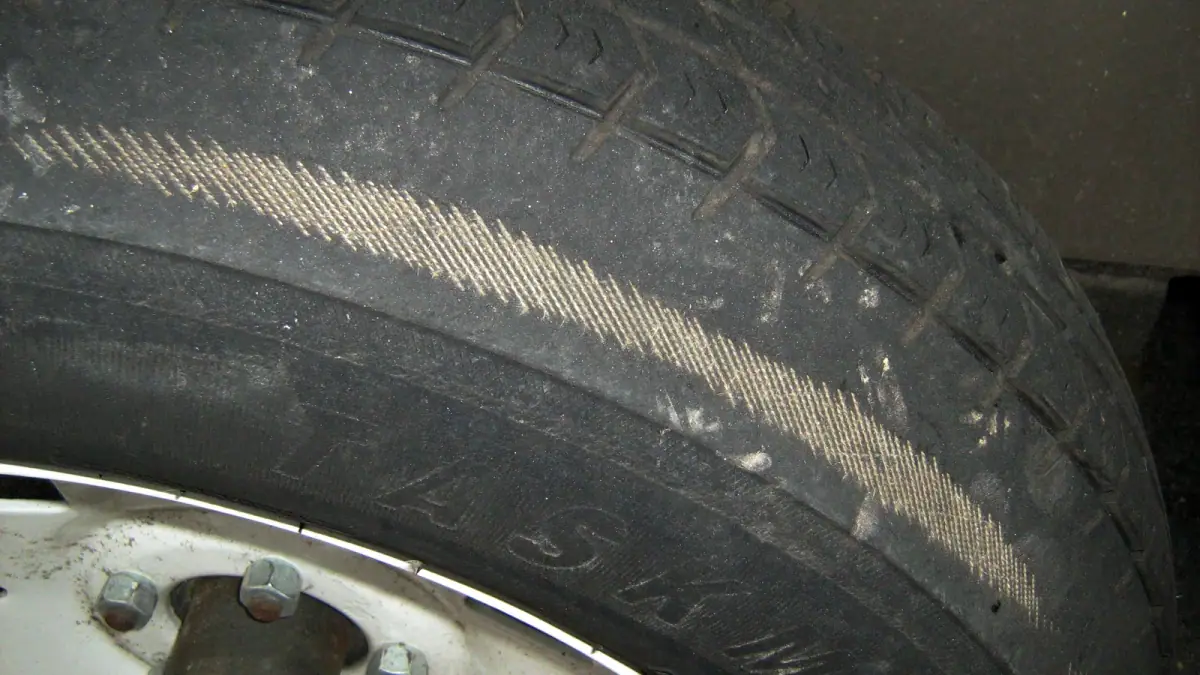
Tread depth is a poor guide on a trailer. Carlstar says long stretches under static load break down the carcass in a way you cannot see from outside, and NHTSA says aging cannot be detected by looking at a tire.
Still, stop using a tire with cuts, bulges, cracking, irregular wear from underinflation or overloading, or unusual noise and vibration. Michelin accepts sidewall cracks shallower than 2/32 inch; anything deeper is a job for a tire dealer. Skip sidewall dressings containing petroleum, alcohol or silicone, which speed up cracking.
Tip: Treat the date code as a prompt to inspect and budget, not as an expiry date someone will enforce.
Do you need a TPMS?
The law does not require one on a trailer, but a monitor gives early warning of a slow leak or a hot wheel. FMVSS 138, the tire pressure monitoring standard, covers vehicles of 10,000 lb GVWR or less, which means your tow vehicle from model year 2008 on, and does not name trailers.
An aftermarket RV system watches pressure, and often temperature, at each wheel while you drive. TireMinder's A1A, for example, flags a blowout when a tire loses 3 psi or more in under 2 minutes, and high temperature above 167°F (75°C). A hot-tire alert can also mean a dragging brake or an overheating wheel bearing.
A monitor does not replace manual checks, and Jayco notes it may not warn of sudden damage or a blowout caused by something outside the tire.
Storage and tire covers
A parked RV's tires age from sunlight, heat and ozone faster than from miles. Keep the RV and spares away from radiators, other heat sources and electric motors, which give off ozone. Michelin's routine: wash the tires with soap and water, put plywood, plastic or a rubber mat between each tire and the ground, cover the tires if the RV sits outside, and inflate to the sidewall maximum. Past three months, consider a monthly hour-long highway drive, because a loaded tire that never moves ages early. Leveling blocks work as that barrier too, keeping rubber off hot asphalt.
Common questions
Are trailer tires and RV tires the same?
No. "RV tire" covers both the ST tires on a travel trailer or fifth wheel and the commercial truck radials on a larger motorhome. Match the prefix and size on your own placard, not the category name.
How many years do RV tires last?
Plan on 6 to 10 years from the date code, even with good tread left; Michelin's cutoff is 10. Budget for a set well before then if the RV spends long stretches parked.
Can I put LT tires on my travel trailer?
Carlstar says no, Dexter says yes at the capacity molded into the sidewall. If you fit them, the tires on each axle must still add up to that axle's GAWR.
What pressure should my RV tires be at?
The cold pressure on your RV's placard, or the tire maker's table figure for what that axle actually weighs. Check it before the day's first mile, with every tire on an axle at the same pressure.