A drop hitch is a ball mount whose ball platform sits below the top of the receiver, so a trailer that rides nose-down can be towed level. To find how much drop you need, measure the difference between the top inside of your receiver opening and the bottom of your trailer coupler.
Drop Hitches: How Much Drop You Need and the Rating That Counts
Some links on this site are affiliate links: if you buy through them we earn a commission, at no extra cost to you. As an Amazon Associate we earn from qualifying purchases.
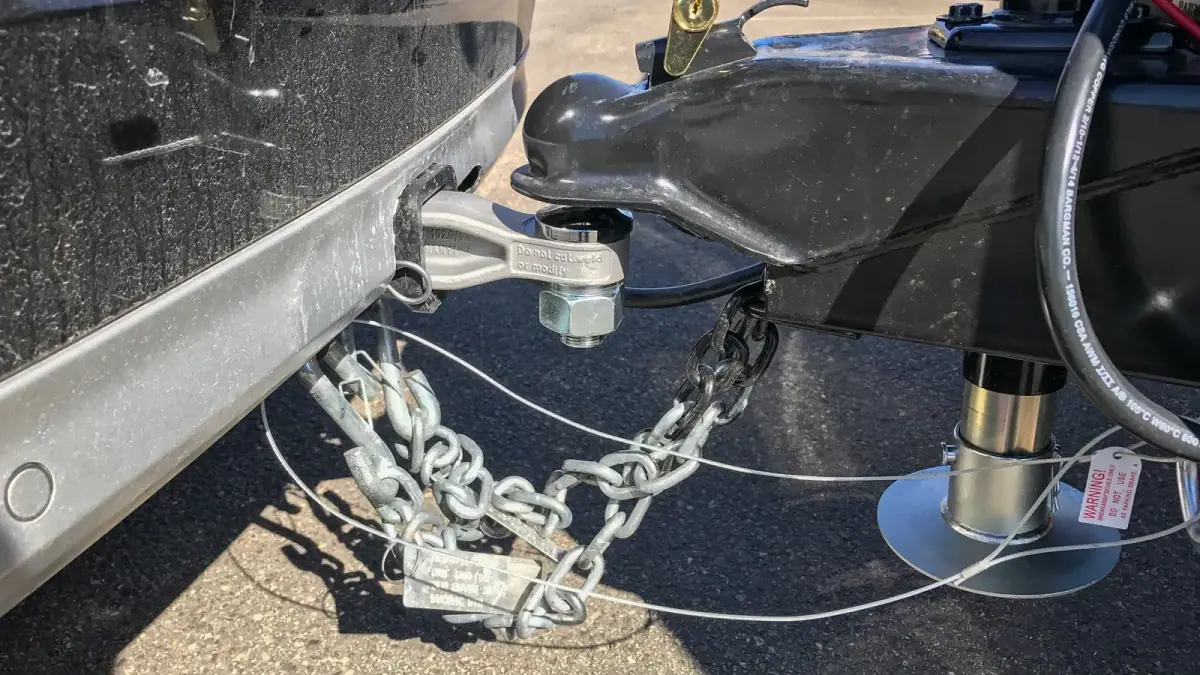
At a glance
- Your number: ground to the bottom of the coupler, minus ground to the top inside of the receiver, with truck and trailer level.
- Lifted trucks: B&W says a lift kit or oversized tires may call for a 5, 7 or 9 inch drop instead of its usual 3 inch.
- The rating that counts: the lowest of the mount, ball, receiver and vehicle, and some mounts are rated 5,000 lb in receivers rated far higher.
On this page (7)
Our picks
- B&W Tow & Stow, 2 inch receiver, 2 and 2-5/16 inch balls, 5 inch drop: 10,000 lb; turns upside down for rise
- Weigh Safe adjustable ball mount with built-in scale, 2 inch receiver, 4 inch drop: 12,500 lb; the draw bar is 3 inches longer than the listed drop
- Gen-Y Mega-Duty 10 inch drop ball mount, 2 inch receiver, 10,000 lb: for lifted trucks; Gen-Y designs it for drop or rise
Do you need a drop hitch?
You need one if your trailer's coupler sits lower than the top of your receiver opening when both are level. If it sits higher, you need rise instead, which is often the same part turned upside down.
Towing level matters. GM's 2026 Silverado and Sierra towing supplement says a trailer out of level loads its axles, springs and tires incorrectly and can lead to sway, trailer damage or a tire blowout, and tells owners not to tow one. There is no standard hitch height, so the drop you need is specific to your truck and that trailer.
How much drop do you need?
Two measurements give you the number, following CURT's and Gen-Y's method.
- Park the truck and the trailer on level ground, with the trailer itself sitting level.
- Measure from the ground to the top of the inside of your hitch receiver opening.
- Measure from the ground to the bottom of the trailer coupler.
- Subtract the receiver figure from the coupler figure. If the coupler is lower, that difference is the drop you need; if it is higher, it is the rise.
- Check what is left underneath: both B&W and Weigh Safe recommend at least 11 inches from the lowest part of the installed hitch to the ground.
Before you order a Weigh Safe, know that each of its draw bars measures 3 inches longer than its listed drop, so an 8 inch drop takes 11 inches of the gap under the truck.
Lifted truck: B&W says the 3 inch Tow & Stow suits most vehicles, but a pickup with a lift kit or oversized tires may need a 5, 7 or 9 inch drop. Measure before you buy a second mount, because the deepest mounts eat ground clearance.
Adjustable or fixed?
Buy fixed if you tow one trailer, adjustable if you tow several with different coupler heights.
A fixed mount is one piece with one drop, so you pick the one that matches your measurement. An adjustable mount moves, and CURT suggests one if you tow different trailers. B&W changes height by pulling two pins and Gen-Y's stacked tube pins to a new position without tools. Weigh Safe slides a ball along the draw bar and locks it with a key.
| Mount | Rating as printed | Drop |
|---|---|---|
| CURT Class 3 fixed, hollow shank | 7,500 lb / 750 lb | 2 in. or 4 in. |
| CURT Class 3 fixed, hollow shank | 5,000 lb / 500 lb | 8 in. or 10 in. |
| CURT Class 4 fixed, hollow shank | 10,000 lb / 1,000 lb | 2 in. to 8 in. |
| Draw-Tite 2793 fixed, Class III | 5,000 lb / 500 lb | 8 in. |
| Draw-Tite 40345 fixed, Class IV | 6,000 lb / 600 lb | 4 in. |
| Reese 21141 adjustable | 5,000 lb / 500 lb | 4-1/2 in. to 7-1/2 in. |
| B&W Tow & Stow, 2 in. shank, 2-5/16 in. ball | 10,000 lb / 1,000 lb | 3, 5, 7 or 9 in. |
| Weigh Safe, 2 in. shank, 2-5/16 in. ball | 12,500 lb / 1,500 lb max tongue | 4, 6, 8 or 10 in. |
| Gen-Y MEGA-DUTY 10K, 2 in. receiver | 10,000 lb / 1,500 lb | 5 in. to 22.5 in. drop or rise |
Gross trailer weight and tongue weight from the CURT catalog, Draw-Tite, the Reese 21141 sheet, B&W's owner's manual, Weigh Safe and Gen-Y. Ratings apply to the ball shown; smaller balls on multi-ball mounts carry less.
A deeper drop lowers the rating in some lines and not others. CURT's Class 3 line loses rating at depth, while CURT's Class 4 line holds 10,000 lb at every drop. Read the figure for the part number you are buying.
Can you use a drop hitch as a rise?
Some mounts flip for rise and some do not, so check your mount's document.
- CURT: not every model can be used in rise, and some are rated lower, such as its 8 and 10 inch Class 3 mounts at 3,500 lb / 350 lb. Its AlumaLite adjustable mounts are drop only.
- Reese 21141: 5,000 lb / 500 lb in drop, 3,500 lb / 350 lb in rise, and one extreme position is for storage only, not towing.
- B&W: the Tow & Stow turns upside down for rise, with no separate rise rating.
- Weigh Safe: every mount inverts for rise and gains 1 inch, so a 4 inch drop gives 5 inches of rise, with no separate rise rating.
- Gen-Y: the BOSS, MEGA-DUTY and PHANTOM mounts are designed and tested for drop or rise.
Reese adds that raised balls usually have reduced load ratings, and the ball's own rating must equal or exceed the trailer's GVWR.
Is a drop hitch safe at your trailer's weight?
Your limit is whichever part is rated lowest: mount, ball, receiver or vehicle.
Draw-Tite, CURT and Weigh Safe each state this rule, and it makes the mount easy to overlook. A Draw-Tite mount listed as Class IV is rated 6,000 lb / 600 lb, while CURT lists Class 4 receivers at up to 10,000 lb. It works the other way too: a 10,000 lb hitch on a truck rated 8,000 lb can still tow only 8,000 lb.
Where the numbers live: Gen-Y is the only maker here that says where its rating is marked: stamped on top of the ball with ball size and maker name. On the truck side, Ford labels each factory receiver, GM puts the tongue rating on the trailering label on the driver side center pillar, and Ram stamps it on the fascia or hitch. Check yours before you trust a catalog figure.
Two habits makers ask for: never hook the safety chains to the ball mount, as CURT and Weigh Safe state, and pull the mount out when you are not towing. Reese says this keeps a deep drop off driveway ramps and limits damage in a rear end collision.
Weight distribution hitches do not use a drop mount
A weight distribution hitch gets its drop or rise from its own shank and head, not from a ball mount, and B&W says such systems are not compatible with the Tow & Stow.
Common questions
What is a drop hitch for?
It lowers the ball so a trailer whose coupler sits low tows level instead of nose-down. CURT describes a ball mount as the part that makes up the difference in hitch height between vehicle and trailer.
How do I know how much drop I need?
Gen-Y and CURT both call the difference between coupler and receiver heights the approximate drop needed, so pick the mount closest to it. A lift, bigger tires or a new trailer changes that number, so measure again after any of them.
Can you use a drop hitch as a rise?
Only if its maker says that model can be inverted. Check whether a lower rise rating applies, as it does on the Reese 21141.
Are drop hitches safe?
Used within their printed ratings and with the trailer level, yes. CURT warns that without a level connection the trailer may wander or sway and the driver can lose control. NHTSA's towing safety page covers the wider checks.