Hitch classes 1 to 5 are a rough industry grouping by receiver opening size and rating range, and they overlap. The figure in pounds on the hitch's own label is what counts, and the lowest-rated part of the chain, truck included, sets what you can actually pull.
Trailer Hitch Classes and Receiver Sizes: Class 1 to 5 Explained
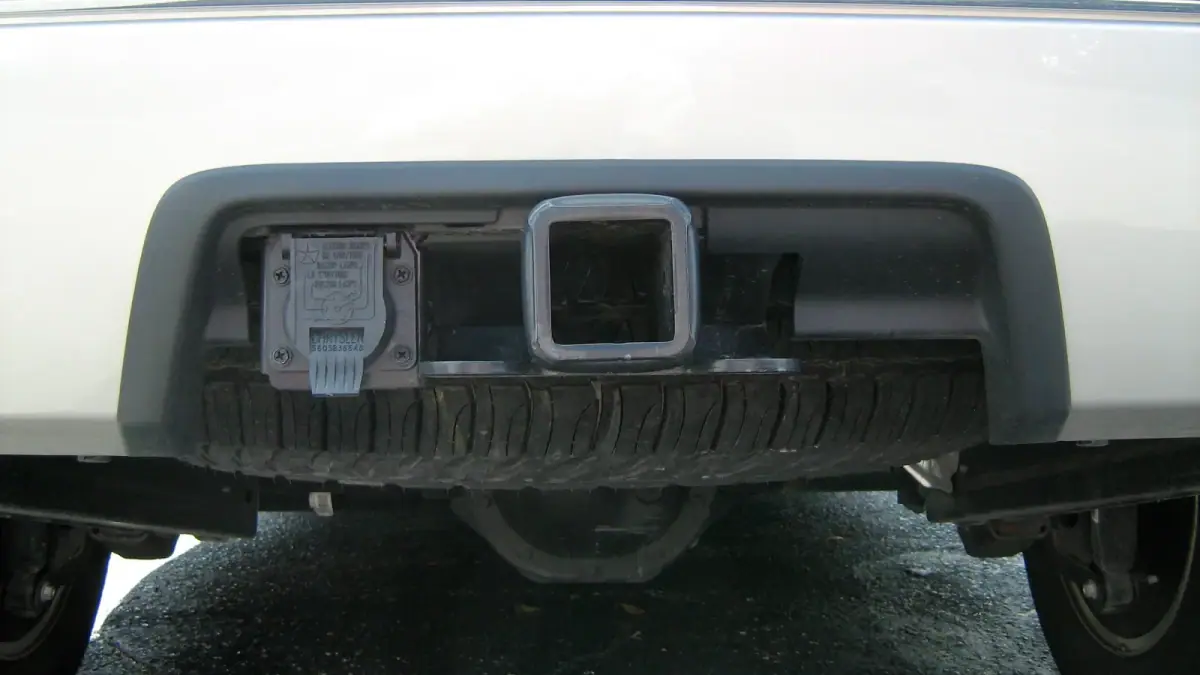
At a glance
- What the class tells you: the size of the square opening and a rough rating band, nothing more. Class 3, 4 and 5 can all use a 2 inch opening.
- What counts: the trailer weight and tongue weight printed on the hitch itself, which vary from one part number to the next.
- What sets your real limit: the weakest rated part in the system, and that is often the truck rather than the hitch.
On this page (7)
What hitch classes 1 to 5 actually mean
CURT, one of the larger hitch makers, states in its aftermarket product catalog that its custom hitches are broken into five classes based on receiver tube size and weight ratings, that ratings vary by part number within a class, and that each hitch is always limited by the lowest-rated towing component. That is the whole idea: a class is a shelf to group products on, not a legal rating.
Two numbers appear for each class. Weight carrying is what the hitch is rated to tow with the trailer's tongue sitting straight on the ball. Weight distributing is what it is rated to tow with a weight distribution system fitted.
| Class | Receiver opening | Weight carrying | With weight distribution |
|---|---|---|---|
| Class 1 | 1-1/4 in. | Up to 2,000 lb / 200 lb tongue | Not rated |
| Class 2 | 1-1/4 in. | Up to 3,500 lb / 350 lb tongue | Not rated |
| Class 3 | 2 in. | Up to 8,000 lb / 800 lb tongue | Up to 12,000 lb / 1,200 lb tongue |
| Class 4 | 2 in. | Up to 10,000 lb / 1,000 lb tongue | Up to 12,000 lb / 1,200 lb tongue |
| Class 5 Xtra Duty | 2 in. | Up to 17,000 lb / 2,550 lb tongue | Up to 17,000 lb / 2,550 lb tongue |
| Class 5 Commercial Duty | 2-1/2 in. | Up to 20,000 lb / 2,700 lb tongue | Up to 20,000 lb / 2,700 lb tongue |
Figures from CURT's catalog class comparison chart, which notes that ratings vary by part number and are limited to the vehicle maker's stated capacities.
Other makers draw the bands differently, and so does CURT elsewhere: its Class 3 web page gives up to 10,000 lb and 1,000 lb of tongue weight, and its Class 4 page gives weight distribution up to 14,000 lb. Plenty of hitches are rated well below their class, too: the Draw-Tite 76638, a Class 3 for the Subaru Solterra, is rated 2,000 lb, and Ford's Maverick tow package carries a Class III receiver rated 4,000 lb. Use the label, not the band.
Tip: Anything you bolt between the receiver and the ball can become the weak link. CURT warns that receiver adapters and extenders reduce tongue weight or vertical load capacity by 25% for products under 12 inches and by 50% for products over 12 inches.
How to tell which class you have
Read it off the hardware rather than guessing from the size of the hole.
- Look on the receiver itself for the capacity label. Ford states that a label affixed to each factory hitch receiver gives both the weight-carrying and weight-distributing capacities. Ram words it differently and tells owners never to exceed the maximum tongue weight stamped on the fascia, bumper or trailer hitch.
- If the hitch is aftermarket, find the part number on the label or sticker and pull up the maker's product page or installation sheet. Those sheets print the trailer weight and tongue weight as a small table.
- If there is no readable label, measure the inside of the square opening. CURT says the "2 inch" in a 2-inch receiver refers to the inside dimension of the square opening where the ball mount goes.
Measuring only narrows it down. A 1-1/4 inch opening means Class 1 or 2; 2 inches means Class 3, 4 or 5; 2-1/2 inches means Class 5. Ford also fits a 3 inch receiver to some Super Duty configurations, a size that sits outside the five-class chart altogether. The opening size does decide which ball mount shank slides in, and the hitch ball bolted to that mount carries a rating of its own.
Tip: A 2 inch receiver takes a 5/8 inch hitch pin at least 3 inches long, which CURT recommends for all Class 3, 4 and 5 hitches with a 2 x 2 receiver.
Class 3 vs class 4 vs class 5
All three share the 2 inch opening, so what changes is the rating and the vehicle the hitch is built for. In CURT's guide to 2-inch receivers, Class 3 is described as the most common size, typically up to 8,000 lb and 800 lb of tongue weight, suited to small boats, campers and ATVs. Class 4 uses the same tube but is stronger, up to 10,000 lb, and is most often found on full-size pickups and SUVs pulling full-size campers. Class 5 goes up to 17,000 lb with 2,550 lb of tongue weight and is aimed at three-quarter-ton and one-ton pickups.
Those are the maker's typical figures, not promises. A Draw-Tite Class 5 Ultra Frame for the 2022 to 2026 Tundra is rated 12,000 lb weight carrying, below CURT's own Class 4 weight-distributing ceiling.
One trap worth naming: the Roman numerals in Ford's and Chevrolet's towing guides are trailer classes, not hitch classes. Ford groups trailers by weight (Class III is 3,501 to 5,000 lb gross trailer weight, Class IV is anything over 5,000 lb), and Chevrolet's Maximum Heavy-Duty (V) band starts at 10,001 lb. Same numerals, a different thing being classified.
Both ratings sit on the same label
For a camper, the weight-distributing figure is usually the one that matters, and the gap between the two can be large. The 2026 F-150's factory receiver is rated 5,000 lb trailer and 500 lb tongue weight carrying, and up to 13,500 lb and 1,400 lb weight distributing with the tow/haul package and the optional max tow axle, per Ford's 2026 RV and trailer towing guide. Ford's own note is blunt: do not exceed 5,000 lb when towing without a weight distribution system. On the Super Duty receivers, by contrast, both columns read the same, 22,000 lb and 2,200 lb of tongue weight on the F-250.
So a receiver rated high on paper may still cap you at a modest trailer until a weight distribution hitch is fitted and set up.
Tip: Class 5 does not guarantee weight distribution compatibility. Draw-Tite's 41936 Ultra Frame, a Class 5 rated 12,000 lb, states that no weight distribution kits can be used on it. Read both numbers before buying bars.
Factory receivers on trucks and SUVs
Truck makers assign classes too, with their own numbers attached. The 2026 Ram 1500 owner's manual lists the factory Class IV hitch at 11,610 lb trailer and 1,161 lb tongue weight, while Ram's 2026 payload and towing chart limits the Class IV receiver's tongue weight to 1,100 lb. The two documents disagree, so work to the lower figure. On Ram HD, the Class V receiver is capped at 2,000 lb of tongue weight on the 2500 and 2,300 lb on the 3500, both below CURT's Class 5 rows.
Ford's smaller trucks show the same mismatch between name and number: the Ranger's tow package includes a Class IV receiver rated 7,500 lb weight carrying, and 5,510 lb on the Ranger Raptor. Those packages are also what bring the 7-pin connector a camper needs for brakes and charge power.
Bolting a hitch to the frame is structural work. Ram states plainly that all trailer hitches should be professionally installed, and that is the right call for any frame-mounted receiver you are not equipped to torque to spec.
Is the hitch the limit, or the truck?
Usually the truck. CURT's own example: with a Class 4 receiver rated 10,000 lb on a truck rated 8,000 lb, you can tow 8,000 lb. Ford says the same from the other side, warning that its published receiver capacities may exceed the vehicle's maximum loaded trailer weight and that the towing selector chart governs. Draw-Tite's installation sheets put it as a rule: the lowest capacity of any component, trailer weight, tongue weight, hitch or vehicle, sets the maximum load.
That means a bigger class is not an upgrade on its own. The chain runs trailer coupler, ball, ball mount, receiver, hitch, truck, and the smallest number wins. Before shopping for a class, find your truck's own rating: GM prints it on the trailering information label on the driver-side center pillar, and every maker publishes it by configuration.
Common questions
How can I tell if I have a class 3 or class 4 hitch?
Not by measuring, because both use a 2 inch square opening. Read the capacity label on the receiver, which Ford says is affixed to each factory hitch receiver, or look up the part number stamped on an aftermarket hitch. If the label is gone, the rating is unknown and the class guess is worthless.
Which is better, a class 2 or class 3 trailer hitch?
Class 3 is rated higher in CURT's catalog chart, up to 8,000 lb against 3,500 lb for Class 2, and it uses a 2 inch opening that accepts far more accessories and weight distribution gear. But a hitch above your vehicle's rating buys you nothing: CURT notes that hitch ratings are limited to the vehicle maker's stated capacities.
What is the difference between a class 3 and a class 5 hitch?
Rating, mostly. In CURT's catalog chart, Class 3 is up to 8,000 lb weight carrying and Class 5 Xtra Duty up to 17,000 lb, both on a 2 inch receiver, while Class 5 Commercial Duty uses a 2-1/2 inch receiver and goes to 20,000 lb. Class 5 hitches are built for three-quarter-ton and one-ton pickups, where the truck can actually use the numbers.
What class hitch do I need for a travel trailer?
It is a weight answer, not a class answer. CURT suggests a Class 4 or even Class 5 hitch for a large camper, but the figures that decide it are your trailer's loaded weight and tongue weight measured against the ratings on the hitch label and your vehicle's own trailer and tongue weight ratings. Whichever of those is lowest is your ceiling.