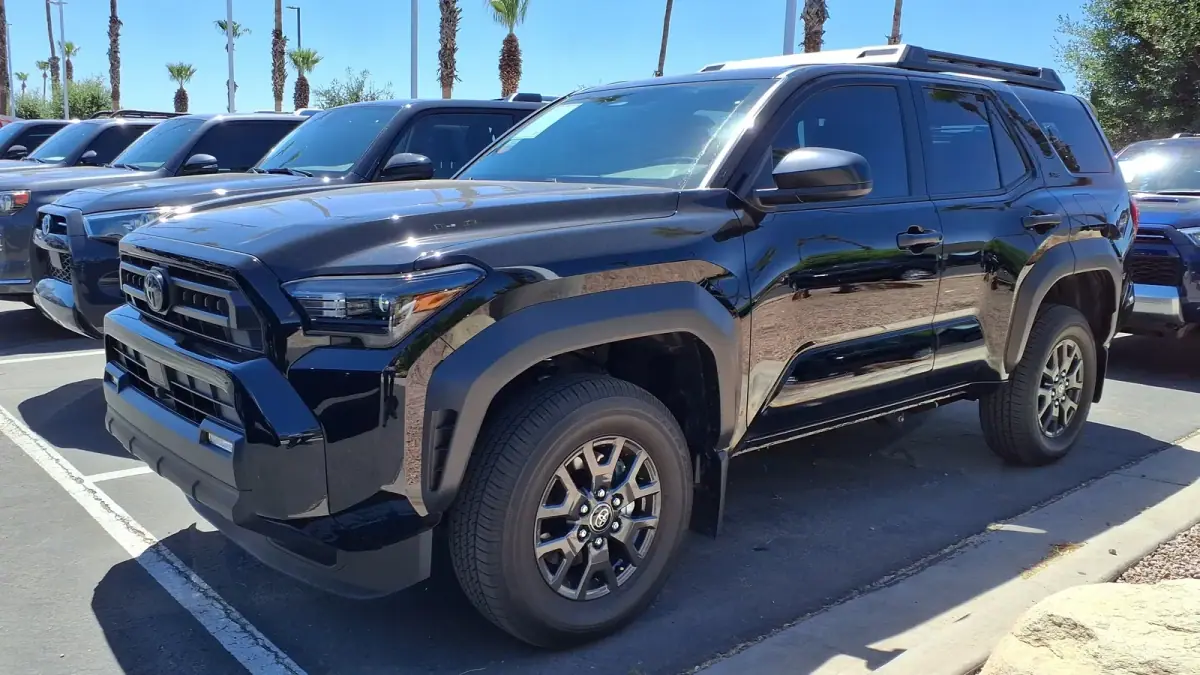
A 2025 or 2026 Toyota 4Runner is rated to tow 6,000 lb, and three of the 2026 hybrid grades are rated 5,800 lb. Every 4Runner from 2016 through 2024, the 4.0L V6 years, is rated 5,000 lb. Toyota names no tow package as a condition of either figure.
Toyota 4Runner Towing Capacity by Year
At a glance
- Most it can tow: 6,000 lb on the 2025 and 2026 4Runner, and 5,800 lb on the 2026 Platinum, TRD Pro and Trailhunter.
- Older models: 5,000 lb for every 2016 to 2024 4Runner, any grade, two-wheel or four-wheel drive.
- People and gear: the 2026 manual allows 895 lb of occupants and luggage, 1,160 lb with the third seat, and the trailer's tongue weight comes out of that.
On this page (9)
- How much can a 4Runner tow, year by year
- Can a 4Runner pull a camper?
- What is left for people and gear
- Which 2026 4Runners tow 6,000 lb
- Does the new 4Runner tow more than the old V6?
- Hitch, trailer brakes and a weight-distributing hitch
- Finding your own 4Runner's figure
- Where the 4Runner's rating runs out
- Common questions
How much can a 4Runner tow, year by year
Find your model year below. The rating changed once in this period, when the new generation arrived for 2025 and the 4.0L V6 was replaced by a turbocharged four.
| Model year | Most it can tow | Engine |
|---|---|---|
| 2026 | 6,000 lb (5,800 lb on three hybrid grades) | 2.4L turbo, or 2.4L turbo hybrid |
| 2025 | 6,000 lb | 2.4L turbo, or 2.4L turbo hybrid |
| 2024 | 5,000 lb | 4.0L V6 |
| 2023 | 5,000 lb | 4.0L V6 |
| 2022 | 5,000 lb | 4.0L V6 |
| 2021 | 5,000 lb | 4.0L V6 |
| 2020 | 5,000 lb | 4.0L V6 |
| 2019 | 5,000 lb | 4.0L V6 |
| 2018 | 5,000 lb | 4.0L V6 |
| 2017 | 5,000 lb | 4.0L V6 |
| 2016 | 5,000 lb | 4.0L V6 |
Figures for 2016 to 2025 come from Toyota's Product Information sheet for each of those model years, such as the 2024 sheet and the 2025 sheet, all rated by the SAE J2807 method. The 2026 split comes from the 2026 owner's manual and its hybrid edition. Toyota's 2026 Product Information prints a single 6,000 lb for the whole line, while the manuals and toyota.com give 5,800 lb on those three hybrid grades; the manual is the document that governs your vehicle. For tongue weight the V6 sheets all say 500 lb, while Toyota's 2016 press release said 470 lb.
Can a 4Runner pull a camper?
By weight, a small camper is the realistic match. Toyota's own words for what the 4Runner tows are trailers, boats or UTVs; its documents never mention campers or travel trailers, and they state plainly that you should never tow beyond the published capacity.
Above 3,000 lb of gross trailer weight Toyota recommends a trailer with two or more axles, which most towable campers have. Toyota also warns against exceeding 65 mph while towing. If your camper is heavier than the 4Runner's rating, the fair comparison is a mid-size pickup such as the Tacoma.
What is left for people and gear
Toyota prints no payload figure for the 2025 or 2026 4Runner. What it does print, in the manual and on the sticker on your own vehicle, is the vehicle capacity weight: the combined weight of occupants and luggage, 895 lb, or 1,160 lb on a 4Runner with the third seat. Every hybrid grade gets 895 lb.
The tongue weight of the trailer counts against that same figure, because Toyota's manual says trailer load is transferred to the vehicle and reduces the cargo and luggage capacity. Toyota wants conventional trailers loaded so the tongue carries 9% to 11% of the gross trailer weight, so a 4,000 lb loaded camper puts 360 to 440 lb on the ball, calculated from that percentage.
Work the rest out from your own numbers: 895 lb minus 440 lb of tongue weight leaves 455 lb for everyone in the vehicle and everything in the cargo area. That is the sum most 4Runner owners run out of first, and the method is on the payload page.
Tip: Toyota states that the trailer weight rating assumes a base vehicle with one driver and one front passenger, and that extra equipment, passengers and cargo reduce it so the combined and axle ratings are not exceeded. A full family and a loaded cargo area are not part of the 6,000 lb figure.
Which 2026 4Runners tow 6,000 lb
Almost all of them. The gas i-FORCE grades are rated 6,000 lb in both two-wheel and four-wheel drive, and so are two hybrid grades; only the three top hybrids come in lower.
| Version | Most it can tow | Engine |
|---|---|---|
| SR5, TRD Sport, TRD Off-Road, Limited | 6,000 lb | 2.4L turbo (i-FORCE) |
| TRD Off-Road, Limited | 6,000 lb | 2.4L turbo hybrid (i-FORCE MAX) |
| Platinum, TRD Pro, Trailhunter | 5,800 lb | 2.4L turbo hybrid (i-FORCE MAX) |
Figures from the 2026 owner's manuals, matched by Toyota's own grade data on toyota.com, which also lists the Premium versions of TRD Sport and TRD Off-Road at the same ratings. Use that page for every grade and drive combination, including curb weights and the gross vehicle weight rating of each build.
Tip: The hybrid does not tow more. The 326 hp i-FORCE MAX reaches the same 6,000 lb as the 278 hp gas engine on TRD Off-Road and Limited, and the Platinum, TRD Pro and Trailhunter are rated 200 lb lower. No Toyota document read gives a reason for the lower figure.
Does the new 4Runner tow more than the old V6?
Yes, by 1,000 lb. The 2016 to 2024 4Runner used a 270 hp, 278 lb-ft 4.0L V6 with a 5-speed automatic and was rated 5,000 lb on every grade. The 2025 generation brought a 278 hp, 317 lb-ft turbocharged 2.4L and a 326 hp, 465 lb-ft hybrid version of it, both with an 8-speed automatic, and a 6,000 lb rating.
Carrying capacity barely moved. Comparing like with like, the V6 manual allowed 880 lb of occupants and luggage with five seats and 1,165 lb with seven, against 895 lb and 1,160 lb for 2026. The older press sheets also printed a separate payload row of 1,495 lb to 1,700 lb; that is a different figure from the manual's, and Toyota does not explain the difference, so go by the sticker on your own 4Runner.
Hitch, trailer brakes and a weight-distributing hitch
Every 2026 4Runner leaves the factory with an integrated receiver hitch and a wiring harness with 4-pin and 7-pin connectors, plus TOW/HAUL modes and Trailer Sway Control. The built-in trailer brake controller is part of the Tow Tech Package: standard on Platinum, TRD Pro and Trailhunter, optional on TRD Sport Premium, TRD Off-Road Premium and Limited, and not available on SR5, TRD Sport or TRD Off-Road. Where it is not fitted, the manual points to a service connector for an aftermarket controller.
Toyota's 2026 manuals set these thresholds by gross trailer weight:
- Above 1,655 lb, the unbraked trailer weight rating, trailer service brakes are required.
- Above 2,000 lb, a sway control device of sufficient capacity is required.
- Above 3,000 lb, Toyota recommends a trailer with two or more axles.
- Above 5,000 lb, a weight-distributing hitch of sufficient capacity is required.
With a weight-distributing hitch connected, Toyota's target is to return the front axle to the weight it carried before hookup, or failing a scale, to restore the front fender height measured above the front axle, without going below it.
Toyota publishes no receiver capacity or maximum tongue weight for the 2025 and 2026 4Runner. The manual puts that on the hitch instead: hitch assemblies have different ratings set by their maker, and the operator must find that rating and not exceed it, so read the label on your receiver and the hitch maker's instructions. The V6 years were clearer, with the sheets listing a weight-carrying tow hitch receiver rated to a maximum of 5,000 lb. Installing or altering a hitch is structural work on the frame: have a Toyota dealer or a hitch shop do it, and keep the trailer wiring within the 64 watts and 5 amps per side that the tow lighting system is designed for.
Finding your own 4Runner's figure
The certification label on the driver's door pillar carries the gross vehicle weight rating and the axle ratings for your exact vehicle, and the Tire and Loading Information placard on the driver's side B-pillar states the combined weight of occupants and cargo that it should never exceed. The trailer weight rating itself is not on either label: it is in the owner's manual table for your grade and drive, which is the row to match before you hitch up.
Where the 4Runner's rating runs out
A 4Runner is sized for small trailers, and the limit that bites first is usually what is left for people and gear rather than the 6,000 lb itself. For heavier travel trailers, the choices to work through are set out on the page covering SUVs that can tow a travel trailer, which is where any comparison between models belongs.
Staying with Toyota, the next size up is the full-size Sequoia. Whatever you tow with, the loading and hookup basics are worth a read on NHTSA's towing safety page.
Common questions
How much can a Toyota 4Runner tow?
A 2025 or 2026 4Runner is rated to tow 6,000 lb, except the 2026 Platinum, TRD Pro and Trailhunter hybrids at 5,800 lb. Every 2016 to 2024 4Runner with the 4.0L V6 is rated 5,000 lb, in two-wheel and four-wheel drive alike. Toyota rates all of these by the SAE J2807 method and names no required tow package.
Can a 4Runner tow 7,000 lbs?
No. No Toyota document for any 4Runner from 2016 through 2026 lists a rating above 6,000 lb, and the V6 years stop at 5,000 lb. A trailer that heavy needs a different tow vehicle.
Is the 4Runner good for towing?
For a small trailer, boat or UTV it is equipped for the job: every 2026 grade has the integrated receiver hitch, the 4-pin and 7-pin wiring, TOW/HAUL modes and Trailer Sway Control, and the brake controller is available on most grades. The ceiling is modest, though, and the 895 lb of occupants and luggage allowed by the 2026 manual, 1,160 lb with the third seat, has to cover the tongue weight as well as the family.
How much can the 4Runner hybrid tow?
The 2026 i-FORCE MAX hybrid is rated 6,000 lb on TRD Off-Road and Limited and 5,800 lb on Platinum, TRD Pro and Trailhunter, according to the hybrid owner's manual and toyota.com. That is no more than the gas i-FORCE 4Runner, which is rated 6,000 lb across the grade range.