In the seven states whose mirror rules we read, the law asks for one thing: a view of the road at least 200 feet behind the vehicle. If your truck's mirrors cannot show you that past a camper wider than the truck, extended mirrors are how you get it back.
Towing Mirrors: When You Need Them and What Fits
Some links on this site are affiliate links: if you buy through them we earn a commission, at no extra cost to you. As an Amazon Associate we earn from qualifying purchases.
At a glance
- What the law asks: a rear view of at least 200 feet in the states we read, not a mirror of any particular type or width.
- Which kind: clip-on extensions go over the factory mirror, bolt-on replacements keep heat, turn signals and power folding.
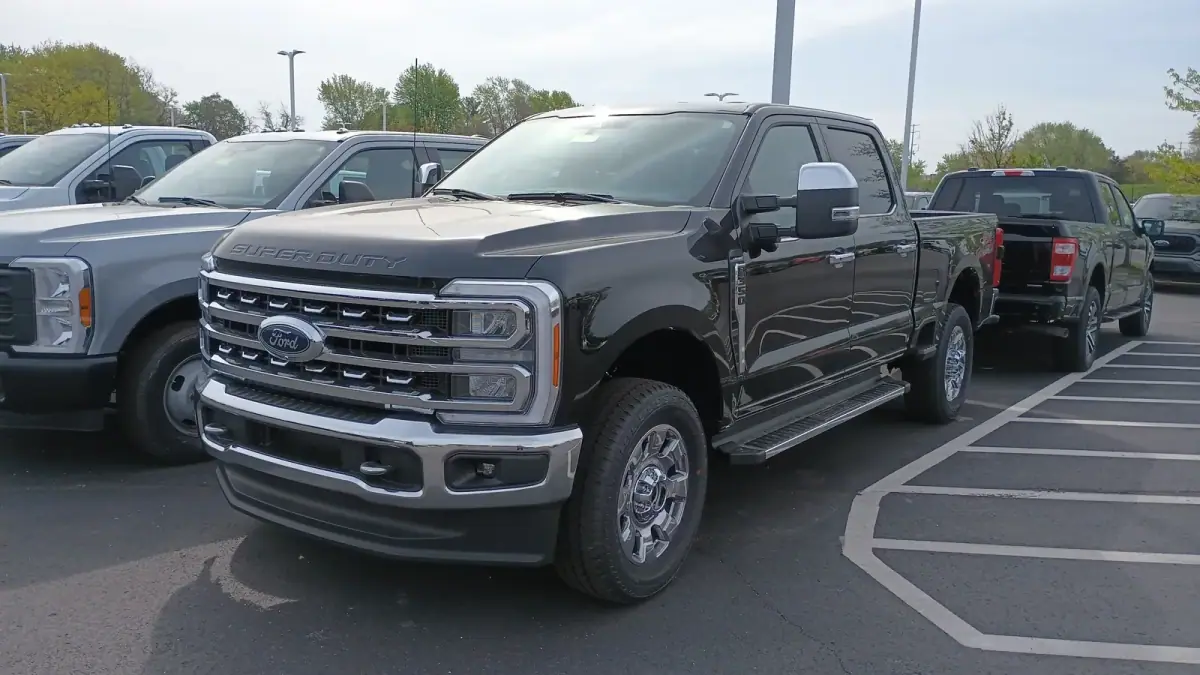
- Factory option: Ford, GM, Ram and Toyota all sell tow mirrors under their own names, and Super Duty has them standard from the base XL.
On this page (6)
Do you legally need towing mirrors?
No statute we read uses the words "towing mirror" or "extended mirror". Each one states a view distance instead, and leaves the equipment up to you. Texas and Florida name towing directly, Minnesota covers a vehicle "connected with another vehicle", and Arizona and Pennsylvania key on a view that is obstructed by how the vehicle is built or loaded.
The step from there to buying mirrors is our plain reading, not a line in any code: if a camper blocks what your mirrors would otherwise show, you need something that reaches past it.
| State | What the law asks | Source |
|---|---|---|
| Texas | A mirror showing the highway at least 200 feet to the rear, including on a vehicle used to tow another vehicle | Sec. 547.602 |
| Florida | Same 200 feet, stated for a vehicle operated singly or when towing any other vehicle; a nonmoving traffic infraction | F.S. 316.294 |
| Minnesota | A mirror or other technology showing 200 feet to the rear when the vehicle is built, loaded or connected with another vehicle so the view is obstructed | Minn. Stat. 169.70 |
| Arizona | Two mirrors showing 200 feet to the rear when the vehicle is constructed or loaded so the driver's rear view is obstructed | A.R.S. 28-956 |
| Washington | A left-side mirror plus a second mirror (inside center or outside right), each showing 200 feet to the rear | RCW 46.37.400 |
| Virginia | A mirror showing not less than 200 feet to the rear; outside mirrors on both sides replace the inside mirror where the rear window is obstructed | Code of Va. 46.2-1082 |
| Pennsylvania | Not less than 200 feet to the rear; with a sign, load or material blocking the view, two outside mirrors of at least 19.5 square inches each | 67 Pa. Code 175.68 |
Figures from the statute and regulation text as published by each state. Pennsylvania's is PennDOT's vehicle equipment and inspection regulation for passenger cars and light trucks, not the Vehicle Code itself. Rules differ state by state and change, so read your own state's code rather than assuming these seven stand for the rest.
Two federal rules get quoted in forum threads and neither is a towing-mirror rule for a private camper owner. FMVSS 111 is a manufacturing standard that sets the rear visibility devices a vehicle must have when it is built, while FMCSA 393.80 requires two outside mirrors on trucks and buses under rules written for commercial motor vehicles in interstate commerce, with an exception for occasional transport of personal property not for compensation.
Worth knowing: Minnesota's section was amended in 2023 to accept "a mirror or other technology" for the 200 foot view, so a camera display can satisfy it there. That is one state's wording, not a general rule, and the other six texts we read still say mirror.
Does your truck already have factory tow mirrors?
Many trucks offer them as a named option, so check before you buy anything. On the 2026 F-150, Ford's order guide lists manual-folding, manually telescoping power glass trailer tow mirrors as 54Y/59S and power-folding PowerScope telescoping mirrors as 54W, both requiring the Tow/Haul Package (53T). Super Duty is different: manually telescoping and folding trailer tow mirrors with power heated glass and a convex spotter mirror are standard equipment from the base XL, and the PowerScope version (54F) is optional on XLT and standard on Lariat.
GM calls them extendable trailering mirrors. The 2026 Chevrolet trailering guide says two levels are available on Silverado 1500 and four on Silverado HD, and gives the vertical manual-folding extendable mirror as 50 square inches of flat surface plus 20 square inches of convex surface. The 2026 GMC Sierra 1500 manual describes the same idea as trailer-tow mirrors, flat on top and convex below, that extend out for towing.
Ram's 2026 1500 manual lists manual or power trailer tow telescoping mirrors, whose head extends for extra-wide loads. Toyota's 2026 Tundra information lists a Tow Mirrors package on Limited and a Premium Tow Mirrors package, which adds the Panoramic View Monitor camera, on Limited, Platinum, 1794 and Capstone. Your own truck's equipment is on its window sticker and in the mirror section of the owner's manual for your model year, next to the label that carries your towing capacity.
Clip-on or replacement mirrors?
If your truck has no factory option, there are two aftermarket routes. The notes below come from retailer listings on Camping World rather than maker instruction sheets, and we rank no brands.
- Clip-on extensions slide or strap over the mirror you already have. CIPA's 11450 custom set is listed as a vehicle-specific slip-on that keeps the original mirror in use, installs without tools, uses a wedge-lock system to reduce vibration, and is not compatible with telescopic mirrors. K-Source's Snap & Zap 81860 is listed for the 2021 to 2026 F-150, snapping on without tools and letting the mirrors still fold, with manually adjusted flat glass, no heat and no turn signal.
- Universal clip-ons strap to almost any mirror. The CIPA 11950 listing gives a 7 inch total extension and a fit up to a 10 inch mirror, and states plainly that it is meant for temporary or light towing and is not recommended as a full-time heavy-duty solution. A K-Source universal dual lens pair is listed with ratcheting rubber straps for mirrors 4-1/2 to 11-1/2 inches tall.
- Bolt-on replacements swap the factory mirror out. K Source's OEM style listing describes versions with heat, manual or power adjustment, manual or power folding, puddle lamps and turn signals, with harnesses made to plug in and no vehicle modification.
The practical split: if the camper comes out a few weekends a year, a clip-on is the cheaper, reversible answer. If you tow most months and want heated glass, signals and folding that behave like the factory parts, replacements are the version built for that. Either way the mirror has to be steady at highway speed, which is what the vibration language in those listings is about.
Worth knowing: GM's Sierra manual warns that hood-mounted air deflectors and add-on convex mirror attachments could decrease mirror performance. That is about stick-on convex spot mirrors rather than tow extensions, but it is a reason to aim the main glass first and treat any add-on lens as a supplement.
How far out do they need to reach?
None of the seven texts we read sets an extension distance, and only Pennsylvania's regulation sets a mirror size. The extension figures that do exist are product dimensions: the 2025 F-150 manual says the optional extending mirrors move out approximately 3 inches (75 mm), and the universal CIPA listing quotes 7 inches.
So the test is a view, not a tape measure. Hitch the camper, sit in the driver's seat and check that each mirror shows the side of the trailer and the lane beside and behind it. FMVSS 111 explains why the factory glass stops where it does: on passenger cars the mirror and its mounting may not protrude farther than the widest part of the body except as needed for the required field of view, and the standard sets reflective surface minimums of 126 square centimeters per side for trucks rated 4,536 kg GVWR or less. Wide trucks such as a one-ton dually need more reach than a half-ton pickup towing the same trailer.
Setting them before you pull out
Do this with the camper hitched and the truck parked, in the maker's own sequence.
- Extend them. Ram manual telescoping mirrors pull outward to the position you want and push fully in to return; the power version uses the door-panel pad, left to extend and right to retract.
- On GM extendable mirrors, grasp the housing firmly and pull back in one motion, arching slightly toward the rear of the vehicle. Reverse the motion to put them back.
- On the F-150's power telescoping mirrors, switch the vehicle on with the ignition in accessory or start, press and release the control switch, then press the left arrow to extend and the right arrow to retract.
- Aim each one. GMC's wording is to adjust so a little of the vehicle and the area behind it can be seen; Ram's is that the outside mirrors can be adjusted to the center of the adjacent lane of traffic.
- Never adjust them while the vehicle is moving. Ford states this as a warning in the F-150 manual.
- Re-check them at the start of every trip. Chevrolet's trailering guide puts mirror adjustments on its pre-trip checklist alongside the hitch bolts, safety chains and lights.
One caution from Ram's manual: objects in a side convex mirror look smaller and farther away than they are, so use the inside mirror when judging the size or distance of a vehicle you saw in the convex section.
Worth knowing: If your truck already has factory telescoping mirrors, extend those rather than clipping an extension over them. CIPA's own custom-fit listing states the slip-on set is not compatible with telescopic mirrors.
Common questions
Do you legally have to use towing mirrors?
No state text we read requires a mirror called a towing mirror. Texas, Florida, Minnesota, Arizona, Washington, Virginia and Pennsylvania all frame the requirement as a rear view of at least 200 feet, and Pennsylvania's inspection regulation adds a 19.5 square inch minimum per outside mirror where a load blocks the view. Other states word it differently, so read your own code.
Are clip-on towing mirrors safe?
We have no test data on any of them, so go by what the makers state. The universal CIPA 11950 listing says it is for temporary or light towing and not a full-time heavy-duty solution, while vehicle-specific clip-ons such as the K-Source Snap & Zap are built for one model's mirror shape and leave the factory glass usable.
How far do towing mirrors need to extend?
Far enough that you can see the lane behind the camper, which depends on trailer width and your mirror position rather than a published number. For scale, Ford's optional extending F-150 mirrors move out approximately 3 inches and a universal clip-on listing quotes 7 inches of total extension.
Do I need towing mirrors for a small camper?
If the trailer is no wider than your truck and the factory mirrors still show the road 200 feet back on both sides, nothing needs adding. In Arizona, Minnesota and Pennsylvania the requirement is triggered by an obstructed view, so a narrow teardrop behind a full-size pickup sits outside it where the mirrors still do their job.