Most RV sewer hoses are 3 inches across, and the hose end is a bayonet that twists onto the lugs on the RV's waste outlet, so most hoses fit most RVs. What varies is the campground end, which is why kits ship with a multi-size adapter.
RV Sewer Hoses Explained: Sizes, Fittings, Supports and How Long They Last
Some links on this site are affiliate links: if you buy through them we earn a commission, at no extra cost to you. As an Amazon Associate we earn from qualifying purchases.
At a glance
- Size: 3 inch is the size hose and fitting makers build to, with a bayonet end for the RV outlet.
- Campground end: adapters cover an unthreaded 3 inch slip inlet and 3, 3 1/2 and 4 inch threaded inlets.
- Replacing: no maker publishes an interval; pinholes and leaks are the wear to look for.
On this page (9)
Our picks
- Camco RhinoFLEX 20 ft sewer hose kit: 23 mil hose, steel wire reinforced; the kit carries the 4-in-1 adapter for 3, 3 1/2 and 4 inch inlets
- Thetford Titan 20 ft sewer hose kit: Thetford's own TPE hose, built for puncture and abrasion resistance
- Camco Sidewinder 20 ft sewer hose support: cradles hold the hose without straps for a steady downhill run
- Camco flexible 3-in-1 sewer hose seal: for parks that ask for a sealed connection; fits 3, 3 1/2 and 4 inch threaded inlets
What size hose fits your RV?
Buy a 3 inch hose and it will almost certainly fit. Camco's couplers and supports are built for 3 inch hoses of any brand, per the Camco RV accessories catalog, Jayco's towable manual calls for a 3 inch hose, and Lippert's Waste Master uses one too.
The RV end is near-universal, not universal. The hose carries the bayonet and the RV's outlet carries the lugs it locks onto. Lippert is the exception: its Waste Master manual covers both a bayonet and a cam lock connection, so look at your own outlet before buying.
The campground end is where adapters come in
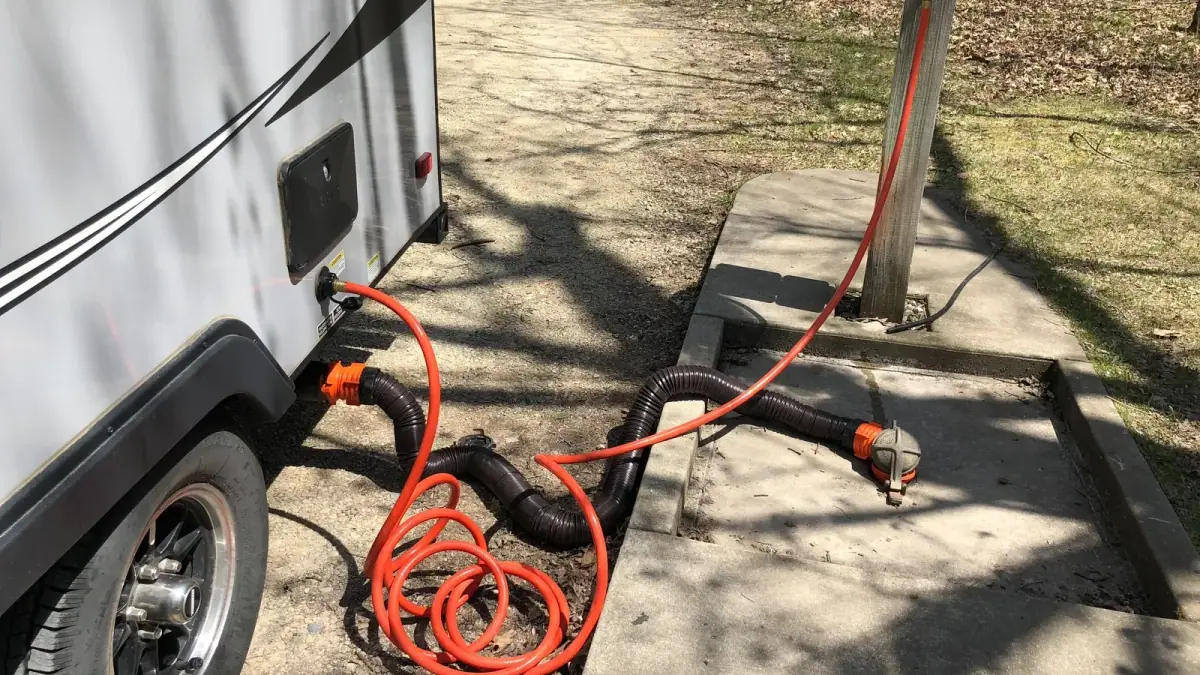
Park sewer inlets come in several sizes, so the adapter does the fitting. Camco's 4-in-1 adapter, supplied in its Rhino X and RhinoFLEX kits, fits a 3 inch slip connection or 3, 3 1/2 and 4 inch threads. A clear elbow between hose and adapter lets you see when the flow has stopped.
Some parks require a sealed connection. Virginia's campground code calls for a four inch riser, with the hose's lower end "secured into the open sewer riser with a gasket of rubber or other suitable material" (12VAC5-450-90, effective 28 November 2018). That is one state's rule. Where a park asks for a seal, Camco's flexible sewer hose seal fits 3, 3 1/2 and 4 inch threaded inlets, even when the thread is stripped or dirty.
Tip: If the inlet at your site will not take the adapter cleanly, the flexible seal is the part that saves the connection, not a bigger adapter.
Couplers, wyes and gaskets
These small parts let you lengthen the run, share an inlet and stop leaks. Two hoses join with a coupler; Camco's Easy Slip internal coupler takes 3 inch hoses of any brand. A wye joins two hoses to one inlet, useful on a motorhome with two separate tank valves. The odor seal is a replaceable gasket, so a leaking end often needs a new gasket, not a new hose.
Lengths, wall thickness and material
A thicker wall resists scrapes longer, and the compressed length decides whether the hose fits your bumper tube. Camco prints wall thickness in mils.
| Camco hose | Wall | Lengths |
|---|---|---|
| RhinoFLEX | 23 mils polyolefin, steel wire reinforced | 15 and 20 ft kits, 5 and 10 ft extensions |
| Rhino X | 23 mil polymer | 20 ft kit, two 10 ft hoses |
| Standard vinyl | 12 mils | 10 and 20 ft |
| Heavy-Duty vinyl | 15 mils | 10, 15 and 20 ft |
| Super Heavy-Duty vinyl | 18 mils | 10 and 20 ft |
Figures from Camco's RV accessories catalog, sanitation section. Thetford builds its Titan hoses from its own TPE for puncture and abrasion resistance, without publishing a temperature range.
Do you need a sewer hose support?
A support holds a steady downhill run so the tank empties instead of pooling in a low spot. Camco describes its supports as elevating and guiding the hose "to keep waste moving downhill" over uneven ground. Its Sidewinder holds the hose in cradles without straps and is sold by hose length: 10, 15, 20 and 30 feet.
No maker or code publishes a slope figure, so the target is simply downhill and supported all the way. Some parks require supports, such as Mohave County's Hualapai Mountain Park in Arizona. Where the sewer inlet sits uphill or far away, a macerator pump does the job gravity cannot.
Connecting and storing the hose
The connect routine is short and the same across builders. Forest River, Jayco and Winnebago manuals run as follows.
- Take the hose from storage and remove the cap from the RV waste outlet.
- Lock the hose's bayonet onto the outlet, clockwise until it seats.
- Fit the adapter end into the park or dump station inlet, and check both ends are secure.
- Dump, then make sure the hose has drained completely.
- Disconnect from the RV, rinse the hose with clean water, cap both ends and stow it.
- Replace the caps on the RV outlet and the dump station inlet.
Which valve opens first belongs with the black and gray tanks, not the hose. On most towables the hose lives in a sewer hose compartment, the hollow bumper tube or a tube under the frame, as the Jayco towable manual describes. A 10 foot RhinoFLEX compresses to 32 inches.
Tip: Thetford says not to lock the two hose ends together in storage, because it can affect long-term seal performance; use the end caps instead. Wear gloves whenever you handle a sewer hose.
Keep the water hoses separate
The hose you flush tanks with is never your drinking water hose. Camco makes its tank flushing hose bright orange so the two do not get mixed up. Jayco says to use a drinking water hose dedicated solely to fresh water and to keep its openings off the ground.
When to replace a sewer hose
No maker publishes a replacement interval, so check the hose itself. Replace it when you find a pinhole, a split or a weeping seam; if only the bayonet gasket has stopped sealing, replace the gasket. What you put in the tank between dumps is covered under tank treatments.
Check the park's rules too. Virginia's code calls for a noncollapsible hose, and the City of Golden's RV park in Colorado requires an airtight sewer connection.
Common questions
Are all RV sewer hoses compatible?
Near enough, but no maker claims all of them are. Camco notes its RhinoFLEX fittings are designed around the RhinoFLEX hose, so test the fit before mixing brands.
What size is a standard RV sewer hose?
Three inches in diameter, with a bayonet fitting at the RV end. A few Lippert systems connect by cam lock instead, depending on how the RV was built.
How often should you replace an RV sewer hose?
There is no set schedule. Inspect it each trip, and remember that gaskets, seals and caps are sold separately, so a worn seal does not mean a new hose.
Do I need a sewer hose support?
You need a downhill run, and on uneven ground a support is how you get one. Some parks also require sewer lines to be elevated with supports.