The black tank holds what goes down the toilet. The gray tank holds the drain water from your sinks and shower. You empty both through a sewer hose at a dump station or a sewer hookup, black tank first and gray tank last, which is the order RV builders' manuals give.
RV Black and Gray Tanks: How They Work, Dumping in Order, Valves and Sensors
Some links on this site are affiliate links: if you buy through them we earn a commission, at no extra cost to you. As an Amazon Associate we earn from qualifying purchases.
At a glance
- Order: Black first, gray last, because the gray water rinses the hose on its way out.
- At a full hookup: Keep the black valve closed until the tank is at least 3/4 full, or only the liquid leaves.
- Sensors: Probe sensors read residue stuck to the tank wall, so the panel can show full when the tank is not.
On this page (8)
What the black and gray tanks are
Your RV has two tanks with two jobs, though not every rig splits them the same way. Forest River's travel trailer and fifth wheel manual describes a gray system of drain lines and a holding tank for the sinks and tub, and a black system of a holding tank and drain for toilet waste. Both tanks vent outside to move odors away from the inside.
On some Keystone floorplans, part of the gray water drains into the black tank. Airstream's smaller trailers, the Basecamp 16 among them, use a combination black and gray tank, and Jayco notes that some models have a single dump valve that releases both tanks together.
The tank stores waste for a few days until you dump it; it is not a septic tank. An RV toilet flushes with about 1 quart of water against 1.6 gallons for a house toilet, so what you put down it, including toilet paper, matters more than it does at home.
How to dump the tanks, in order
Dumping is the same short routine every time, and the order is what keeps it clean. These steps follow Jayco's 2027 towable manual for a two-valve rig:
- Level the RV so the tanks drain properly.
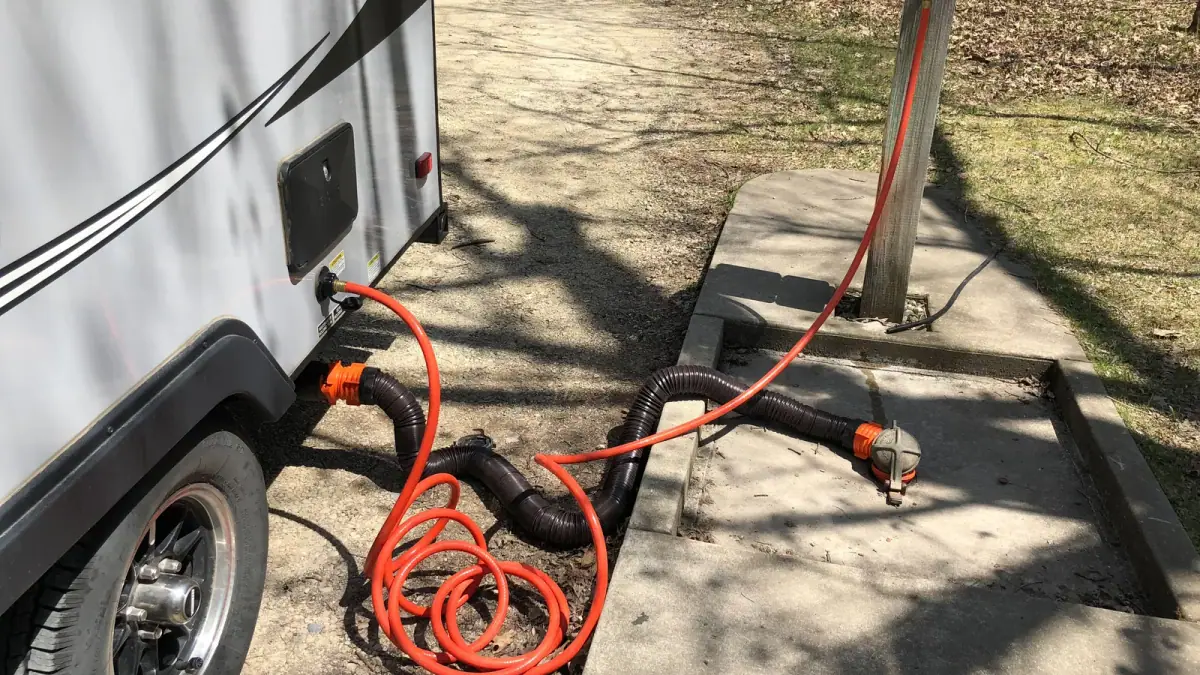
- Take off the waste pipe cap and attach the sewer hose to the RV outlet.
- Secure the other end at the approved dump inlet.
- Open the black tank valve, and close it when that tank is empty.
- Open the gray tank valve, and close it when that tank is empty.
- Make sure the hose has drained completely into the sewer.
- Remove and store the hose, then put the cap back on.
Black goes first because the gray water then starts cleaning the sewer hose as it drains. Keystone adds gloves, eye protection and a face mask to the list. Forest River adds a rinse between the two: once the black tank is empty, hold the toilet pedal to send several gallons through, then dump the gray.
At a full hookup, keep the black valve closed
Leaving the black valve open at a sewer site is the classic mistake, because only the liquid drains away. Forest River and Jayco both say to wait until the black tank is at least 3/4 full before opening it, so the water can carry the solids out. With the valve open, Keystone's 2027 manual says, the solids stick to the bottom and build up. A closed valve also keeps sewer gases from coming back up the hose.
Tip: Thetford warns that an open black valve leaves a pyramid of solids directly under the toilet, which can plug the toilet and the tank when you try to clear it.
The gray valve is where builders differ. Airstream says you can leave it open while hooked up to sewer and close it before dumping the black tank. Forest River applies its 3/4 rule to both tanks.
Valves: manual, cable and electric
Each waste tank typically has one valve, closed to hold and open to drain, and it works in one of three ways.
| Valve type | How it works | What to know |
|---|---|---|
| Manual slide (gate) | Handle at the outlet, pulled out to open | One valve per waste tank, usually on the roadside |
| Cable | Handle on a side wall or compartment wall, cable to the valve | Valterra: the wire must move freely in its housing, and the cable is secured every 18 to 24 inches |
| Electric | Switch drives the blade open and closed | Valterra EZ-Valve: 12 V DC, 2.5 A per valve, 1.3 seconds to cycle, with a ring-pin manual override |
Figures from Keystone's 2027 owner's manual and Valterra's instructions for its cable valve and the EZ-Valve electric system. The electric valve grows from 11 1/2 inches closed to 15 1/4 inches open, so it needs clearance under the rig.
For a stiff valve, use a drain valve lubricant such as Camco's TST Drain Valve Lube or Thetford's Drain Valve Lubricant rather than force.
Why the sensor says full when it is not
The panel reports whatever touches the probes inside the tank, so residue can make it read full. Forest River and Keystone list residue on the tank walls, water with low mineral content, a low battery and loose wiring as causes. Most panels only show empty, 1/3, 2/3 or full, so compare the reading against a tank whose level you know.
Tip: A freshly dumped tank that still shows 2/3 usually has sludge or tissue bridging a probe. Thetford says that kind of build-up responds to a cleaner, though not every sensor fault does.
Winnebago says most debris dislodges during travel if you keep at least 1/3 of a tank of fluid in it. Garnet's SeeLeveL system avoids the problem with senders mounted on the outside of the tank, which work on most plastic or poly tanks but not metal ones. Cleaning a fouled probe is a job for tank treatment and flushing.
Portable holding tanks
If your sewer hose will not reach, a wheeled tote tank carries the waste to the dump station. Camco's Rhino totes come in 15, 21, 28 and 36 gallon sizes and connect to the RV outlet through a bayonet adapter. Barker's instructions for its 32 gallon Tote-Along give the routine: take the sewer hose off before towing, hook the tow handle to a hitch ball, then at the dump site attach the hose, remove the cap for ventilation and pull the handle up to empty it. A macerator pump is the other way to cover the distance.
Tip: Tow a tote at walking speed. Thetford's SmartTotes 2 manual sets a limit of 5 MPH, and going faster can damage the wheels or tank and voids the warranty.
Weight, and what to do before you drive
Full tanks are heavy cargo, so dump them before you drive. Water weighs 62.3 pounds per cubic foot at 70°F (21°C) in the USGS water density table, and a cubic foot is 7.48 gallons, so a gallon weighs roughly 8.3 lb (calculated). A 40 gallon tank filled with water therefore carries about 330 lb (calculated) in one spot.
Jayco and Forest River tell owners to dump both tanks before traveling, and to reduce speed if you cannot reach a dump station. The one exception is Winnebago's advice above to keep 1/3 of fluid in for the sensors.
Common questions
How often should I empty the black tank?
Every few days in regular use. Thetford, as a treatment maker, suggests emptying the waste holding tank every 3 to 5 days depending on the additive used.
Can you drive an RV with a full black tank?
Jayco's 2025 Class C manual says never to travel with full black or gray tanks. The contents are not counted in the cargo carrying capacity, so full tanks can push you past individual tire ratings, the GAWR or the GVWR, and they change how the rig handles.
How long can waste stay in an RV tank?
No builder manual puts a number of days on it. Thetford adds that extremely hot weather and longer retention need extra treatment.
Can I empty gray water on the ground?
Treat it as no unless the park says otherwise. Texas state parks allow wastewater, black and gray, to be discharged only at designated dump stations, and Theodore Roosevelt National Park prohibits dumping any waste on the ground. Airstream notes that emptying gray on the ground at a campsite is often illegal.