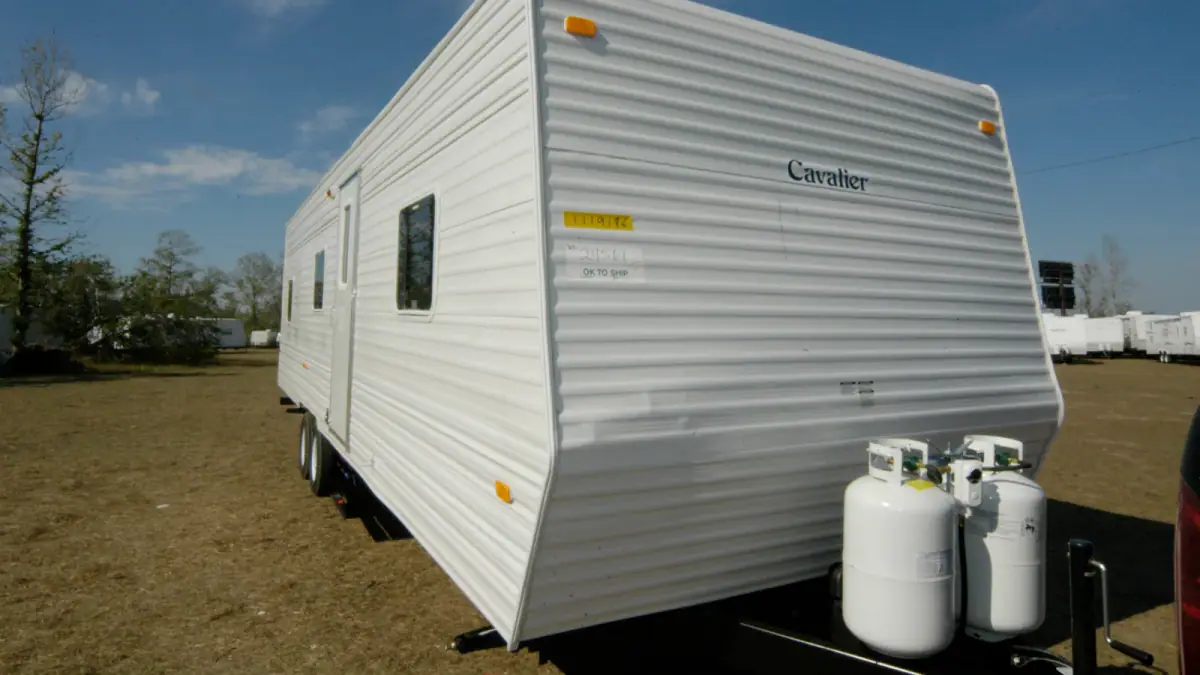
Travel trailers and fifth wheels carry removable bottles, usually two 20 or 30 lb ones on the tongue or in a front compartment. Motorhomes have a tank built into the chassis, filled with the coach parked at the station. Your own size is stamped on the bottle and printed on the builder's spec sheet.
RV Propane Tanks: Sizes, Filling vs Exchange and the Date That Matters
At a glance
- Common sizes: two 20 lb (4.7 gal each) or 30 lb (7.1 gal each) bottles on towables; 12.2 gal built into one 2027 Jayco Class C.
- Fill vs exchange: a refill fills by weight to the cylinder's rated capacity, while Blue Rhino and AmeriGas both state 15 lb of propane in their exchange tanks.
- The date that matters: a cylinder must be requalified, meaning inspected and re-dated, within 12 years of manufacture, then every 5, 10 or 12 years depending on the test used.
On this page (7)
What size propane tank does your RV use?
Towables use removable bottles called DOT cylinders, which come off the trailer for filling. Motorhomes use an ASME tank bolted under the floor, so you drive the whole coach to the filling station, as Jayco's 2025 Class C manual describes it.
| Tank | Holds | Where you find it |
|---|---|---|
| 20 lb DOT cylinder | 4.7 gal | Pairs on a travel trailer's A-frame tongue |
| 30 lb DOT cylinder | 7.1 gal | Pairs on larger trailers and fifth wheels, often in a front compartment |
| 40 lb DOT cylinder | 9.4 to 9.5 gal | Same Type 1 valve as the 20 and 30 lb sizes (Worthington, Manchester) |
| 100 lb DOT cylinder | 23.6 to 23.8 gal | Not supplied on any RV in the manuals read; different valve (CGA-510 or POL) |
| ASME tank, Class C | 12.2 gal (41 lb) | Under the floor of a 2027 Jayco Redhawk 26M, filled in place |
Cylinder capacities are the makers' ratings from Worthington and Manchester Tank. Builders state motorhome tanks differently (Jayco in gallons and pounds, Winnebago as water capacity filled to 80 percent), so read your own unit's spec sheet rather than comparing brands.
How long will a tank last?
It depends on which appliances run and for how long. The furnace and oven use the most, so in cold weather keep one bottle full, as Keystone's 2027 manual advises.
Calculated from the makers' figures: an Atwood AFMD30 furnace burns 30,000 BTU per hour, and a 20 lb cylinder holds 4.7 gal at 91,502 Btu per gallon (PERC's Technical Pocket Guide). That is about 430,000 Btu, or roughly 14 hours of continuous burner time.
A furnace cycles with the thermostat, though, so those 14 hours may stretch across two cold nights or a week of mild ones. Do the same sum with your own appliance's rated input, which is on its data plate.
Tip: To see what is left without a gauge, weigh the cylinder and subtract the tare weight stamped on it (16.6 lb on Worthington's 20 lb). Every 4.2 lb above that is one gallon still in the bottle, by PERC's figures.
Fill or exchange?
A refill fills the cylinder by weight to its rated capacity, 4.7 gal in a 20 lb bottle. An exchange swaps it for a company-filled one: Blue Rhino and AmeriGas both state 15 lb of propane in their exchange tanks, and AmeriGas takes any brand in exchange.
To take a cylinder in for a refill:
- Close the service valve and disconnect the hose.
- Lift the cylinder out and fit the dust cap or plug.
- Carry it secured, in the orientation marked on it, straight there and back.
- Have it filled by weight at a certified propane facility, never above 80 percent of capacity.
- Reinstall it securely, reconnect the hose and leak check the connection.
Tip: Exchange is the quick way out of an out-of-date cylinder. Blue Rhino requalifies tanks as part of its process, so a bottle a filling station turns away can still be swapped for one that is in date.
Is your tank out of date?
Check the date stamped on the edge of the collar. A cylinder must be requalified within 12 years of manufacture, as PHMSA's guide "Is Your Cylinder Safe to Fill?" explains, and a later requalification shows as a stamp or sticker.
After that, the interval depends on the test, shown by the letter after the requalifier ID and date:
- No letter: volumetric expansion test, good for 12 more years.
- S: proof pressure test, good for 10 more years.
- E: external visual inspection, good for 5 more years.
Those intervals come from 49 CFR 180.209 for the DOT-4BA240 and 4BW cylinders used on RVs. Under section 180.205(c), a cylinder past its date cannot be filled and offered for transportation until a DOT-approved requalifier has requalified and marked it, though one filled before then may stay in service until empty.
A station may also refuse a bottle with heavy rust or pitting, dents, bulges, cracks, a damaged collar or footring, or a faulty valve or relief device, as PHMSA tells fillers. Never refill a cylinder that has been damaged or exposed to fire.
The triangular knob: OPD valves
A triangular handwheel marked "OPD" means the cylinder has an overfill prevention device, a backup shutoff in the filling valve that only acts above the 80 percent level. Winnebago's 2026 towables manual warns never to adjust or tamper with it.
This is not a federal DOT rule. PHMSA states plainly that the federal hazardous materials regulations do not contain it: the requirement sits in NFPA 58, which many states have adopted as state law. As PHMSA summarizes NFPA 58, it covers 4 to 40 lb cylinders made or requalified after September 30, 1998, or refilled on or after April 1, 2002. Round or star-shaped handwheels have no OPD, and where your state has adopted NFPA 58 those cylinders can no longer be refilled.
Handling and leak checks
Keep cylinders upright, in the position marked "top" or by an arrow, so the pressure relief device works, and never carry them, full or empty, inside the trailer. Before pulling into a fuel station, put out all pilot lights, shut the gas off to every appliance and switch off any engines, as Jayco's manual says.
For a leak check, spray soapy water on the joints and fittings; bubbles mark the leak. Never use a solution containing ammonia or chlorine, which corrode copper lines and brass fittings, and never test with a flame. Keep a working propane alarm inside the coach too.
Found bubbles, smelled gas or heard hissing? Close the service valve and stop there. Any leak at the valve, the regulator or the lines, and any suspected overfill, is a job for a qualified RV or propane technician. Never repair the LP tank or try to adjust the regulator yourself.
Common questions
What size propane tank does an RV use?
Check the size stamped on the cylinder collar, or the tank capacities row on your floorplan's spec sheet on the builder's website. On a motorhome with a fixed ASME tank, only the spec sheet gives a figure.
How long does a 20 lb propane tank last in an RV?
There is no honest fixed figure, because it depends on which appliance is running. Find the rated input on that appliance's data plate, in BTU per hour, and work out the hours from the cylinder's gallons.
Can I connect a 100 lb propane tank to my RV?
Check your manual first, because builders disagree: Winnebago permits other tanks only if every connecting component is compatible, while Forest River says never to use any container other than the one supplied. A 100 lb cylinder also uses a different valve (CGA-510 on Worthington's, POL on Manchester's) from the Type 1 on 20 to 40 lb bottles, so plumbing one in is work for a qualified propane technician.
Can I refill an exchange propane cylinder?
Yes. An exchange bottle is an ordinary DOT cylinder, so a certified propane facility can fill it by weight off the RV if it has an OPD valve and is within its requalification date.