An RV propane regulator drops the high pressure inside the cylinder to the low, steady pressure the appliances burn, 11 inches of water column. Most campers with two cylinders use a two-stage automatic changeover regulator, though not every RV does.
The RV Propane Regulator: How It Works, Signs It Is Failing, Replacing It
Some links on this site are affiliate links: if you buy through them we earn a commission, at no extra cost to you. As an Amazon Associate we earn from qualifying purchases.
At a glance
- What it does: reduces cylinder pressure to 11 inches of water column so the furnace, water heater, refrigerator and range burn correctly.
- Red or orange indicator: the changeover regulator has switched to the reserve cylinder, not that both cylinders are empty.
- Who works on it: adjusting or fitting a regulator, and measuring its pressure with a gauge called a manometer, is work for a qualified propane technician.
On this page (7)
What does the regulator do?
The regulator is what lets your appliances use bottled propane safely, as the 2027 Keystone owner's manual puts it. On a two-stage unit the first stage drops cylinder pressure to 10 to 13 lbs, and the second stage brings it down to 11 inches of water column, as the Grand Design and Jayco manuals explain. Size matters too: the RV standard, NFPA 1192, requires the regulator's capacity to be at least the total input of every propane appliance in the RV, as the Railroad Commission of Texas study guide puts it.
How do I tell if it is bad?
A bad regulator shows up at the burners, usually on more than one appliance at once. Grand Design ties slow heating, poor lighting and flames too low or too high to a defective regulator.
- Weak or uneven flames on several appliances: have a gas dealer or certified RV technician pressure test the regulator.
- Appliances dropping out when several run at once: it can be the regulator, or the excess flow device in the pigtail tripping. Keystone says that cuts flow to roughly 20,000 BTU/hr, so one appliance works alone but the furnace or several together will not.
- A propane smell at the regulator: in a 2021 recall of one regulator model, NHTSA named this, with gas venting through the relief valve, as a sign of too-high pressure.
- A hiss lasting more than a second or two as gas starts to flow: Jayco treats that as a leak. Close the cylinder valve and have your dealer test the propane system.
No maker gives a replacement age, only inspections: Jayco asks for a propane system check every 5,000 miles or at least once a year.
Tip: The one regulator job Keystone gives owners is the vent: keep it pointing downward with its cover on, and clean it with a toothbrush. A clogged regulator can push pressure higher or cause component failure.
What pressure should it deliver?
The number to know is 11 inches of water column, and reading it takes a calibrated manometer, so Jayco sends any adjustment to a qualified propane technician.
| Source | Pressure | Applies to |
|---|---|---|
| Grand Design, Jayco | 11 in. W.C. | Regulator outlet to the appliances |
| Forest River | 11 in. W.C. | Line pressure for all RV propane appliances |
| Dometic WH water heater | 10 to 13 in. W.C. | Inlet gas pressure |
| Suburban SF-Q furnace | 11 to 13 in. W.C. | Supply pressure for input adjustment |
| Norcold N61V, N81V | 11 in. W.C. | Figure checked at the annual service |
Sources: the Grand Design Momentum manual and the Forest River, Dometic, Suburban and Norcold manuals.
Dometic says the pressure should be set with three appliances running. That is why a weak regulator often shows only when the furnace, the water heater and a refrigerator running on gas all draw at once.
Are all RV regulators the same?
No. Three types turn up on campers, and they are not interchangeable.
| Type | What it does | Where it is used |
|---|---|---|
| Single stage | One pressure reduction | Small portable applications and low-pressure outdoor cooking appliances; Jayco says some of its models ship with one |
| Integral two stage | Combines both stages in one body, converting tank pressure to 11 in. W.C. | Not tied to any RV type by its maker |
| Two-stage automatic changeover | Both stages, switching to the reserve cylinder automatically when the primary is near empty; a lever selects the supply cylinder | Most campers with two cylinders |
Descriptions from Marshall Excelsior's regulator pages and the Jayco and Forest River manuals.
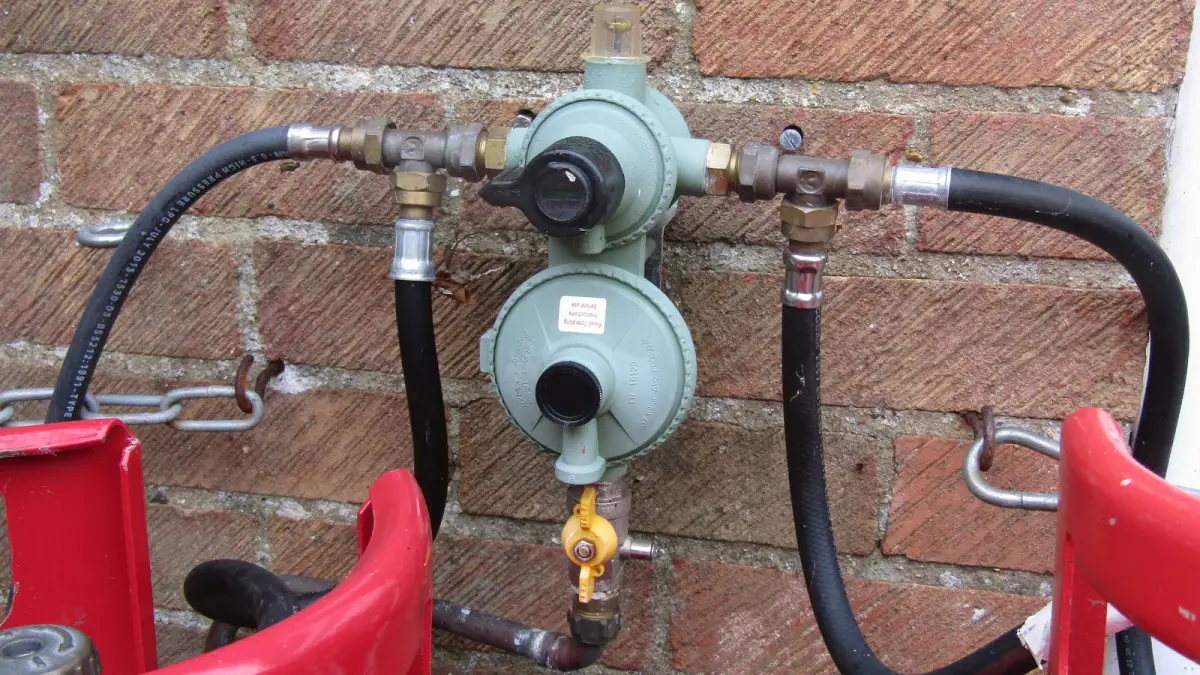
On a changeover regulator, the arrow on the black lever points to the supply cylinder. With both valves open the indicator reads green; when the supply cylinder runs out it turns red and the reserve keeps feeding the RV. Jayco uses green and orange instead.
Before removing the empty cylinder, turn the lever to the cylinder now supplying the regulator and close the empty cylinder's valve. The Fairview regulator guide warns that disconnecting a hose while the indicator is red will cause a propane leak.
Tip: Red does not mean you are out of propane. Marshall Excelsior and Fairview both say it means the empty cylinder needs refilling while the reserve carries the load.
Which regulator does my camper need?
Buy the same type as the one fitted, with enough capacity for all your appliances combined. RV changeover units have two 1/4 in. female inverted flare inlets and a 3/8 in. FNPT outlet. Marshall Excelsior's MEGR-253 is rated at 225,000 BTU/hr on the primary cylinder and 150,000 on the reserve, and Fairview's GR-9984 at 345,000 BTU/hr on the primary cylinder.
Fitting a regulator, adjusting it and leak testing the system under pressure are jobs for a qualified RV or propane technician. Fairview restricts installation and adjustment to qualified LP gas service personnel, and Keystone warns the work needs specialized training and tools.
Tip: A grill regulator is not a stand-in. Single-stage units are meant for small portable and outdoor cooking use, and Forest River notes a two-stage unit is also less likely to freeze up.
Pigtails, fittings and the grill connection
The pigtail is the short hose from the propane cylinder valve to the regulator. Current campers use the Type 1 ACME connection with a large green nut, the same as on grill cylinders: hand tight, no tools, with an excess flow device and a sleeve that shuts it off at 240 to 300°F (116 to 149°C). The older P.O.L. fitting is brass with a left-hand thread.
- Inspect the hose before each season and at each fill, looking for cracks or stiffness.
- Replace propane parts only with the same type and rating.
- Route the pigtail with no tension and clear of sharp edges.
- After reconnecting a filled cylinder, brush soapy water on the joints: bubbles mark a leak. Never use ammonia or chlorine cleaners, or an open flame.
An outside kitchen grill plugs in through a quick coupler. With the handle off, push back the sleeve, insert the plug until the sleeve locks, then turn the handle on. Disconnect it before travel.
Common questions
Are all RV propane regulators the same?
No. Some RVs have a single-stage unit and most two-cylinder campers a two-stage changeover. Read the type and fittings off the one you have before ordering, because they differ.
How do I tell if my RV propane regulator is bad?
Suspect it when more than one appliance burns badly at the same time. Only a manometer test confirms it, so book a gas dealer or certified RV technician rather than swapping parts.
What pressure should an RV propane regulator deliver?
11 inches of water column at the appliances, measured with several running. A technician checks it with a manometer at the annual propane service.
What propane regulator does my camper need?
The same type and fittings as the one fitted, sized for every propane appliance you have. Buying the part is where the owner's job ends.