Most RVs cool with one rooftop unit rated 13,500 or 15,000 BTU, non-ducted or ducted, as Dometic, Coleman-Mach and Furrion build them. Larger rigs run two. Portable, 12 V and under-bench units exist for the cases where a roof unit will not work.
RV Air Conditioners Explained: Rooftop, Ducted, 12 V and Portable, and BTU Sizing
At a glance
- Common sizes: 13,500 and 15,000 BTU rooftop units, with 9,200 and 10,000 BTU models for small campers.
- Sizing: no maker publishes a BTU chart by length or climate; Dometic says RVs over about 26 ft (8 m) may need a second unit.
- Swapping brands: the roof opening is about 14 in square on all three brands, but the ceiling assembly and thermostat usually have to match.
On this page (7)
What kinds of RV air conditioner are there?
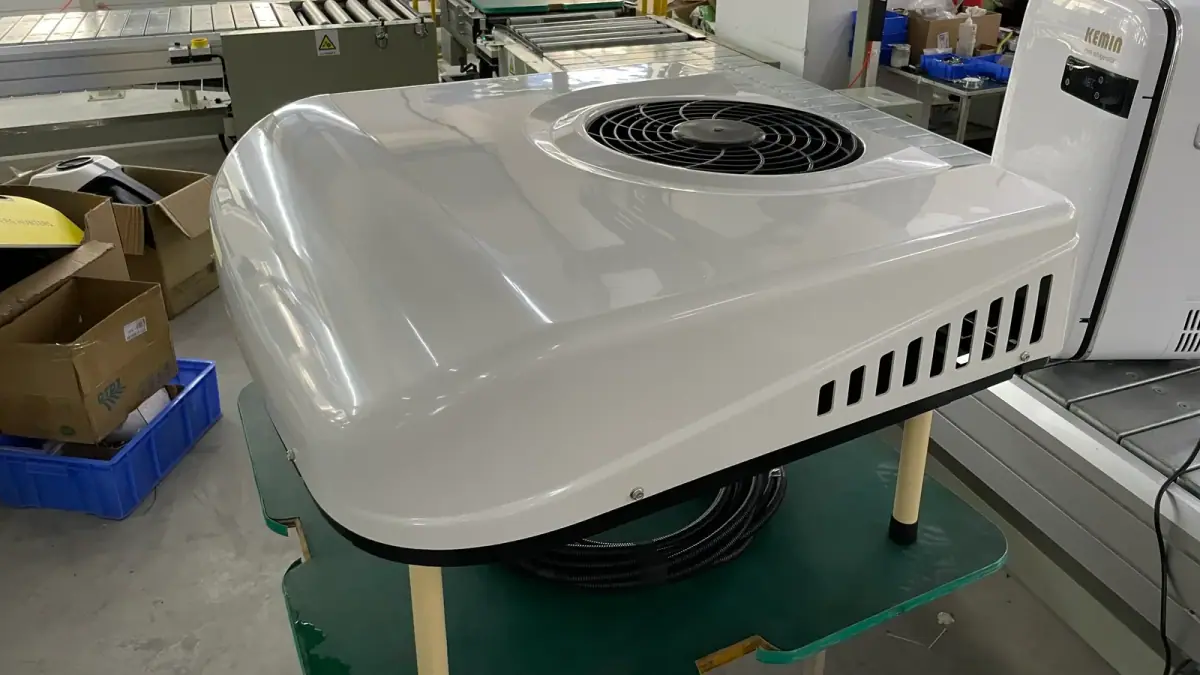
Nearly all of them sit on the roof over a square opening and blow cooled air down through a ceiling assembly. Models differ in where the air goes, how tall the shroud is, whether they can heat, and what power they need.
| Type | How it cools the RV | Typical BTU | What it needs |
|---|---|---|---|
| Rooftop, non-ducted | Blows straight down into the room from the ceiling unit | 13,500 or 15,000 BTU (Coleman-Mach Mach 3 NDQ, Mach 15 NDQ) | 115 V, 20 A circuit; roof opening about 14 in square |
| Rooftop, ducted | Feeds ceiling registers through ducts built into the RV | 13,500 or 15,000 BTU (Mach 3 DQ, Mach 15 DQ; Dometic FreshJet 5) | Same power and opening, plus factory ducting and a ceiling plenum |
| Rooftop, low profile | Same as above in a shorter shroud | 9,200 to 15,000 BTU (Mach 8 Cub Plus to Mach 8 Plus) | Shroud 8.25 in tall on ultra low profile, against 13.8 in on medium |
| Rooftop heat pump | Cools, then reverses the refrigerant flow to warm the air | 15,000 BTU cooling (Mach 15 HP2); 13,500 BTU ducted (Mach 10 DQ) | A matching heat pump thermostat; no heat pump heat below freezing |
| 12 V or 48 V DC rooftop | Runs off the battery bank with no generator or shore power | About 9,600 BTU at 12 V (Nomadic Cooling X2 Helix Gen II) | 64 A at 12 V; fits a 14 x 14 in opening |
| Portable | Stands on the floor and vents hot air outside through a duct | 6,100 BTU cooling (EcoFlow WAVE 3) | AC power or a power station, and a vent path out of the RV |
Figures from the Coleman-Mach 2025 catalog and Dometic's rooftop installation manual.
Nomadic Cooling sells the X2 Helix Gen II as a 12 V or 48 V DC rooftop unit for vans, RVs and truck campers. EcoFlow lists RV use for the WAVE 3, which has no built-in battery. Dometic's RTX runs on 12 V, but its own manual calls it a parking cooler for a truck cab, not an RV unit.
Ducted or non-ducted
This is set when the RV is built, so know which one you have before you buy a replacement. Non-ducted units drop the air straight into the room from the ceiling assembly. Ducted units push it through ducts in the ceiling to registers down the RV, by way of a plenum under the roof opening. The duct run is designed for each RV, as Furrion's Chill manual sets out.
How many BTU does your RV need?
No maker publishes a BTU chart by length, floor area or climate, so size from the heat your RV takes on. Dometic's manual lists what raises the load:
- the size of the RV
- the window area
- how much insulation is in the walls and roof
- where the RV will be used
- the comfort level you want to hold
Coleman-Mach adds sun exposure, the number of people inside and the outside temperature. Its 38200 Series manual sets a plain test: if the unit cannot hold about 80°F (27°C) inside, the heat gain has outrun its capacity. A unit sized right but losing ground is a different problem: see an air conditioner that stops cooling.
On length, Dometic says RVs over about 26 ft (8 m) may need more than one unit. Coleman-Mach also recommends two units for more cooling, because park hookups and generators limit how big one unit can be.
Tip: Placement matters as much as the rating. Dometic puts a single unit slightly forward of the midpoint, centered side to side, and two units at one third and two thirds of the length. Coleman-Mach wants the forward unit in a motorhome within 9 feet of the driver's compartment.
Heat pumps and heat strips
A heat pump gives you electric heat in mild weather; a heat strip only takes the chill off. The heat pump is the rooftop unit running in reverse, moving warmth inside. The heat strip is an electric element in the ceiling assembly, 5,600 BTU/h on medium and low profile Coleman-Mach units and 6,000 BTU/h on ultra low profile, which Coleman-Mach calls a chill chaser.
Neither one replaces the furnace. Below freezing, Coleman-Mach's heat pump compressor shuts down to keep the outdoor coil from icing. Dometic's thermostat locks out heat pump mode below 30°F (-1°C), and on the CCC 2 thermostat the furnace takes over until the outside sensor reads above 35°F.
Tip: Cold air from the registers on a chilly morning is usually not a fault. Between about 42°F and 30°F outside, a Dometic heat pump switches briefly to cooling every 25 minutes of compressor run time to melt ice off the outside coil.
What it draws while running
Running draw is modest; the start is what trips breakers. Furrion rates its 13,500 BTU Chill at 11.3 A and the 15,000 BTU version at 14.6 A on 115 V. Coleman-Mach lists 13.9 A cooling for the Mach 15.
For an instant at start, the compressor draws far more: Dometic prints 68 to 70 A locked rotor for the Brisk II. That surge trips small generators and crowded 30 amp hookups, and it is what a soft start module is built to flatten.
Can you replace a rooftop unit yourself?
The roof opening is close to standard across brands, but the controls must match. All three brands mount over an opening of roughly 14 in square, usually an old vent spot, with the shroud nose facing forward. Each maker sets its own tolerance, so an opening that suits one brand may need reframing for another:
- Dometic: 14.3 in square, reduced if over 14.4 in and enlarged if under 14.1 in
- Coleman-Mach: 14 to 15 in, enlarged below 14 in, reframed above 15 in
- Furrion: 14-1/4 in square, plus 1/2 in
Coleman-Mach tells installers to match the rooftop unit to the ceiling assembly, every unit needs a thermostat, and its 9 Series control parts do not work with the older 8 Series. A cross-brand swap therefore usually means buying the matching ceiling assembly as well.
Tip: Coleman-Mach sells one Dometic to Coleman-Mach ducted ceiling assembly conversion kit (9330A5521). It keeps the existing Dometic CT wall thermostat, control box and ducted plenum, and does not suit non-CT thermostat systems or 3-speed blowers.
Lifting takes two people, and Dometic wants a roof that supports at least 130 lb while in motion. Cutting or reframing the roof, sealing it and making the 115 V connection are not owner jobs: Dometic requires a qualified person for the mechanical work and a qualified electrician for the power, and Airxcel bars anyone not trained in flammable refrigerants from the sealed system. Book an RV technician for that part.
Common questions
How long does an RV air conditioner last?
No maker states a service life; the published figure is the warranty. Coleman-Mach covers its units for two years, with an optional contract adding three years on parts only. Filter and coil care is what you control, at the intervals in the maintenance instructions.
Is a mini split better than a rooftop AC for an RV?
None of the makers in our sources covers a mini split installed in an RV, so there are no ratings to compare. Where the roof has no room or the wrong shape, Dometic suggests an under-bench unit fitted inside instead.
Can you use a portable air conditioner in an RV?
Yes, as cooling for one area. EcoFlow vents the WAVE 3 outside through an insulated exhaust duct, and it needs AC power or a power station to run. At 6,100 BTU it is well under half of a 13,500 BTU roof unit.
Can I replace a rooftop RV air conditioner myself?
You can choose the matching unit and ceiling assembly and help lift it. Dometic, Airxcel and Furrion all specify a qualified installer for the roof, sealing and wiring, and Airxcel adds that improper installation voids the warranty.