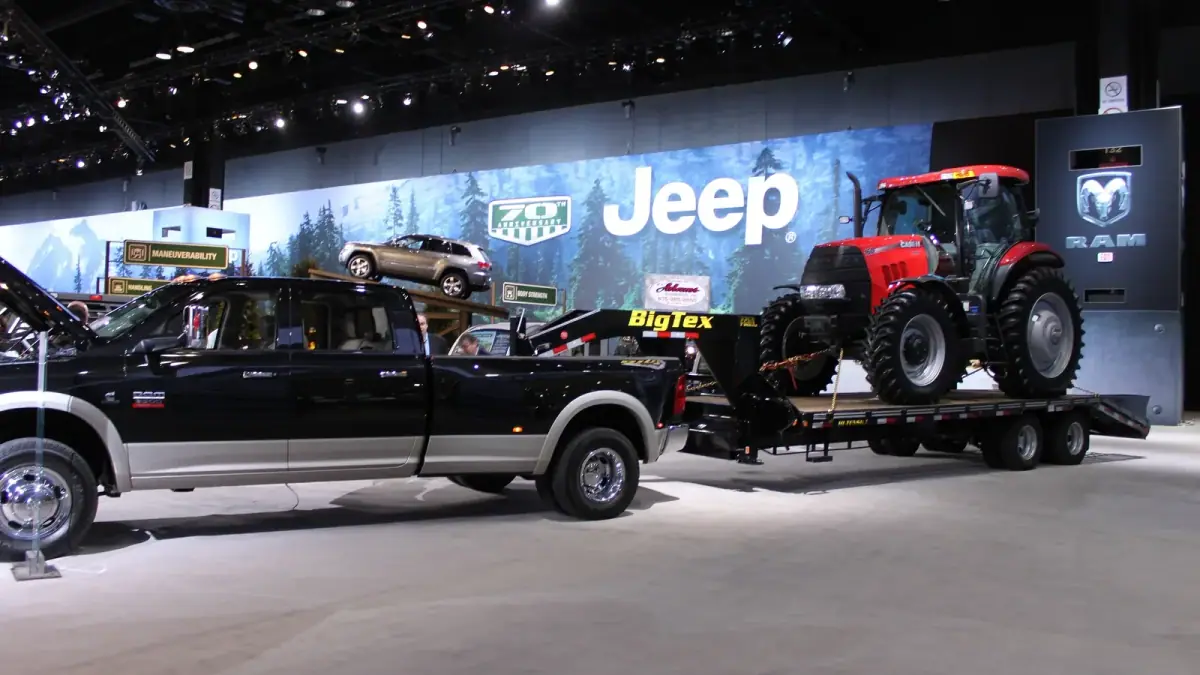
A gooseneck hitch is a ball mounted in the pickup bed, over or just ahead of the rear axle. The trailer's coupling arm drops onto the ball, so its weight presses down on the frame above the axle. Truck makers rate this setup for much heavier trailers than a bumper hitch.
Gooseneck Hitches Explained: Ball-in-Bed vs Rail Systems and Ratings
At a glance
- Three ways to fit one: drop a ball into factory bed pucks, bolt an under-bed hitch to the frame, or pin a gooseneck plate into existing fifth wheel rails.
- Factory prep is heavy-duty only: the factory gooseneck prep package from Ford, Chevrolet or Ram comes on Super Duty, Silverado and Sierra HD, and Ram 2500/3500.
- The lowest-rated part sets the limit: a 30,000 lb ball caps a truck rated 38,000 lb at 30,000 lb.
On this page (9)
What a gooseneck hitch is
In Ford's 2026 towing guide, a gooseneck hitch attaches in the truck bed using custom or universal rails, and the tongue weight rests directly on the bed over the rear axles, which Ford says gives great stability and suits heavier loads. GM and Ram describe the same thing: a ball mounted over the rear axle, with the trailer's pivoted coupling arm dropping onto it.
Makers differ slightly on exactly where the ball sits. GM wants the hitch centerline over or near the rear axle. CURT's own over-bed instructions call for 2 to 6 inches ahead of the axle, and B&W's Ram 1500 Turnoverball sheet says that ball installs over the axle. Follow the instructions for the hitch you buy.
Because the load sits over the axle, a gooseneck carries far more vertical weight than a bumper hitch. GM puts kingpin weight at 15 to 25 percent of trailer weight, Ford uses 15 percent for fifth wheel and gooseneck towing, and Reese prints 15 to 25 percent. All of that lands on the truck's payload, and GM warns it must not push the truck past its axle or gross vehicle ratings. Your own truck's maximum tongue weight for a gooseneck hitch is printed on its trailering information label.
Under-bed, above-bed, or your existing rails
CURT's catalog names three basic ways to install a gooseneck hitch, and the choice usually comes down to what the truck already has:
- Factory puck system. On trucks with a towing prep package, a puck-system gooseneck kit is the easiest route: the ball and two safety chain anchors drop into the pucks and lock with a quarter-turn latch.
- Under-bed brackets. The traditional method for trucks without pucks. B&W's Turnoverball bolts to existing holes in the frame and needs only a 4-inch hole in the bed, no welding and no bed removal. CURT's Double Lock hitches flip the ball over and store it in its own hole so the bed stays clear.
- Existing fifth wheel rails. A gooseneck plate or ball pins into industry-standard base rails in place of the fifth wheel head. PullRite's #2111 gooseneck plate is rated 25,000 lb trailer weight and 6,250 lb pin weight; CURT's rail goosenecks run 25,000 lb, or 30,000 lb for the Spyder #16090 with its base rail.
Above-bed plates are the fourth option and the least simple. CURT's over-bed folding ball and flat plates are rated 30,000 lb trailer weight and 7,500 lb vertical load, but the fixed plates need reinforcement to reach that rating, and the #61052 instructions have the installer fabricate a steel support that ties the ball to the frame and drill through the frame rails.
Factory prep packages
Heavy-duty trucks can be ordered with the mounting hardware already built in. Ford's 5th Wheel/Gooseneck Hitch Prep Package is option 53W, optional on F-250 and F-350 and standard on F-450, and it cannot be combined with a drop-in bedliner or bed mat. Chevrolet's Z6A package adds a hitch platform ready to accept a gooseneck ball or fifth wheel hitch, a box-mounted trailer harness, a spray-on bedliner, and the box holes drilled and capped. Ram's prep group is a factory-installed rear-axle structural crossmember with integrated mounting hardware, plus a 7-pin harness in the bed.
One wrinkle on Ford: the order guide says 53W is compatible only with Ford's own Gooseneck Hitch Kit (15J), the F-450 dual hitch kit (15E) or the dealer-installed Ford accessory gooseneck hitch made by Reese. CURT, B&W and PullRite all list their own puck-system balls for Ford trucks. Both statements are on the record, so check with your dealer before ordering a non-Ford ball for a 53W truck.
Tip: On a truck with factory pucks, fitting the hitch is not a shop job at all. CURT's word for its puck kits is "drop-in": lift and twist the latch, set the ball in the hole, return the latch, and the two chain anchors go in the same way, with no tools.
What the hitch is rated for
Gooseneck hardware is rated by trailer weight and vertical load, and the figures are published per product. These are the makers' own numbers.
| Hitch | Maker's rating | Condition |
|---|---|---|
| CURT puck kit, 30K | 30,000 lb, 7,500 lb vertical | 2-5/16 in ball, factory pucks |
| CURT puck kit, 38K | 38,000 lb, 9,500 lb vertical | 2-5/16 in ball, factory pucks |
| CURT PowerHaul Double Lock | 38,000 lb, 9,500 lb vertical | 40,000 lb only with CURT's 3-inch ball |
| CURT PowerHaul OEM-style, Ram | 35,000 lb, 8,750 lb vertical | Ram 2500/3500, 2019 to 2025 |
| B&W Turnoverball | What the truck is rated to tow | Under-bed, 4-inch hole in the bed |
| B&W OEM ball and chain kit | 30,000 lb, 7,500 lb vertical | Factory pucks, GM/Ford/Nissan or Ram |
| PullRite #4436 puck ball | 30,000 lb | Factory pucks or an under-bed system |
| Reese Elite and Signature | 25,000 lb, 6,250 lb pin | Elite needs the Ford Super Duty rail kit |
| Ford accessory gooseneck ball | 27,500 lb, or 40,000 lb | 2-5/16 in ball, or 3-inch ball; requires 53W |
Figures from the CURT aftermarket catalog, the B&W Turnoverball owner's manual, PullRite product pages, Reese assembly instructions and Ford's 2026 towing guide. CURT's #60703 install sheet prints 40,000 lb without the 3-inch-ball condition its catalog attaches, so treat 38,000 lb as the figure for the included 2-5/16 inch ball.
Every maker says the same thing about mixing parts. PullRite puts it plainly: the lowest rating of any one component becomes the rating of the entire system. CURT adds that its ratings are limited to the vehicle maker's stated capacities, and B&W rates the Turnoverball to tow what the truck is rated to tow rather than printing a higher number. Accessories count too: B&W's 4-inch extender is rated 20,000 lb and its Extend-A-Goose coupler 24,000 lb, and fitting either one caps the whole setup there.
What your truck is rated for
The truck's gooseneck rating is usually the number that decides the job, and on 2026 heavy-duty pickups it spans a wide range.
| 2026 truck | Highest gooseneck rating | Configuration |
|---|---|---|
| Ram 2500 | 20,000 lb | Gooseneck hitch-type limit |
| Ram 3500 | 37,100 lb | Gooseneck hitch-type limit |
| Ford F-250 | 23,000 lb | H.O. diesel, Regular Cab 4x2, axle upgrade package |
| Ford F-350 single rear wheel | 27,600 lb | H.O. diesel, Regular Cab 4x4 |
| Ford F-350 dually | 38,000 lb | H.O. diesel, Regular Cab 4x2, 4.10 axle |
| Ford F-450 | 40,000 lb | H.O. diesel, 4x2 Regular Cab, 40K Gooseneck Tow Package |
| Chevrolet Silverado 2500 HD | 22,050 lb | Duramax, Regular Cab long bed 4x4, Max Trailering |
| Chevrolet Silverado 3500 HD | 36,000 lb | Duramax, Regular Cab 2WD dually, Max Trailering |
Ford figures from its 2026 towing guide, Chevrolet figures from the 2026 Chevrolet trailering guide, Ram figures from the 2026 Ram 2500/3500 owner's manual. Ram's two numbers are hitch-type limits, so the drivetrain's own maximum also applies. Every other row is one specific cab, bed, engine and axle combination; the F-350 ratings by year and configuration show how much the figure moves with the build.
Note the Ram 2500: its gooseneck limit of 20,000 lb sits below its fifth wheel limit of 25,000 lb. On the Silverado 3500 HD dually it runs the other way, 36,000 lb on a gooseneck against 32,000 lb with a fifth wheel hitch.
Tip: On the biggest trucks the ball becomes the weak link. A common 30,000 lb puck ball sits below the F-350 dually's 38,000 lb, the Ram 3500's 37,100 lb and the Silverado 3500 HD's 36,000 lb, so towing to the truck's limit means buying the 38K hardware, or Ford's 3-inch ball on an F-450.
Can you tow a fifth-wheel RV with a gooseneck
Yes, with an adapter or a replacement pin box, and that is a decision with its own warranty and rating questions. The fifth wheel hitch page compares the two systems and covers pin box adapters, including what Lippert approves on its frames.
Which trucks can take one
Factory prep packages are a heavy-duty feature only. Every other truck needs an aftermarket kit, and the kits reach further down the range than many owners expect: B&W says the Turnoverball can be installed on every full-size truck on the market, including short beds, and CURT lists Double Lock kits for the 2007 to 2018 Silverado 1500 and Sierra 1500 along with F-150, Ram 1500 and Tundra applications. Hitch fitment is not a rating, though. The truck maker's own gooseneck figure still governs.
Two fitment limits are worth knowing before you order. Reese says not to install its Elite Series gooseneck on, or tow with, a pickup whose bed is shorter than 6 feet, and recommends 8-foot beds for the best turning clearance. On short beds generally, Ford, GM, CURT and B&W all warn that the trailer can reach the cab in tight turns, and GM asks for at least 6 inches of clearance between the top of the box and the trailer shelf above it.
Installation is where this stops being a driveway job. Ram's 2026 owner's manual says all trailer hitches should be professionally installed, under-bed kits mean cutting a hole through the bed with brake, fuel and electrical lines running along the frame rails where the hardware goes, and over-bed plates need a support fabricated and drilled into the frame. Have a hitch installer do the structural work, and use a licensed technician for anything that disturbs fuel or brake lines. B&W's own FAQ says most owners have a dealer fit theirs.
Safety chains
Chains are not optional on a gooseneck. Ram says safety chains must always be used between vehicle and trailer, connected to the hitch's hook retainers. GM is the most specific for this hitch type: install the anchor rings that come with the gooseneck prep package, or use the aftermarket hitch's own attachment point.
Hitch makers agree on the details. CURT says to attach the trailer to both safety chain loops every time, and to put both anchors in the rear-most under-bed mounts on a puck system. B&W, CURT, Ford and Reese all say to leave only enough slack for full turning: too much slack may stop the chains from holding the trailer if the coupling lets go, and chains must never drag on the road.
Common questions
Can you put a gooseneck hitch on any truck?
Not any truck, but more than you would guess. B&W states that its Turnoverball installs on every full-size truck on the market, and CURT publishes under-bed kits for half-tons such as the 2007 to 2018 Silverado 1500 and Sierra 1500. Each hitch is built for one year and make and cannot be moved to another, and the truck's published gooseneck rating always governs what you can actually pull.
What are the downsides of a gooseneck hitch?
You cut a hole in the bed: 4 inches for a B&W Turnoverball or a CURT under-bed hitch, 3-1/2 inches for a Reese Elite. Ford's factory gooseneck options cannot be combined with a drop-in bedliner or bed mat. On two-wheel-drive trucks CURT also warns against inverting the stored ball under heavy loads, where it can contact the differential, brake lines or sensors, and not to invert it at all on a Tundra.
How much weight can a gooseneck hitch hold?
Published aftermarket ratings run from 25,000 lb for rail-mounted plates up to 38,000 lb for CURT's 38K hardware and 40,000 lb with its 3-inch ball, with vertical loads of 6,250 to 10,000 lb. B&W instead rates the Turnoverball to tow what the truck is rated to tow. Whichever you buy, the lowest-rated item in the chain, truck, hitch, ball, coupler or trailer, is the real limit.
Do I need safety chains with a gooseneck hitch?
Yes. Ford, Ram, GM, CURT, B&W and Reese all instruct owners to connect safety chains on every tow, because the chains are what keeps the trailer attached if the coupling or ball separates. Use the anchor points supplied with the prep package or the hitch, never the bed sheet metal.